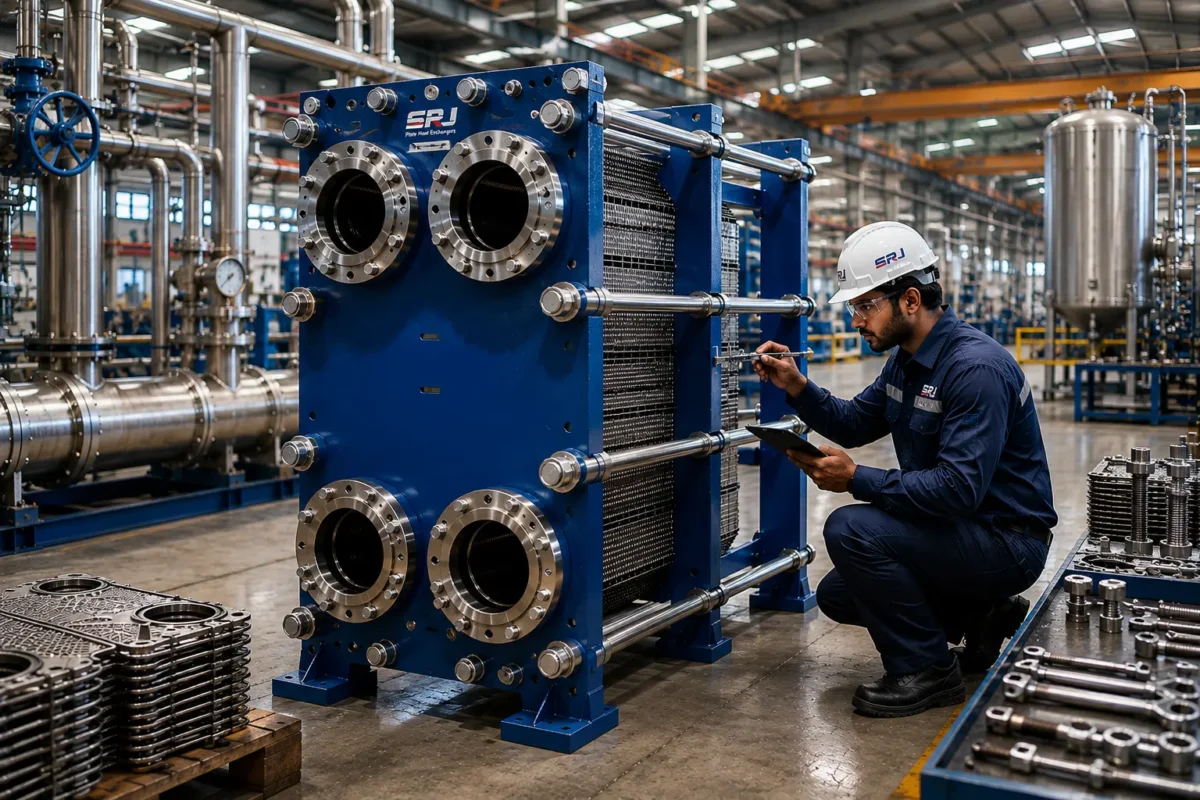
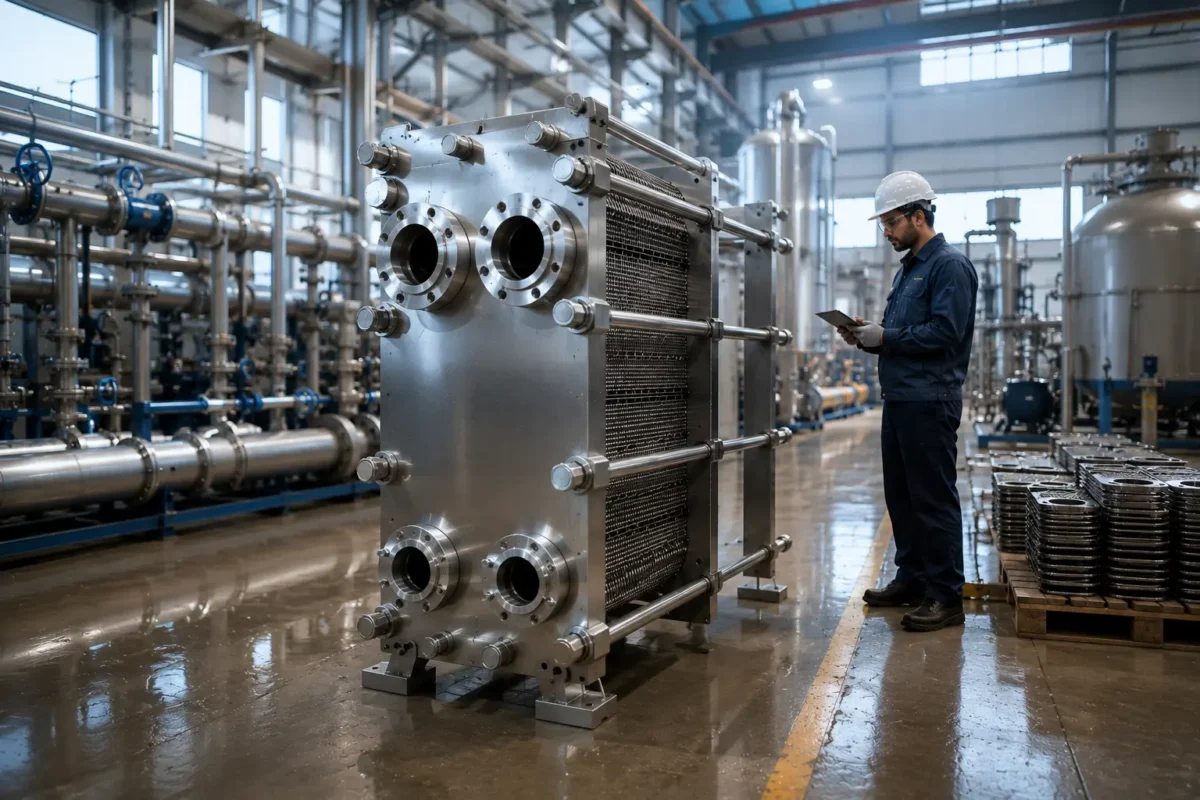
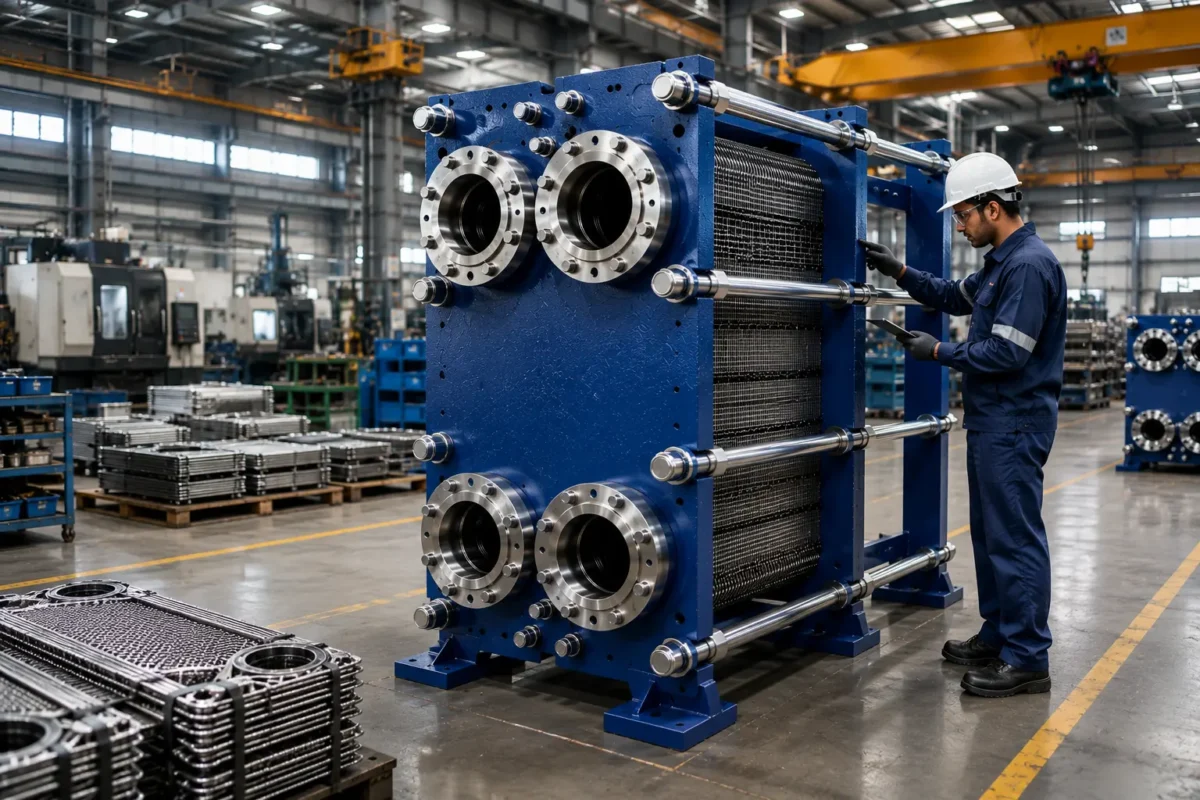
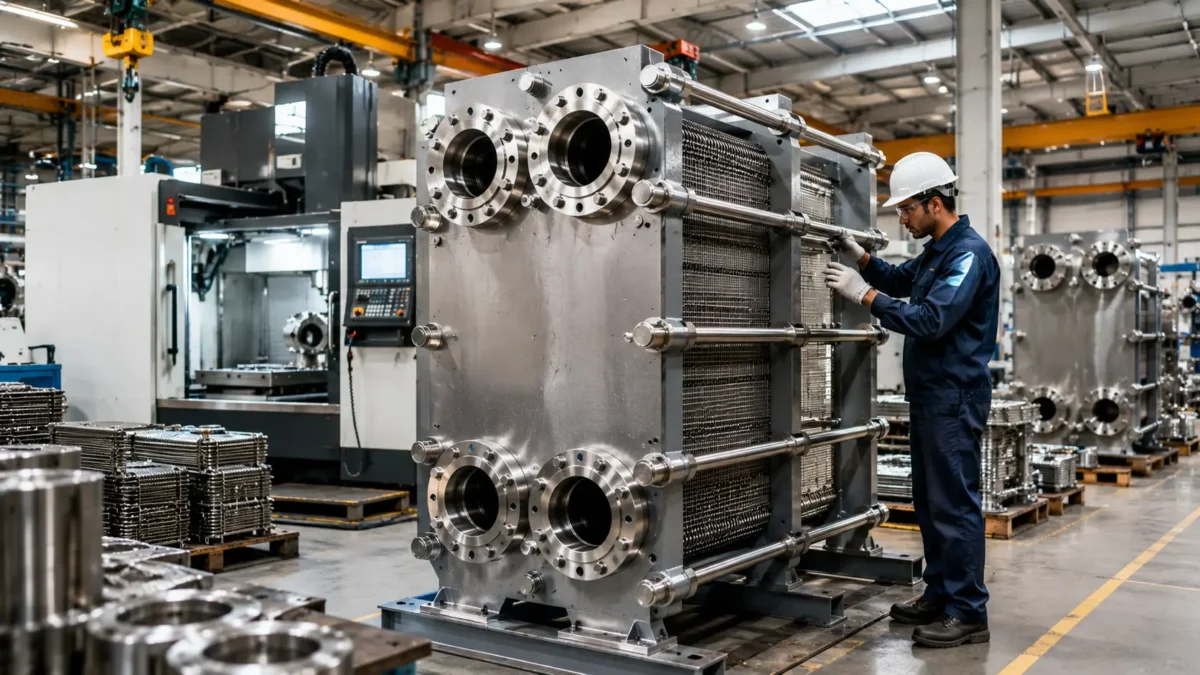
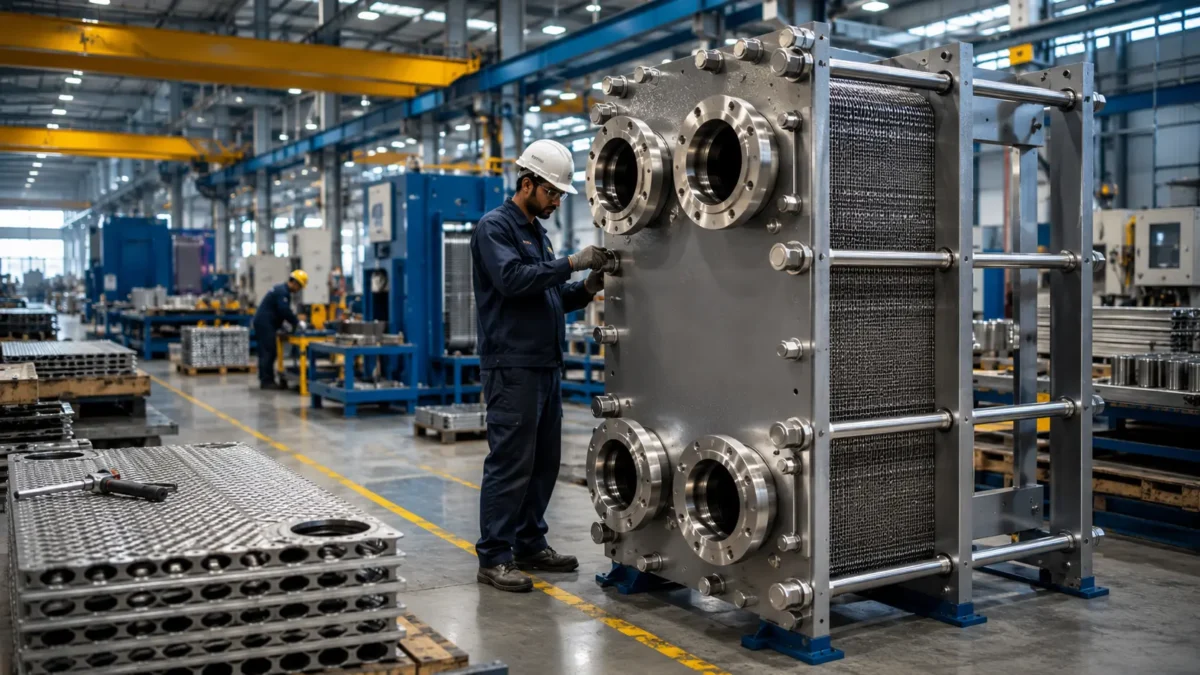
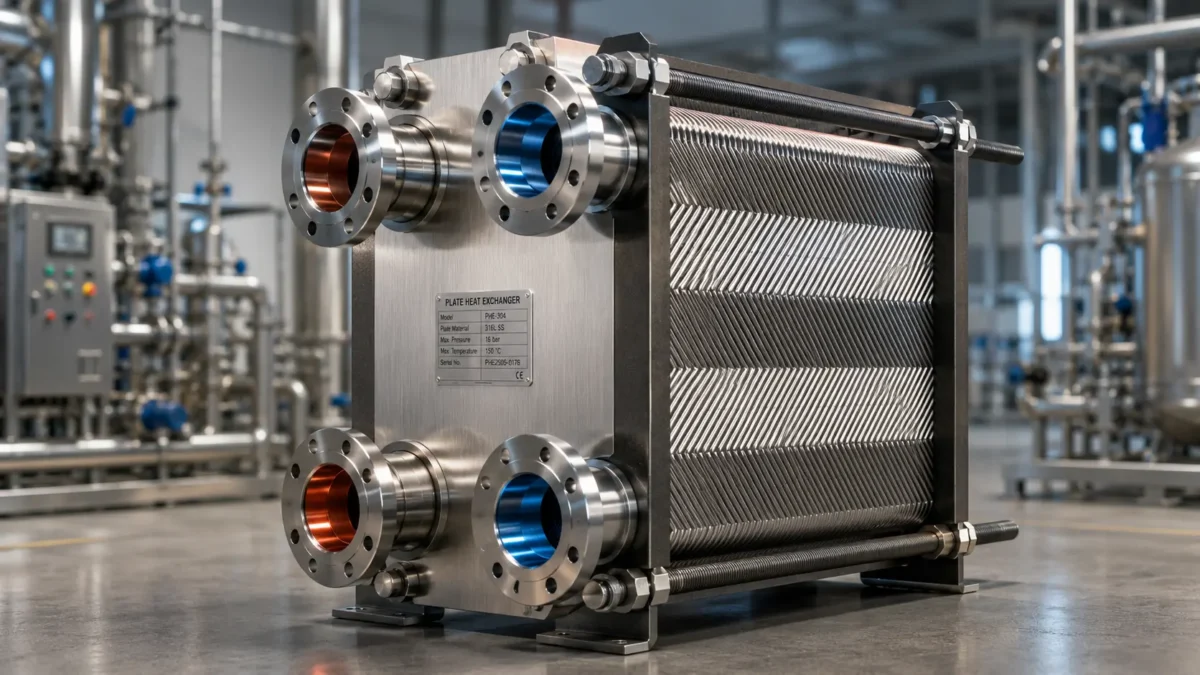
Plate Heat Exchanger Manufacturers in Bhosari MIDC for Industrial Cooling and Process Industries

Plate heat exchanger manufacturers in Bhosari MIDC support industrial cooling, process heating, utility operations and manufacturing industries across Pune MIDC regions. Pune’s industrial belt including Bhosari MIDC, Chinchwad MIDC, Pimpri MIDC, Chakan MIDC, and Talegaon MIDC has become one of India’s strongest manufacturing and engineering corridors. These industrial regions support large-scale operations across automotive manufacturing, engineering industries, pharmaceutical production, food processing, fabrication sectors, chemical processing, and industrial utility infrastructure.

Industries operating across these MIDC regions require reliable thermal systems capable of maintaining continuous production operations, process temperature control, industrial cooling efficiency, and stable manufacturing performance. SRJ Heatt Exchangers India Pvt Ltd supports industries across Pune industrial regions with dependable thermal solutions designed for demanding industrial applications and long-term operational reliability.

Plate Heat Exchanger Manufacturers in Bhosari MIDC for Manufacturing Industries

Bhosari MIDC is one of Pune’s most established industrial regions with strong presence across:

  • engineering industries
  • automotive component manufacturing
  • industrial fabrication
  • machinery production
  • process industries
  • utility operations

Manufacturing facilities operating in Bhosari require thermal systems for:

  • industrial cooling
  • process temperature management
  • hydraulic oil cooling
  • utility water circulation
  • compressor cooling systems

Industries searching for plate heat exchanger manufacturers in Bhosari MIDC commonly focus on thermal efficiency, operational durability, process stability, and long-term industrial performance.

Industrial Cooling Systems for Bhosari Manufacturing Operations

Continuous manufacturing operations in Bhosari MIDC require thermal systems capable of handling:

  • heavy operational loads
  • continuous production cycles
  • fluctuating thermal conditions
  • industrial utility applications

Reliable thermal systems help industries improve:

  • production stability
  • operational efficiency
  • cooling consistency
  • energy optimization
  • maintenance intervals

Industrial process efficiency directly depends on stable temperature management and dependable thermal performance.

Plate Heat Exchanger Suppliers in Chinchwad MIDC for Process Applications

Chinchwad MIDC continues to grow across automotive manufacturing, engineering industries, processing operations, and industrial utility sectors. Industries in this region require efficient thermal systems for:

  • process cooling applications
  • utility heat transfer systems
  • industrial water cooling
  • machinery temperature control
  • manufacturing operations

Industrial facilities operating across Chinchwad require reliable heat transfer systems capable of supporting uninterrupted manufacturing activities and process stability.

Industrial Applications Across Chinchwad MIDC

Thermal systems are widely used in:

Industry TypeCommon Application
Automotive IndustriesOil cooling systems
Engineering PlantsProcess cooling
Pharmaceutical UnitsTemperature control
Food ProcessingHeating and cooling
Utility InfrastructureHeat recovery systems

Stable thermal performance helps industries maintain manufacturing consistency and improve operational productivity.

PHE Gasket Manufacturers in Pimpri MIDC for Industrial Maintenance Support

Pimpri MIDC supports a wide range of industrial operations including engineering manufacturing, automotive industries, utility infrastructure, and heavy industrial processing.

Industries operating in Pimpri require reliable replacement support and maintenance solutions for:

  • industrial cooling systems
  • process thermal systems
  • utility operations
  • continuous production environments

Efficient replacement support helps industries reduce:

  • leakage issues
  • operational downtime
  • thermal instability
  • maintenance frequency

Industrial operations depending on continuous manufacturing require stable thermal performance and dependable maintenance support.

PHE Gasket Suppliers in Chakan MIDC for Automotive and Manufacturing Industries

Chakan MIDC has emerged as a major automotive and industrial manufacturing hub with large-scale production facilities operating across the region.

Industrial applications in Chakan commonly require:

  • utility cooling systems
  • hydraulic cooling
  • industrial process temperature management
  • manufacturing thermal systems
  • operational heat transfer solutions

Industries searching for phe gasket suppliers in Chakan MIDC typically prioritize:

  • operational durability
  • reliable performance
  • maintenance efficiency
  • process stability

Continuous production facilities require dependable thermal systems capable of supporting uninterrupted manufacturing operations.

PHE Plate Manufacturers in Talegaon MIDC for Industrial Operations

Talegaon MIDC continues to witness strong industrial expansion across engineering, automotive, food processing, packaging, and utility sectors.

Industrial facilities operating in Talegaon require thermal systems for:

  • industrial cooling applications
  • utility heat transfer operations
  • process temperature control
  • manufacturing support systems

Efficient thermal systems help industries improve:

  • production continuity
  • process efficiency
  • operational reliability
  • long-term industrial performance

Industrial manufacturing environments require dependable heat transfer performance for stable operational conditions.

Common Industrial Cooling Challenges Across Pune MIDC Regions

Industries across Bhosari, Chinchwad, Pimpri, Chakan, and Talegaon MIDC commonly face:

  • inconsistent cooling efficiency
  • increasing energy consumption
  • process temperature instability
  • pressure drop problems
  • maintenance-related shutdowns
  • reduced thermal performance

These issues directly impact industrial productivity, manufacturing stability, and operational costs.

Reliable thermal systems help industries maintain stable production operations while improving long-term process efficiency.

Importance of Efficient Heat Transfer Systems

Industrial thermal systems play a critical role in:

  • process temperature stability
  • energy optimization
  • operational continuity
  • industrial productivity
  • manufacturing consistency
  • reduced maintenance downtime

Industries operating under continuous production cycles require reliable thermal systems capable of maintaining efficient performance under demanding industrial conditions.

Industrial Thermal Solutions for Pune Manufacturing Sectors

SRJ supports industries across Pune industrial regions with:

  • industrial cooling systems
  • process-oriented thermal solutions
  • utility heat transfer applications
  • industrial maintenance support
  • replacement support solutions
  • energy-efficient thermal systems

Solutions are selected according to industrial process conditions, manufacturing requirements, and operational applications.

Industrial Growth Across Pune MIDC Regions

Bhosari MIDC, Chinchwad MIDC, Pimpri MIDC, Chakan MIDC, and Talegaon MIDC continue to expand as major industrial manufacturing regions in Maharashtra.

As industrial infrastructure and production capacities increase, industries require reliable thermal systems capable of supporting:

  • continuous manufacturing operations
  • industrial process expansion
  • utility infrastructure modernization
  • energy-efficient industrial operations

Modern manufacturing facilities require dependable thermal performance to maintain productivity, operational reliability, and process efficiency.

Conclusion

Industrial operations across Bhosari MIDC, Chinchwad MIDC, Pimpri MIDC, Chakan MIDC, and Talegaon MIDC require reliable thermal systems for industrial cooling, process temperature management, utility operations, and manufacturing efficiency.

SRJ Heatt Exchangers India Pvt Ltd supports industries across Pune manufacturing regions with dependable thermal solutions designed for process stability, energy efficiency, operational reliability, and long-term industrial performance.

Plate Heat Exchanger Distributor in Gandhinagar for Industrial Cooling and Process Applications

Plate heat exchanger manufacturer in Gandhinagar solutions are widely used across pharmaceutical, chemical, engineering and industrial manufacturing sectors for process cooling, utility operations and thermal performance applications.

Gandhinagar has become one of Gujarat’s rapidly growing industrial regions with strong expansion across engineering, pharmaceuticals, chemical processing, food manufacturing, packaging industries, utility infrastructure, and industrial fabrication sectors. Industrial areas including Chhatral GIDC, Kalol GIDC, Randheja GIDC, and surrounding manufacturing zones continue to increase demand for efficient thermal systems capable of supporting continuous industrial operations.

Industries operating across Gandhinagar require reliable heat transfer systems for stable production performance, process temperature control, industrial cooling, and energy-efficient operations. SRJ Heatt Exchangers India Pvt Ltd supports industries across Gandhinagar with industrial thermal solutions designed for demanding manufacturing environments and long-term operational reliability.

Industrial Growth and Manufacturing Demand in Gandhinagar

The industrial ecosystem in Gandhinagar continues to expand due to:

  • engineering and fabrication industries
  • pharmaceutical manufacturing
  • chemical processing units
  • food and beverage industries
  • utility infrastructure projects
  • industrial machinery manufacturing

As industrial operations expand, the requirement for efficient cooling and heating systems has increased significantly across manufacturing facilities and process industries.

Plate Heat Exchanger Suppliers in Gandhinagar for Industrial Applications

Industries across Gandhinagar require thermal systems for:

  • process cooling
  • industrial water circulation
  • hydraulic oil cooling
  • utility operations
  • compressor cooling
  • process temperature control

Efficient thermal systems help industries maintain stable operating conditions while improving process reliability and reducing operational losses.

Industrial facilities operating under continuous production cycles require dependable heat transfer systems capable of maintaining consistent thermal performance under varying industrial loads.

Best Plate Heat Exchanger Suppliers in Gandhinagar for Process Reliability

Industrial buyers searching for reliable thermal systems focus on operational performance, process stability, and long-term efficiency. Manufacturing industries require systems capable of supporting continuous production environments without frequent interruptions or thermal instability.

Reliable thermal systems help industries:

  • improve process efficiency
  • maintain stable operating temperatures
  • reduce energy consumption
  • lower maintenance frequency
  • improve production continuity

Industries across Gandhinagar increasingly prioritize thermal solutions designed for operational durability and long-term industrial use.

Plate Heat Exchanger Manufacturer in Gandhinagar for Manufacturing Industries

Manufacturing industries in Gandhinagar operate under demanding industrial conditions where thermal performance directly affects production efficiency and operational stability.

Common industrial applications include:

IndustryApplication
Pharmaceutical PlantsProcess temperature control
Chemical IndustriesIndustrial cooling
Engineering UnitsOil cooling systems
Food ProcessingHeating and cooling operations
Utility OperationsHeat recovery systems

Proper thermal management helps industries improve production quality, operational consistency, and utility efficiency.

Thermal Requirements Across Gandhinagar Industrial Areas

Industrial zones including Chhatral GIDC, Kalol GIDC, Randheja GIDC, and surrounding manufacturing regions require thermal systems capable of handling:

  • continuous operational loads
  • varying process temperatures
  • industrial cooling requirements
  • utility heat transfer operations
  • high-production manufacturing environments

Reliable heat transfer systems are essential for maintaining industrial productivity and reducing operational downtime.

Common Industrial Challenges Faced by Manufacturing Facilities

Industries commonly face operational issues such as:

  • inconsistent cooling performance
  • increasing energy consumption
  • pressure drop problems
  • unstable process temperatures
  • reduced thermal efficiency
  • repeated maintenance shutdowns

These issues directly affect industrial productivity, manufacturing stability, and long-term operational efficiency.

Importance of Efficient Heat Transfer Systems

Industrial cooling and heating systems play a critical role in maintaining:

  • stable process conditions
  • operational reliability
  • efficient production cycles
  • lower utility consumption
  • reduced maintenance requirements
  • long-term industrial performance

Efficient thermal systems help industries maintain production consistency while improving operational efficiency across manufacturing operations.

Industrial Cooling Solutions for Gandhinagar Industries

SRJ supports industrial operations across Gandhinagar with:

  • industrial cooling systems
  • process-oriented thermal solutions
  • utility heat transfer applications
  • industrial maintenance support
  • replacement support solutions
  • energy-efficient thermal systems

Solutions are selected according to actual operating conditions, industrial process requirements, and manufacturing applications.

Manufacturing Expansion and Industrial Infrastructure Development

Gandhinagar continues to witness rapid industrial growth across manufacturing and utility sectors. As production capacities expand, industries increasingly require reliable thermal systems capable of supporting:

  • industrial process expansion
  • continuous manufacturing operations
  • utility infrastructure upgrades
  • energy optimization initiatives
  • industrial cooling modernization

Modern industrial facilities require dependable thermal performance to maintain operational stability and process efficiency.

Process Efficiency and Operational Stability

Properly designed thermal systems help industries improve:

  • process temperature management
  • industrial productivity
  • cooling consistency
  • energy optimization
  • operational continuity
  • system reliability

Stable thermal performance is critical for industries operating under continuous manufacturing conditions and high production demand.

Conclusion

Industrial operations across Gandhinagar including Chhatral GIDC, Kalol GIDC, Randheja GIDC, and surrounding manufacturing regions continue to increase demand for reliable thermal systems and efficient industrial cooling solutions.

SRJ Heatt Exchangers India Pvt Ltd supports manufacturing and process industries with dependable heat transfer solutions designed for operational stability, process cooling, energy efficiency, and long-term industrial reliability.

Plate Heat Exchanger Manufacturers in Chhatral GIDC for Gandhinagar Industrial Applications

Gandhinagar district has emerged as one of Gujarat’s important industrial regions with rapidly growing manufacturing, engineering, pharmaceutical, chemical, food processing, and utility sectors. Industrial areas including Chhatral GIDC, Kalol GIDC, and Randheja GIDC continue to witness increasing demand for efficient thermal systems used in industrial cooling, process heating, and energy-efficient operations.

Industries operating across these industrial zones require reliable heat transfer systems capable of handling continuous operational loads, fluctuating process temperatures, and demanding manufacturing conditions. SRJ Heatt Exchangers India Pvt Ltd supports industries across Gandhinagar with industrial thermal solutions designed for long-term process reliability and efficient heat transfer performance.

Plate Heat Exchanger Manufacturers in Chhatral GIDC for Industrial Cooling Systems

Chhatral GIDC is one of Gandhinagar’s major industrial zones with strong presence across:

  • pharmaceutical manufacturing
  • engineering industries
  • chemical processing
  • packaging industries
  • plastic and polymer manufacturing
  • industrial utility operations

Manufacturing plants in Chhatral require efficient thermal systems for:

  • process cooling
  • hydraulic oil cooling
  • industrial water circulation
  • utility temperature control
  • compressor cooling applications

Reliable heat transfer systems help industries maintain stable process temperatures and improve operational efficiency during continuous production cycles.

Industrial Growth in Chhatral GIDC and Thermal System Demand

As industrial production expands in Chhatral GIDC, industries increasingly require thermal systems capable of:

  • reducing energy consumption
  • improving process efficiency
  • maintaining stable production conditions
  • lowering operational downtime
  • supporting continuous industrial operations

Industrial facilities operating under heavy production loads require dependable thermal performance to maintain manufacturing consistency and reduce utility losses.

Plate Heat Exchanger Suppliers in Kalol GIDC for Manufacturing Industries

Kalol GIDC has become an important industrial area for manufacturing and process industries in Gandhinagar district. Industries operating in Kalol commonly require efficient heat transfer systems for:

  • industrial cooling operations
  • utility systems
  • process temperature management
  • HVAC-related industrial applications
  • heat recovery operations

Thermal systems play a critical role in maintaining operational reliability and production stability across manufacturing facilities.

Industrial Applications Across Kalol GIDC

Industries in Kalol GIDC commonly use thermal systems in:

Industry TypeCommon Application
Chemical IndustriesProcess cooling
Engineering UnitsOil cooling
Pharmaceutical PlantsTemperature control
Food ProcessingHeating and cooling
Utility OperationsHeat recovery systems

Reliable thermal management improves operational performance while helping industries reduce long-term maintenance requirements.

PHE Gasket Manufacturers in Randheja GIDC for Industrial Maintenance Support

Randheja GIDC continues to develop as an industrial support region for manufacturing and utility operations across Gandhinagar. Industries operating in this region require dependable maintenance support and compatible replacement components for uninterrupted industrial performance.

Efficient replacement support helps industries maintain:

  • leak-free operation
  • stable thermal performance
  • reduced pressure loss
  • lower maintenance downtime
  • consistent process efficiency

Industrial operations depending on continuous production require reliable replacement solutions to maintain long-term operational stability.

Industrial Cooling Challenges Across Gandhinagar GIDC Regions

Industries across Chhatral, Kalol, and Randheja GIDC often face operational challenges such as:

  • inconsistent cooling efficiency
  • rising energy costs
  • pressure drop issues
  • thermal performance reduction
  • frequent maintenance shutdowns
  • unstable process temperatures

These problems directly affect production efficiency and increase operational expenses across manufacturing facilities.

Importance of Efficient Heat Transfer Systems

Properly designed industrial thermal systems help industries improve:

  • process temperature stability
  • operational reliability
  • energy efficiency
  • cooling consistency
  • maintenance intervals
  • production continuity

Industrial facilities operating in continuous manufacturing environments require stable thermal performance for reliable daily operations.

Industrial Solutions for Gandhinagar Manufacturing Facilities

SRJ supports industries across Chhatral GIDC, Kalol GIDC, and Randheja GIDC with:

  • industrial cooling solutions
  • process-oriented thermal systems
  • replacement support
  • utility heat transfer systems
  • industrial maintenance support
  • energy-efficient thermal applications

Solutions are selected according to actual operating conditions, production requirements, and industrial application demands.

Manufacturing and Utility Industries in Gandhinagar

Gandhinagar district continues to grow across:

  • pharmaceutical manufacturing
  • industrial engineering
  • process industries
  • packaging industries
  • utility infrastructure
  • industrial fabrication sectors

As industrial development expands, the requirement for reliable thermal systems and efficient industrial cooling solutions continues to increase across all major GIDC regions.

Thermal Systems for Continuous Industrial Operations

Industrial facilities operating in Chhatral, Kalol, and Randheja require thermal systems capable of supporting:

  • continuous production cycles
  • industrial utility operations
  • varying thermal loads
  • process cooling requirements
  • manufacturing stability

Reliable thermal systems help industries maintain operational continuity and improve overall production efficiency.

Conclusion

Industrial operations across Chhatral GIDC, Kalol GIDC, and Randheja GIDC in Gandhinagar require dependable thermal systems for industrial cooling, process temperature control, utility operations, and manufacturing efficiency.

SRJ Heatt Exchangers India Pvt Ltd supports industries across Gandhinagar with reliable heat transfer solutions designed for stable thermal performance, operational efficiency, and long-term industrial reliability.

Plate Heat Exchanger Solutions for AIADA and JSIIDC Jharkhand Industrial Operations

Jharkhand is one of India’s fastest-growing industrial regions with strong presence across steel production, mining support industries, engineering manufacturing, power generation, food processing, chemical processing, and infrastructure development. Industrial areas developed under AIADA and JSIIDC play a major role in supporting large-scale manufacturing and industrial operations across the state.

Cities including Jamshedpur, Ranchi, Bokaro, Dhanbad, Adityapur, Hazaribagh, Ramgarh, Deoghar, Giridih, and Chaibasa continue to witness rising industrial activity, increasing the demand for reliable thermal systems and efficient industrial cooling solutions.

SRJ Heatt Exchangers India Pvt Ltd supports industrial operations across Jharkhand with efficient heat transfer solutions designed for continuous production environments and demanding industrial applications.

Industrial Demand Across Jharkhand Manufacturing Regions

Industrial facilities across Jharkhand require stable thermal systems for:

  • process cooling
  • hydraulic oil cooling
  • utility water circulation
  • industrial heat recovery
  • compressor cooling
  • production temperature control

As manufacturing operations expand across AIADA and JSIIDC industrial zones, industries require thermal systems capable of maintaining consistent operational performance under heavy industrial conditions.

Jamshedpur Industrial Operations and Thermal Requirements

Jamshedpur remains one of Jharkhand’s largest industrial cities with major steel processing, engineering, fabrication, and manufacturing operations.

Industries in Jamshedpur commonly require:

  • industrial cooling systems
  • utility heat transfer solutions
  • process temperature management
  • continuous operational cooling
  • energy-efficient thermal systems

Thermal stability is essential for maintaining production consistency in continuous industrial operations.

Adityapur Industrial Area and Manufacturing Applications

Adityapur Industrial Area under AIADA is among the largest industrial hubs in eastern India. The region supports:

  • automotive component manufacturing
  • engineering units
  • industrial fabrication
  • process industries
  • utility operations

Industrial facilities operating in Adityapur require reliable thermal systems for uninterrupted manufacturing and efficient process cooling applications.

Bokaro Industrial Infrastructure and Cooling Systems

Bokaro’s industrial ecosystem includes steel processing plants, engineering industries, utility operations, and heavy manufacturing facilities.

Common thermal applications include:

  • cooling water systems
  • industrial oil cooling
  • process heat management
  • thermal recovery systems
  • industrial utility cooling

Efficient thermal systems help industries improve operational efficiency and reduce energy consumption.

Ranchi Manufacturing and Utility Sector Applications

Ranchi continues to expand across engineering, industrial manufacturing, utility infrastructure, and process operations.

Industries in Ranchi commonly require:

  • industrial heat transfer systems
  • HVAC cooling support
  • process cooling applications
  • industrial utility operations
  • energy-efficient thermal management systems

Reliable process temperature control directly improves operational stability and production performance.

Dhanbad and Mining Industry Thermal Applications

Dhanbad’s industrial environment includes mining support industries, heavy engineering operations, and utility applications.

Industrial operations commonly require:

  • hydraulic cooling systems
  • industrial oil cooling
  • process cooling systems
  • utility heat transfer applications
  • heavy-duty thermal systems

Industrial environments with continuous operations demand reliable thermal performance and low-maintenance systems.

Ramgarh and Hazaribagh Industrial Growth

Ramgarh and Hazaribagh are witnessing increasing industrial development across:

  • manufacturing operations
  • engineering facilities
  • processing industries
  • utility infrastructure projects

Industries in these regions require efficient thermal systems capable of handling continuous operational loads and industrial cooling requirements.

Common Industrial Problems Faced by Manufacturing Facilities

Industrial plants across Jharkhand often face operational issues such as:

  • inconsistent thermal performance
  • high energy consumption
  • pressure drop issues
  • leakage problems
  • reduced cooling efficiency
  • repeated maintenance shutdowns

These issues directly affect production efficiency, operational reliability, and industrial output.

Plate Heat Exchanger Manufacturers in AIADA Jharkhand

Industrial operations across AIADA Jharkhand require efficient thermal systems for process cooling, industrial heating, utility operations and continuous manufacturing performance.Industries searching for plate heat exchanger manufacturers in AIADA Jharkhand require reliable thermal systems for manufacturing, engineering, food processing, steel processing and utility operations. Efficient heat transfer systems help improve process stability, reduce operational cost and maintain continuous industrial performance across Jharkhand industrial regions.

Importance of Efficient Heat Transfer Systems

Reliable industrial thermal systems help improve:

  • production consistency
  • operational stability
  • process temperature control
  • energy optimization
  • maintenance efficiency
  • long-term plant reliability

Industrial cooling systems play a critical role in maintaining uninterrupted manufacturing operations.

Industrial Support Across AIADA and JSIIDC Jharkhand

SRJ supports industrial applications across Jharkhand with:

  • process-oriented thermal systems
  • industrial cooling solutions
  • replacement support
  • utility heat transfer systems
  • industrial maintenance support
  • application-based thermal solutions

Solutions are designed according to industrial operating conditions, process requirements, and production environments.

Thermal Systems for Continuous Production Environments

Industries operating across Jharkhand require thermal systems capable of handling:

  • continuous production cycles
  • fluctuating thermal loads
  • industrial process conditions
  • heavy-duty manufacturing operations
  • utility cooling requirements

Reliable thermal performance helps industries reduce downtime and maintain efficient operations.

Industrial Expansion and Modernization Requirements

As industrial development expands across Jharkhand, many facilities are upgrading thermal systems to improve:

  • process efficiency
  • cooling reliability
  • energy performance
  • operational productivity
  • system durability

Modern manufacturing environments require efficient heat transfer solutions capable of supporting long-term industrial growth.

Conclusion

Industrial regions across AIADA and JSIIDC Jharkhand including Jamshedpur, Ranchi, Bokaro, Dhanbad, Adityapur, Ramgarh, Hazaribagh, and other growing industrial cities continue to increase demand for reliable thermal systems and efficient industrial cooling solutions.

SRJ Heatt Exchangers India Pvt Ltd supports industrial operations with dependable heat transfer solutions designed for process cooling, operational stability, energy efficiency, and long-term industrial performance.

Plate and Frame Heat Exchanger – Complete Guide for Industrial Buyers

If you work in a chemical plant, a power station, a food processing unit, or an HVAC facility, you have likely heard of a plate and frame heat exchanger. It is one of the most efficient and compact devices for transferring heat between two fluids. But what exactly is it? How does it work? And why should you choose one over a shell-and-tube design?

This article answers all those questions. We explain the basics, the working principle, the types of heat transfer, and the key performance parameters like NTU and LMTD. We also cover practical buying information for PHE plate heat exchanger users in India. Whether you are a plant engineer, a procurement manager, or a student, this guide is for you.

What is a Plate and Frame Heat Exchanger?

A plate and frame heat exchanger is a type of heat exchanger that uses a series of thin, corrugated metal plates stacked together and clamped within a frame. The plates create alternating channels for two fluids. One fluid flows through the odd-numbered channels. The other fluid flows through the even-numbered channels. Heat transfers from the hot fluid to the cold fluid through the plate walls.

The plates are held together by tightening bolts on a frame. Gaskets seal the channels and direct the fluids. This design allows you to add or remove plates easily, which changes the heat transfer area. You can also disassemble the entire unit for cleaning and maintenance.

Compared to traditional shell-and-tube heat exchangers, a plate and frame heat exchanger offers a much larger surface area in a smaller footprint. The corrugated plate pattern creates turbulence even at low flow speeds, which improves heat transfer efficiency. This is why PHE plate heat exchanger technology has become the preferred choice for thousands of industrial applications worldwide.

What is the Purpose of a Plate Heat Exchanger?

The purpose of a plate heat exchanger is to transfer thermal energy from one fluid to another without allowing the fluids to mix. The plates act as a physical barrier. The heat passes through the metal, but the fluids stay separate.

Industries use plate heat exchangers for many duties. Heating cold water with hot steam. Cooling hot oil with cooling water. Condensing refrigerant vapors in a chiller. Evaporating a liquid to concentrate a product. Recovering waste heat from an exhaust stream to preheat incoming feed.

Without plate heat exchangers, most industrial processes would be inefficient. You would need larger equipment, more energy, and longer processing times. By transferring heat effectively, these devices save fuel, reduce emissions, and lower operating costs.

In simple terms, the purpose is to move heat from where you have too much to where you need it – as efficiently as possible.

How Does a Plate and Frame Heat Exchanger Work?

The working principle is straightforward. Hot fluid enters through one port and flows into alternate channels between the plates. Cold fluid enters through another port and flows into the remaining channels. The fluids travel in opposite directions – counterflow – which maximizes the temperature difference along the entire length of the plates.

The corrugated plate pattern creates a turbulent flow. Turbulence breaks up the boundary layer that normally resists heat transfer. This gives a much higher heat transfer coefficient compared to smooth tubes. Some plate designs also create a rotational flow on the plate surface, which shortens the residence time of the liquid and reduces fouling.

The gaskets around the edges of each plate seal the channels. They also direct the fluid from the port into the correct channels. By changing the gasket arrangement, you can achieve different flow patterns – single-pass, two-pass, or multi-pass. Multi-pass designs increase the fluid velocity for better heat transfer but also increase pressure drop.

If you need to handle aggressive fluids or high pressures, manufacturers offer semi-welded and fully welded plate heat exchangers. In semi-welded units, one side is laser-welded to eliminate gasket leakage risk. In fully welded units, there are no gaskets at all.

What are the 4 Types of Heat Transfer?

Before you select a plate and frame heat exchanger, it helps to understand the four fundamental modes of heat transfer. These principles govern how heat moves from one fluid to another.

Conduction

Conduction is the transfer of heat through a solid material. In a plate heat exchanger, heat travels through the metal plate from the hot fluid on one side to the cold fluid on the other side. The thermal conductivity of the plate material determines how easily heat passes through. Stainless steel has lower conductivity than copper, but it is stronger and more corrosion-resistant.

Convection

Convection is the transfer of heat between a solid surface and a moving fluid. In a plate heat exchanger, convection happens twice. First, heat transfers from the hot fluid to the plate surface. Then, heat transfers from the opposite plate surface to the cold fluid. The corrugations on the plates enhance convection by creating turbulence.

Radiation

Radiation is the transfer of heat through electromagnetic waves. In most industrial plate heat exchangers operating below 400 degrees Celsius, radiation is negligible. However, in very high temperature applications like furnace heat recovery, radiation becomes significant.

Phase Change (Latent Heat Transfer)

Phase change occurs when a fluid evaporates or condenses. During evaporation, the fluid absorbs a large amount of heat without changing temperature. During condensation, it releases that same amount of heat. Plate heat exchangers are excellent for evaporators and condensers because the plates provide a large surface area for phase change. For example, a PHE plate heat exchanger used as a refrigerant evaporator in a chiller can achieve very high heat transfer coefficients.

Understanding these four types helps you specify the right plate and frame heat exchanger for your application. For single-phase liquid-to-liquid duty, conduction and convection dominate. For two-phase duty, phase change is the key mechanism.

What is NTU and LMTD in Heat Exchanger Design?

When engineers design a plate and frame heat exchanger, they use two important concepts: LMTD and NTU. You do not need to become an expert, but understanding the basics helps you communicate with suppliers.

LMTD – Log Mean Temperature Difference

LMTD stands for Log Mean Temperature Difference. It represents the average temperature difference between the hot and cold fluids along the entire length of the heat exchanger. In a counterflow plate and frame heat exchanger, the hot fluid cools down gradually while the cold fluid heats up gradually. The temperature difference is not constant. LMTD gives a single value that accounts for this changing difference.

The formula for LMTD in counterflow is:

LMTD = (Delta T1 – Delta T2) / ln(Delta T1 / Delta T2)

Where Delta T1 is the temperature difference at one end and Delta T2 is the temperature difference at the other end.

A higher LMTD means a larger driving force for heat transfer. For the same duty, a higher LMTD allows you to use fewer plates. However, you cannot arbitrarily increase LMTD because it is determined by your process inlet and outlet temperatures.

NTU – Number of Transfer Units

NTU stands for Number of Transfer Units. It is a dimensionless parameter that indicates the size of the heat exchanger relative to the heat transfer required. NTU is calculated as:

NTU = (U x A) / (m_dot x Cp)_min

Where U is the overall heat transfer coefficient, A is the heat transfer area, m_dot is the mass flow rate, and Cp is the specific heat capacity.

A higher NTU means a larger heat exchanger or better heat transfer performance. For a given set of fluids, you can increase NTU by adding more plates (increasing A) or by choosing a plate design with higher U.

In practice, engineers use LMTD and NTU together. The basic heat transfer equation is:

Q = U x A x LMTD x Correction Factor

For counterflow plate and frame heat exchangers, the correction factor is usually close to 1. For crossflow or mixed flow arrangements, it is lower.

If you ask a Plate Heat Exchanger manufacturer in India for a quote, they will calculate these values for you. You only need to provide your fluid properties, flow rates, and desired temperatures.

Types of Plate and Frame Heat Exchangers

Not all plate heat exchangers are the same. Here are the main types available in the market.

Gasketed Plate and Frame Heat Exchanger

This is the most common type. Plates are sealed with elastomeric gaskets. The frame has fixed and movable covers. Tightening bolts compress the plate pack. Gasketed units are easy to open for cleaning and plate replacement. They are suitable for pressures up to 15 bar and temperatures up to 180 degrees Celsius depending on the gasket material.

Semi-Welded Plate Heat Exchanger

In a semi-welded unit, pairs of plates are laser-welded together along the edges. The welded pairs are then assembled with gaskets between them. This design is used when one fluid is aggressive or hazardous. The welded side has no gaskets, so there is no leakage risk. The other side remains gasketed for easy maintenance. Semi-welded units handle higher pressures than fully gasketed designs.

Brazed Plate Heat Exchanger

Brazed plate heat exchangers have no frame and no gaskets. The plates are vacuum-brazed together using copper or nickel. They are extremely compact and low-cost. However, they cannot be opened for cleaning. They are ideal for clean fluids like water, oil, or refrigerant in HVAC and refrigeration applications. Brazed units are also called PHE plate heat exchanger in many catalogs, but they are actually a specific subset.

Fully Welded Plate Heat Exchanger

In a fully welded design, the entire plate pack is welded together and then inserted into a pressure vessel. There are no gaskets at all. These units handle the highest pressures and temperatures – up to 400 degrees Celsius and 40 bar or more. They are used in petrochemical plants, refineries, and high-pressure process heating.

Wide Gap Plate Heat Exchanger

Wide gap units have larger gaps between plates. They are designed for fibrous fluids, slurries, and liquids containing coarse particles. The smooth port design prevents fibers from snagging. Wide gap units are used in sugar mills, distilleries, pulp and paper plants, and wastewater treatment.

Spiral Heat Exchanger

Although not a plate type, spiral heat exchangers are often compared to plate units. They use coiled metal sheets to form a single channel. The spiral design is self-cleaning. Hinged covers allow easy access. Spiral units excel with sludges, slurries, and high-viscosity liquids.

Finned Tube Heat Exchanger vs Plate and Frame

You may also consider a finned tube heat exchanger for some applications. How do they compare?

A finned tube heat exchanger uses tubes with extended surfaces (fins) to increase the heat transfer area. Air or gas typically flows across the finned side, while a liquid flows inside the tubes. Finned tube units are common for air coolers, radiators, and gas-to-liquid duties.

Plate and frame heat exchangers are generally more efficient for liquid-to-liquid duties. They have higher heat transfer coefficients and smaller footprints. However, finned tube heat exchangers are better when one fluid is air or a gas because plates are not effective for gases.

For liquid-to-gas or gas-to-gas applications, choose a finned tube heat exchanger. For liquid-to-liquid applications, choose a plate and frame heat exchanger. Some hybrid designs exist, but that is the general rule.

Plate Heat Exchanger Fittings – What You Need to Know

When you purchase a plate and frame heat exchanger, the fittings are the connection points where pipes attach to the unit. Fittings include the inlet and outlet nozzles on the fixed and movable covers. They may also include drain ports, vent ports, and instrument connections.

Standard fittings are usually flanged (ANSI, DIN, or BS) or threaded (NPT, BSP). The fitting size and type must match your existing piping. Most Plate Heat Exchanger manufacturers in India offer custom nozzle positions and sizes at an additional cost.

The material of the fittings should match the plate material to avoid galvanic corrosion. Stainless steel 304 and 316 are common. For aggressive service, fittings may be lined with PTFE or made from Hastelloy.

Gasket fittings are a separate category. These are the grooves on the plates that hold the gaskets. The groove design is critical for a leak-free seal. Always use genuine gaskets from the same manufacturer who made the plates. Aftermarket gaskets often have incorrect profiles and fail quickly.

Plate Heat Exchanger Price – What Determines Cost

If you are searching for plate heat exchanger price information, you will quickly learn that prices vary widely. A small brazed unit for a residential HVAC system may cost a few thousand rupees. A large gasketed unit for a chemical plant may cost several lakhs. A fully welded titanium unit for a desalination plant may cost crores.

The main factors that affect plate heat exchanger price are:

Plate Material
Stainless steel 304 is the cheapest. Stainless steel 316 is slightly more expensive. Titanium is significantly more expensive. Hastelloy and SMO 254 are the most expensive. The material must resist corrosion from your fluids.

Plate Count
More plates mean more heat transfer area and higher cost. However, adding plates also increases pressure drop. The optimal plate count balances capital cost against pumping cost.

Frame Size
Larger frames with heavier materials cost more. Frames for high pressure applications are thicker and more expensive.

Gasket Material
EPDM is the least expensive. NBR is moderate. Viton and PTFE-coated gaskets are the most expensive. The correct gasket material depends on your fluid chemistry.

Customization
Standard units with off-the-shelf plates are cheaper. Custom units with special plate patterns, nozzle positions, or high-alloy materials cost more.

Quantity
Single unit prices are higher per unit. Bulk orders for multiple identical units get volume discounts.

Brand
Global brands command premium prices. Local manufacturers in India offer lower prices. SRJ offers manufacturer-direct pricing without distributor markup.

To get an accurate plate heat exchanger price for your application, you need to provide detailed specifications. Do not rely on generic online quotes. Contact a manufacturer directly.

How to Choose a Plate Heat Exchanger Manufacturer in India

India has many plate heat exchanger manufacturers. Some are large, established companies. Others are small workshops. Here is what to look for.

Manufacturing Capability
Does the manufacturer press their own plates or buy from elsewhere? In-house plate pressing ensures quality control. Ask about their ISO certification.

Product Range
Do they offer only gasketed units, or do they also offer semi-welded, fully welded, spiral, and wide gap? A wider range indicates deeper engineering capability.

Material Options
Can they supply titanium, Hastelloy, or super duplex? Many manufacturers only work with stainless steel. If you need high-alloy materials, check first.

Gasket Quality
Do they manufacture their own gaskets or source from third parties? Genuine manufacturer gaskets are always better. Ask for material test certificates.

Spare Parts Availability
What is their policy on spare plates and gaskets? A good manufacturer stocks spares for at least ten years. Avoid suppliers who discontinue models quickly.

Reference Installations
Ask for a list of customers in your industry. Call those references. Ask about reliability, support, and lead times.

If you search for a Plate Heat Exchanger manufacturer in India, you will find many options. Do your homework. A cheaper upfront price often leads to higher long-term costs.

Common Applications of Plate and Frame Heat Exchangers

Chemical Processing
Heating and cooling corrosive chemicals. Condensing solvents. Recovering waste heat from reactor jackets.

HVAC and District Cooling
Chilled water systems. Condenser water heat rejection. Heat recovery from exhaust air.

Food and Beverage
Pasteurization of milk and juice. Cooling of beer and wine. Heating of edible oils.

Pharmaceuticals
Heating purified water. Cooling fermentation vessels. Solvent recovery.

Power Generation
Lube oil cooling. Generator cooling. Heat recovery from flue gases.

Desalination
Brine preheating. Distillate cooling. Heat recovery in multi-effect distillation.

Pulp and Paper
Black liquor heating. White water cooling. Tall oil recovery.

Sugar and Distilleries
Juice heating. Spent wash cooling. Molasses heating.

In each application, the plate and frame heat exchanger provides efficient, compact, and maintainable heat transfer.

Frequently Asked Questions

Question 1 – What is the difference between a plate heat exchanger and a shell-and-tube heat exchanger?

A plate heat exchanger uses stacked plates, while a shell-and-tube unit uses tubes inside a shell. Plate units have higher heat transfer coefficients, smaller footprints, and easier maintenance. Shell-and-tube units handle higher pressures and are more tolerant of fouling.

Question 2 – Can I use a plate heat exchanger for steam?

Yes, but with caution. Steam condensing in a plate heat exchanger is very efficient. However, the steam side must be properly designed to avoid water hammer and pressure pulsations. Use a gasketed or brazed unit rated for steam pressure.

Question 3 – How do I clean a plate and frame heat exchanger?

For gasketed units, open the frame, remove the plates, and clean them individually. Use a pressure washer (below 50 bar) or a soft brush. For chemical cleaning, circulate a cleaning solution through the unit without disassembling. For brazed units, chemical cleaning is the only option.

Question 4 – What is the typical lifespan of a plate heat exchanger?

With clean fluids and proper maintenance, a gasketed unit lasts 15 to 20 years. Plates may need replacement after 10 years if corrosion occurs. Gaskets last 3 to 5 years depending on temperature and chemical exposure.

Question 5 – How do I calculate the number of plates I need?

You do not need to calculate it yourself. Provide your duty conditions to a manufacturer. They will use software to calculate the required plate count based on LMTD, NTU, and pressure drop constraints.

Question 6 – What is the maximum pressure for a gasketed plate heat exchanger?

Typically 15 to 20 bar. For higher pressures, use semi-welded or fully welded units. Always check the nameplate rating.

Question 7 – What is the difference between counterflow and parallel flow?

In counterflow, the fluids travel in opposite directions. This gives the highest LMTD and best performance. In parallel flow, they travel in the same direction. Parallel flow is rarely used because the temperature difference drops quickly.

Conclusion

A plate and frame heat exchanger is an essential piece of equipment for modern industry. It transfers heat efficiently, saves space, and allows easy maintenance. Understanding the basics – what it is, its purpose, the four types of heat transfer, and the concepts of NTU and LMTD – helps you make better purchasing decisions.

Whether you need a PHE plate heat exchanger for a small HVAC system or a large chemical plant, choose a reliable manufacturer. Consider the plate material, gasket quality, and spare parts availability. Do not focus only on the lowest plate heat exchanger price. Look at total cost of ownership.

For finned tube heat exchanger applications, remember that plate units are better for liquid-to-liquid duty. For plate heat exchanger fittings, always match materials and use genuine gaskets.

This guide covers everything you need to know. Use it to specify your next heat exchanger with confidence.

Plate Heat Exchanger Manufacturers in Vatva GIDC and Plate Heat Exchanger Suppliers in Odhav GIDC for Industrial Applications

Ahmedabad’s industrial ecosystem is heavily driven by manufacturing, chemicals, engineering, and process industries. Areas like Vatva GIDC and Odhav GIDC are among the most active industrial belts where uninterrupted thermal performance directly affects production efficiency. This is why industries frequently search for reliable plate heat exchanger manufacturers in vatva gidc and dependable plate heat exchanger suppliers in odhav gidc who can support urgent industrial requirements with fast delivery and technically correct solutions.

In these industrial zones, thermal systems are not optional equipment—they are a core part of daily operations. Even a small drop in heat transfer efficiency can lead to production delays, energy loss, and increased operational cost.

At SRJ Heatt Exchangers India Pvt Ltd, the focus is on supporting industries in Vatva and Odhav GIDC with practical, process-oriented thermal solutions designed for real plant conditions.

Why Industries in Vatva and Odhav GIDC Need Reliable Thermal Solutions

Industrial units in these regions operate under continuous production pressure. When companies search for plate heat exchanger manufacturers in vatva gidc or plate heat exchanger suppliers in odhav gidc, the requirement is usually immediate and operational.

Common Industrial Challenges:

  • low thermal efficiency
  • rising energy consumption
  • process temperature instability
  • system leakage or pressure drop
  • urgent replacement during shutdown

A dependable supplier or manufacturer must solve these issues quickly and accurately.

Plate Heat Exchanger Manufacturers in Vatva GIDC for Chemical and Process Industries

Vatva GIDC is known for its strong presence in chemical and process manufacturing. These industries rely heavily on controlled temperature management.

Typical Applications in Vatva GIDC:

  • chemical process cooling
  • reaction temperature control
  • utility water systems
  • heat recovery applications
  • industrial oil cooling

A professional plate heat exchanger manufacturers in vatva gidc must provide systems capable of handling aggressive fluids, continuous operation, and variable process loads.

Plate Heat Exchanger Suppliers in Odhav GIDC for Engineering and Utility Applications

Odhav GIDC hosts a wide range of engineering, fabrication, and utility-based industries. Here, businesses searching for plate heat exchanger suppliers in odhav gidc usually prioritize:

  • fast delivery timelines
  • compatibility with existing systems
  • easy maintenance
  • efficient cooling performance

Industries in Odhav prefer suppliers who can respond quickly and provide technically suitable solutions without repeated modifications.

What Industrial Buyers Actually Expect

When industries search for plate heat exchanger manufacturers in vatva gidc or plate heat exchanger suppliers in odhav gidc, they are generally looking for:

  • accurate system sizing
  • reliable operational performance
  • reduced downtime
  • long-term energy savings
  • availability of replacement parts

In industrial environments, performance matters more than theoretical specifications.

Common Problems Faced by Industries in Vatva and Odhav

Most industrial buyers contact suppliers after facing serious operational issues.

Frequently Reported Problems:

  • uneven heating or cooling
  • higher utility cost
  • fouling and scaling buildup
  • leakage between channels
  • frequent maintenance shutdowns

These issues indicate the need for a technically capable plate heat exchanger manufacturers in vatva gidc or a reliable plate heat exchanger suppliers in odhav gidc.

How the Right Manufacturer or Supplier Helps

A professional supplier does not simply sell equipment—it improves operational stability.

Key Advantages:

  • optimized thermal performance
  • lower energy consumption
  • stable process temperature
  • quick replacement support
  • improved equipment lifespan

This directly impacts production efficiency and maintenance cost.

Types of Requirements in Vatva and Odhav GIDC

Industrial demand in these regions is generally divided into four categories:

Emergency Replacement

When existing systems fail during operation.

Planned Shutdown Maintenance

For scheduled replacement of worn components.

New Project Installation

For plant expansion or new manufacturing units.

Efficiency Upgrade

Replacing old systems with more energy-efficient solutions.

A dependable plate heat exchanger manufacturers in vatva gidc and plate heat exchanger suppliers in odhav gidc must be capable of handling all these scenarios.

Why Fast Response Matters in Industrial Zones

In Vatva and Odhav GIDC, downtime directly affects production targets.

  • delayed replacement increases production loss
  • inefficient systems increase operating cost
  • repeated failures reduce process reliability

This is why industries prefer working with experienced plate heat exchanger manufacturers in vatva gidc and trusted plate heat exchanger suppliers in odhav gidc who can provide fast and reliable support.

How SRJ Supports Industries in Vatva and Odhav GIDC

At SRJ, the focus is on understanding actual industrial requirements rather than offering generic products.

Our Support Includes:

  • application-based system selection
  • fast supply for urgent industrial needs
  • compatibility with existing installations
  • reliable replacement support
  • technical guidance for process efficiency

This makes SRJ a dependable choice for industries searching for plate heat exchanger manufacturers in vatva gidc and plate heat exchanger suppliers in odhav gidc.

How to Choose the Right Supplier or Manufacturer

Before selecting any supplier, industries should evaluate:

  • do they understand your process application?
  • can they provide fast industrial support?
  • are replacement components readily available?
  • do they provide technically correct solutions?

A reliable partner should be able to support both immediate and long-term operational needs.

Conclusion

Searching for plate heat exchanger manufacturers in vatva gidc or plate heat exchanger suppliers in odhav gidc is not just about finding equipment—it is about choosing an industrial partner who understands production pressure, process requirements, and downtime costs.

With the right support, industries in Vatva and Odhav GIDC can improve thermal efficiency, reduce operational losses, and maintain reliable production performance.

FAQs

1. Who are the leading plate heat exchanger manufacturers in Vatva GIDC?

Reliable manufacturers in Vatva GIDC provide industrial thermal systems for chemical, engineering and process industries.

2. Why industries search for plate heat exchanger suppliers in Odhav GIDC?

Industries in Odhav GIDC require fast supply, replacement support and efficient thermal systems.

3. What industries use plate heat exchangers in Vatva GIDC?

Chemical plants, process industries, engineering units and utility systems commonly use them.

4. What are common applications in Odhav GIDC industries?

Applications include process cooling, oil cooling, HVAC systems and industrial heat recovery.

5. Do suppliers in Odhav GIDC provide replacement parts?

Yes, compatible plates and gaskets are available for industrial maintenance requirements.

6. Why is thermal efficiency important in Vatva GIDC industries?

Efficient thermal systems reduce energy cost and improve production stability.

7. Can manufacturers in Vatva GIDC support urgent industrial requirements?

Yes, reliable manufacturers provide fast supply for shutdown and emergency situations.

8. What problems indicate replacement requirements?

Leakage, pressure drop, low efficiency and repeated maintenance are common indicators.

9. How to select the right plate heat exchanger supplier in Odhav GIDC?

Choose based on technical support, delivery capability and product reliability.

10. Are customized thermal solutions available for industrial plants?

Yes, systems are designed according to flow rate, temperature and industrial application requirements.

Best Plate Heat Exchanger Suppliers in Mumbai – SRJ India

If you are in Mumbai and looking for a plate heat exchanger distributor, you already know that options are plenty but reliable ones are rare. From the chemical plants in Taloja to the pharmaceutical units in SEEPZ MIDC, from the refineries in Mahul to the engineering workshops in Chakala MIDC, every industry needs efficient heat transfer. But finding a supplier who actually manufactures, not just trades, is a different game.

This article is for procurement managers, plant engineers, and maintenance heads in Mumbai. We will talk about what makes a good plate heat exchanger supplier, why gaskets matter (especially for SEEPZ and Chakala), and how to buy directly from a manufacturer without paying middleman margins. No fluff. Just practical information.

Why Mumbai Needs Better Plate Heat Exchanger Suppliers

Mumbai’s industrial belt is massive. You have the traditional manufacturing zones like Taloja, Mahul, and Navi Mumbai. Then you have the MIDC areas – SEEPZ, Chakala, Marol, Andheri East. And further out, Tarapur, Palghar, and Vasai. Each zone has its own challenges.

In SEEPZ MIDC, you have electronics and precision engineering units. They need clean, compact heat exchangers for cooling sensitive equipment. But their biggest headache is gaskets. A leaking gasket can shut down a production line. That is why phe gasket manufacturers in SEEPZ MIDC are constantly in demand. But many local gasket suppliers use low-quality elastomers that fail in months.

In Chakala MIDC, which is a hub for engineering, auto components, and packaging, the story is similar. Machinery runs hot. Hydraulic oil needs cooling. Process water needs heating. And gaskets take the abuse. The best phe gasket suppliers in Chakala MIDC are those who understand the local operating conditions – high ambient temperatures, often poor water quality, and continuous shifts.

SRJ India serves all of these areas. We are a plate heat exchanger manufacturer, not a trader. And we supply genuine gaskets – EPDM, NBR, Viton, and PTFE-coated – that match our plates exactly. No mismatched aftermarket gaskets that leak after three months.

What Makes SRJ Different from Other Plate Heat Exchanger Distributors in Mumbai

Let us be direct. Mumbai has hundreds of traders who will sell you a plate heat exchanger. They buy from some factory in Gujarat or Pune, slap their label on it, and add a 20 percent margin. When you need a spare plate or a gasket set, they say the model is discontinued. Or they offer you a cheap substitute that does not fit.

SRJ does not work that way. We design and manufacture our own plates, our own frames, and we source gasket materials directly from trusted elastomer suppliers. We keep stock of spare plates and gaskets for every model we have sold in the last ten years. If you bought a unit from us five years ago, you can still get a replacement gasket kit tomorrow.

Here is what you should check before choosing a plate heat exchanger supplier in Mumbai.

First, ask if they manufacture or just assemble. A genuine plate heat exchanger manufacturer will have their own plate pressing lines and welding equipment. They will show you ISO 9000 certification.

Second, ask about semi-welded and spiral technology. Many suppliers in Mumbai only offer basic gasketed units. But if you handle sulfuric acid, refrigerants, or high-fouling liquids, you need more. SRJ offers laser-welded semi-welded units, spiral heat exchangers with hinged covers, and fully welded models for high pressure.

Third, ask about gaskets. This is critical for SEEPZ and Chakala. A good phe gasket manufacturer will provide material test certificates and recommend the right elastomer for your fluid. EPDM for water and dilute acids. NBR for oils. Viton for aggressive chemicals. SRJ supplies all three.

Fourth, ask about lead time to Mumbai. A trader in Dadar might promise two weeks, but his own supplier may delay. SRJ ships from our factory to Mumbai within 10 to 15 working days for standard units, 25 to 30 days for custom.

Which Plate Heat Exchanger Should You Buy for Your Mumbai Plant

Let us go case by case.

Case 1 – You operate a chemical plant in Taloja handling H2SO4 or HCL

Standard gasketed units will fail because the acid attacks the gaskets. You need a semi-welded plate heat exchanger. The acid flows through laser-welded channels. No gasket on that side. The cooling water side uses gaskets for easy maintenance. SRJ has supplied these to multiple chemical plants in Taloja and Mahul.

Case 2 – You run a pharmaceutical unit in SEEPZ MIDC with clean utilities

You need brazed plate heat exchangers for HVAC, purified water heating, or solvent cooling. Brazed units have no gaskets, so no leak risk. They are compact and highly efficient. SRJ’s brazed units use ripple-type plates for high turbulence even at low flow.

Case 3 – You are in Chakala MIDC with hydraulic systems or machine tool cooling

Hydraulic oil coolers are best served by brazed or gasketed plate heat exchangers. But the gaskets matter immensely. If your machine runs 24×7, you need EPDM gaskets for water-oil applications, or NBR for oil-only. SRJ supplies gaskets that last 3 to 5 years in continuous service.

Case 4 – You have a distillery or food processing unit in Vasai or Palghar handling viscous or fibrous liquids

You need wide gap or spiral heat exchangers. Wide gap units have larger passages for fibers and solids. Spiral units are self-cleaning. SRJ offers both. For distillery spent wash, we recommend wide gap. For fruit pulp or sauces, spiral units work better.

Case 5 – You need high temperature or high pressure (above 15 bar or above 180°C)

Gasketed units are not safe. Use fully welded plate heat exchangers. SRJ builds these for refineries and power plants. No gaskets at all. Welded plate packs inside a pressure vessel.

Why Gaskets Are So Important for SEEPZ MIDC and Chakala MIDC

Let us focus on these two locations because you specifically asked.

SEEPZ MIDC is home to many electronics, pharmaceutical, and precision engineering companies. Here, even a small leak can ruin products. A leaking gasket in a cooling circuit can contaminate clean water. A failed gasket in a heating loop can cause a production stop. That is why finding reliable phe gasket manufacturers in SEEPZ MIDC is a priority for plant managers.

The problem is that many gasket suppliers in SEEPZ sell universal gaskets cut from generic sheets. These do not match the plate groove exactly. They compress unevenly and leak within weeks. SRJ manufactures gaskets specifically for our plate designs. The profile matches perfectly. The elastomer is chosen based on your fluid. And we pressure test every gasketed unit before dispatch.

Chakala MIDC has a different profile. It is heavy on engineering, auto components, packaging machinery, and printing. Here, hydraulic oils, cutting fluids, and coolants are common. The best phe gasket suppliers in Chakala MIDC understand that NBR gaskets are for oil, but if there is water in the system, you need EPDM. Many local suppliers get this wrong. SRJ provides clear recommendations and material certificates.

If you are currently buying gaskets from a local supplier in SEEPZ or Chakala, ask them for a material test report. If they cannot provide one, switch to a manufacturer-backed gasket supplier.

How to Buy from SRJ – For Mumbai Buyers

The process is straightforward. You do not need to visit our factory. You do not need to go through a complicated tender.

Step one – Tell us your application. Fluids, temperatures, flow rates, pressures, materials compatibility. You can email or call our sales team.

Step two – Our engineers perform a thermal design. We tell you the exact plate count, pressure drop, and heat transfer coefficient. No guesswork.

Step three – We provide a manufacturer-direct quote. No distributor markup. You pay for the plates, frame, gaskets, and welding.

Step four – We manufacture and ship to your Mumbai location – SEEPZ, Chakala, Taloja, Mahul, Vasai, Palghar, or anywhere in the Mumbai metropolitan region.

Step five – We support you with spare plates and gaskets. For larger units, we can send a service engineer for commissioning.

Common Mistakes Mumbai Buyers Make

Mistake one – Buying from the cheapest trader

The cheapest unit usually has thinner plates, lower grade gaskets, and no after-sales support. You will replace it in two years. Buy from a manufacturer even if the upfront price is slightly higher. The total cost of ownership will be lower.

Mistake two – Ignoring gasket quality

A bad gasket will leak. A leak will cause downtime. Downtime in Mumbai costs thousands per hour. Buy genuine gaskets from the same manufacturer who made your plates. Do not mix brands.

Mistake three – Not checking material compatibility

Viton is not always better. For hot water, Viton is overkill and expensive. EPDM works fine. For oils, NBR is correct. For aggressive chemicals, Viton or PTFE-coated gaskets. SRJ will recommend the right one.

Mistake four – Over-tightening bolts

Tighter is not better. Over-tightening distorts plates and crushes gaskets. Use a torque wrench. Follow the manual.

Frequently Asked Questions for Mumbai Buyers

Question 1 – Do you have a branch in Mumbai?

We do not maintain a physical branch in Mumbai to keep costs low. But we have channel partners in Andheri and Vashi for spare parts support. New equipment ships directly from our factory.

Question 2 – Can you supply gaskets for other brands?

We primarily supply gaskets for SRJ plate heat exchangers. If you have another brand, we can attempt to match the profile, but we recommend buying original gaskets from that brand for best fit.

Question 3 – What is your typical lead time to Mumbai?

Standard brazed and gasketed units: 10 to 15 working days. Semi-welded, spiral, and fully welded: 25 to 30 working days. Express delivery available for emergencies.

Question 4 – Do you have experience supplying to SEEPZ MIDC and Chakala MIDC?

Yes. We have supplied plate heat exchangers and replacement gasket sets to multiple companies in both SEEPZ and Chakala. References available on request.

Question 5 – How do I know if I need a new heat exchanger or just new gaskets?

If your plates are not corroded or punctured, and the performance drop is due to gasket leakage or fouling, new gaskets and cleaning may suffice. If plates are damaged, replace the unit. SRJ can inspect photos or visit your site.

Conclusion – Your Reliable Plate Heat Exchanger Partner in Mumbai

Mumbai’s industries need equipment that works hard and lasts long. They do not need traders who vanish after the sale. SRJ India is a plate heat exchanger manufacturer with a direct supply line to Mumbai. We also supply genuine gaskets to SEEPZ MIDC and Chakala MIDC.

Whether you need a brazed unit for a lab in SEEPZ, a wide gap unit for a food plant in Vasai, or a semi-welded unit for a chemical factory in Taloja, we can help. Contact us, describe your application, and get a manufacturer-direct quote. No middlemen. No guesswork. Just engineering that works.

Best Plate Heat Exchanger Suppliers in Raipur – Get the Right One for Your Plant

If you are responsible for procurement or plant operations in Raipur, you already know the challenge. You need a plate heat exchanger that works reliably day after day. But every supplier claims to be the best. How do you separate the real manufacturers from the middlemen?

Raipur’s industrial scene is booming. Steel plants, chemical factories, rice mills, distilleries, and power plants are running at full capacity. But many of them struggle with one common problem – heat exchangers that foul quickly, leak at the gaskets, or cannot handle the pressure. And when the equipment fails, production stops.

That is where SRJ India comes in. We are a plate heat exchanger manufacturer with a direct supply line to Raipur. Not a trader. Not a distributor who adds his margin and disappears when you need spares. A real manufacturer with ISO 9000 certification and decades of engineering experience.

In this guide, we will walk you through everything you need to know before buying a plate heat exchanger in Raipur. No fluff. Just practical advice from people who design and build these machines every day.

Why Raipur Needs Better Heat Exchanger Suppliers

Let us be honest. Raipur has no shortage of local suppliers. You can find someone selling plate heat exchangers on almost every industrial road. But ask them about semi-welded units for sulfuric acid. Or wide gap models for rice husk slurry. Or spiral units for distillery spent wash. Most will give you a blank look.

Here is what typically happens. A local trader buys standard plates from a big brand, assembles them locally, and sells them as his own. The price looks attractive. But six months later, the gaskets start leaking. You call him. He says the brand has changed its design. Spare plates are not available. Your plant runs at reduced capacity for weeks.

This is not theoretical. This happens every day in Urla, Siltara, Boriam, and Tilda. We have heard these stories from customers who finally came to us after losing money on cheap imports and local assemblies.

SRJ takes a different approach. We manufacture everything ourselves. Laser-welded semi-welded channels. Ripple-type plates for high turbulence. Hinged covers for easy cleaning. And we keep spare plates and gaskets for every model we have sold in the last ten years.

What Makes SRJ Different from Other Plate Heat Exchanger Suppliers in Raipur

Let us get specific. You are comparing options. Here is what you should look for.

First, check if the supplier actually manufactures the plates or just assembles them. A genuine plate heat exchanger manufacturer like SRJ controls the entire process – from plate pressing to welding to pressure testing. This means consistent quality and faster customisation.

Second, ask about semi-welded and spiral technology. Many suppliers in Raipur only offer basic gasketed units. But if you handle aggressive chemicals, refrigerants, or fouling liquids, gasketed units will fail. You need laser-welded channels on one side. SRJ offers this as a standard product, not a special order.

Third, ask about wide gap units. Rice mills and distilleries in Tilda and Boriam handle fibrous liquids that clog standard plates. A wide gap heat exchanger with smooth ports lets those fibers pass through without blocking. Most local suppliers do not stock these. We do.

Fourth, ask about maintenance access. If you cannot open your heat exchanger for cleaning without special tools, you will pay more in downtime. SRJ’s spiral units come with hinged covers and C-clamps. Open them by hand. Clean the coil. Close them. No special tools required.

Fifth, ask about lead time. A trader in Raipur might promise two weeks, but then his own supplier delays the shipment. As a manufacturer, SRJ ships directly from our factory. Standard models reach Raipur in 10 to 15 working days. Custom units in 25 to 30 days.

Which Type of Plate Heat Exchanger Should You Buy for Your Raipur Plant

This depends entirely on what fluids you are handling and what pressures and temperatures you need. Let us go case by case.

Scenario 1 – You handle sulfuric acid or hydrochloric acid in Siltara or Urla

Standard gasketed units will fail because the acid attacks the gaskets. You need a semi-welded plate heat exchanger. The acid flows through laser-welded channels. There is no gasket on that side. The other side (cooling water or brine) uses gaskets for easy maintenance. SRJ has supplied dozens of these units to chemical plants in Chhattisgarh.

Scenario 2 – You run a distillery in Boriam and need to cool spent wash

Spent wash is hot, viscous, and contains solids. A standard plate heat exchanger will clog in days. You need a wide gap plate heat exchanger or a spiral unit. Wide gap units have larger passages. Spiral units have a single channel that is self-cleaning. SRJ recommends either depending on your specific solids loading.

Scenario 3 – You operate a rice mill in Tilda and want to recover heat from parboiling water

Parboiling water contains rice husk fibers. These fibers will snag on sharp port edges in standard plates. SRJ’s wide gap units have smooth port designs that prevent snagging. You can also choose wide-wide or wide-narrow channel configurations to balance pressure drop and heat transfer.

Scenario 4 – You need a compact heat exchanger for HVAC or hydraulic oil cooling in a commercial building in Raipur city

A brazed plate heat exchanger is your best bet. No gaskets. Very compact. High heat transfer coefficient. SRJ’s brazed units have ripple-type plates that create strong turbulence even at low flow speeds. Pressure losses are one third of tubular heat exchangers for the same duty.

Scenario 5 – Your plant operates at high pressure or high temperature (above 15 bar or above 180 degree Celsius)

Gasketed units are not safe here. Gaskets can extrude or permeate. You need a fully welded plate heat exchanger. Plates are welded together. No gaskets at all. SRJ builds these for petrochemical and power plant applications, including in Korba and Bhilai.

Real Problems That Raipur Industries Face – And How SRJ Solves Them

Let us share some real situations. Names are confidential, but the problems are common.

A chemical plant in Siltara was using a gasketed plate heat exchanger for H2SO4 cooling. The EPDM gaskets were failing every three months. Each replacement required a full shutdown and cost them days of production. SRJ replaced the unit with a semi-welded model. The welded side now handles the acid. No gasket contact. No leaks. The plant has been running for eighteen months without a single gasket change.

A distillery in Boriam had a shell-and-tube heat exchanger for spent wash cooling. The tubes kept fouling with organic solids. Cleaning required pulling the tube bundle, which took two days. SRJ installed a wide gap plate heat exchanger. The wide channels allow solids to pass through. Cleaning now takes four hours. And the heat transfer coefficient is three times higher than the old shell-and-tube unit.

A rice mill in Tilda was losing heat because their old plate heat exchanger kept clogging with rice husk fibers. The supplier could not provide replacement plates because the model was discontinued. SRJ supplied a wide gap unit with smooth ports. Fibers pass straight through. The mill recovered 15 percent of their waste heat and reduced fuel consumption.

These are not isolated cases. They are the reason why procurement managers in Raipur are now looking beyond local traders and contacting manufacturers directly.

How to Buy from SRJ – A Simple Process for Raipur Buyers

You do not need to visit our factory in Greater Noida. You do not need to go through a lengthy tender process. Here is how it works.

First, tell us about your application. What fluids are you using? What are the inlet and outlet temperatures? What flow rates? What pressure? What materials are compatible? You can send this information by email or call our sales team.

Second, our engineers will perform a thermal design. We will tell you exactly how many plates you need, what the pressure drop will be, and what the expected heat transfer coefficient is. You will get a performance guarantee, not just a price.

Third, we will provide a quote. Because we manufacture directly, our pricing is lower than what distributors offer. There is no hidden markup. You pay for the plates, the frame, the gaskets, and the welding. Nothing else.

Fourth, we manufacture and ship to Raipur. Standard units ship within 10 to 15 working days. Custom units take 25 to 30 working days. Express delivery is available for emergencies.

Fifth, we support you after installation. Spare plates and gaskets are in stock. If you need a service engineer to visit your plant in Raipur, we can arrange that. For smaller units, we provide detailed manuals and video guidance.

Cost Comparison – Why Manufacturer-Direct Saves You Money

Let us talk numbers. A typical 100 square meter gasketed plate heat exchanger from a brand-name distributor might cost you 8 to 10 lakh rupees. From a local assembler in Raipur, maybe 6 to 7 lakh rupees but with questionable quality. From SRJ directly, you will pay significantly less because there is no distributor margin.

But the real savings come from reliability. A cheap heat exchanger will fail in 2 to 3 years. You will spend on gaskets, plates, downtime, and lost production. A properly designed and manufactured unit from SRJ will last 15 to 20 years with basic maintenance. Over that period, you save crores.

We have seen plants replace their heat exchangers three times in ten years because they bought from the lowest bidder. That is not saving money. That is spending more over time.

Common Mistakes Raipur Buyers Make – And How to Avoid Them

Mistake 1 – Buying only on price

The lowest price usually means thinner plates, cheaper gaskets, and no after-sales support. You will pay more in the long run. Ask for plate thickness, gasket material certification, and warranty terms before comparing prices.

Mistake 2 – Ignoring pressure drop

A heat exchanger that gives excellent heat transfer but eats up your pumping power is not efficient. SRJ provides pressure drop calculations as part of our quote. You can make an informed decision.

Mistake 3 – Not planning for spare parts

Ask your supplier if they stock plates and gaskets for the model you are buying. If they say no, walk away. SRJ maintains a buffer stock for all current models.

Mistake 4 – Using the wrong gasket material

NBR, EPDM, and Viton are not interchangeable. NBR works for oils. EPDM works for water and dilute acids. Viton works for aggressive chemicals. Using the wrong material leads to rapid failure. SRJ will recommend the correct material based on your fluid analysis.

Mistake 5 – Over-tightening the bolts

Many plant operators believe tighter bolts mean fewer leaks. Actually, over-tightening distorts the plates and damages the gaskets. Follow the torque specifications in the manual. SRJ provides clear instructions with every unit.

Frequently Asked Questions from Raipur Buyers

Question 1 – Do you have a branch office in Raipur?

We do not maintain a physical branch in Raipur, but we have channel partners in Urla and Siltara who handle spare parts and minor service requests. For new equipment, orders are processed directly from our factory. This keeps prices lower because we do not have the overhead of a branch office.

Question 2 – Can you send a technician to my plant in Raipur for commissioning?

Yes. For larger units and complex applications, we can send a service engineer. For smaller units, we provide detailed commissioning guides and video support. Many of our Raipur customers have successfully commissioned units themselves using our manuals.

Question 3 – What is the warranty on your plate heat exchangers?

We offer a standard warranty against manufacturing defects. The warranty period varies by product type – typically 12 to 24 months. Extended warranties are available at an additional cost. Ask our sales team for details.

Question 4 – Do you supply to government tenders in Chhattisgarh?

Yes. We have experience supplying to state government projects and public sector units. We can provide all necessary documentation including ISO certificates, material test certificates, and previous supply references.

Question 5 – How do I know if a spiral heat exchanger or a wide gap unit is better for my application?

Send us your fluid properties – viscosity, solids concentration, fiber length, and operating temperature. Our engineers will recommend the right type. Spiral units are better for high fouling and self-cleaning. Wide gap units are better for fibrous slurries where you need to open the unit for regular cleaning.

Final Thoughts – Finding the Right Plate Heat Exchanger Supplier in Raipur

You have options. Many suppliers will promise you the world. But when your heat exchanger fails on a Friday evening before a long weekend, only a genuine manufacturer will answer your call and ship a replacement plate by Monday.

SRJ has been in this business for years – first as SRJ Engineers, now as SRJ Heatt Exchangers India Pvt Ltd. We have learned that the best marketing is a product that works. Our customers in Raipur stay with us because we solve their problems. We do not create new ones.

Whether you need a single brazed unit for a small HVAC system or a bank of semi-welded units for a chemical plant, we are ready to help. Tell us what you need. We will design, manufacture, and deliver it to your plant in Urla, Siltara, Boriam, Tilda, Kumhari, or anywhere in Raipur.

Make the call. Get a quote. Compare it with what you are paying now. You will see the difference.

BEST PLATE HEAT EXCHANGER SUPPLIERS IN RAJKOT GIDC – SRJ INDIA

Looking for a reliable plate heat exchanger distributor in Rajkot GIDC? SRJ India is a trusted plate heat exchanger manufacturer and supplier serving Metoda, Lodhika, Bhaktinagar, Dared, Gondal Road, and all GIDC areas. Get semi-welded, spiral, brazed, fully welded, and wide gap heat exchangers for chemical, refrigeration, sugar, distillery, pulp and paper, and petrochemical industries.

INTRODUCTION – WHY RAJKOT GIDC NEEDS HIGH-QUALITY PLATE HEAT EXCHANGERS

Rajkot’s GIDC (Gujarat Industrial Development Corporation) estates – including Metoda, Lodhika, Bhaktinagar, Dared, and Gondal Road – are home to thousands of engineering, chemical, pharmaceutical, and food processing units. These industries depend heavily on efficient thermal management. That is where plate heat exchangers become indispensable.

But finding the best plate heat exchanger suppliers in Rajkot GIDC is not easy. Many local distributors offer low-quality, high-maintenance units that fail under high pressure or with corrosive fluids. Some suppliers do not stock specialized variants like semi-welded or wide gap models, forcing buyers to compromise on performance.

SRJ Heat Exchangers India Pvt Ltd (formerly SRJ Engineers Pvt Ltd) is a premier plate heat exchanger manufacturer with a strong supply chain reaching every GIDC zone in Rajkot. The company has decades of experience in designing and manufacturing heat transfer equipment for challenging applications.

In this article, we explore why SRJ is a trusted plate heat exchanger distributor in Rajkot GIDC, the types of heat exchangers available, detailed technical specifications, industry-wise applications across Rajkot’s industrial sectors, how to select the right model, and how to source directly from the manufacturer.

COMPANY OVERVIEW – SRJ HEAT EXCHANGERS INDIA PVT LTD

SRJ Heat Exchangers India Pvt Ltd was formerly known as SRJ Engineers Pvt Ltd. The company is an ISO 9000-certified manufacturer with a strong focus on quality assurance in design, procurement, production, and final inspection. Their factory is strategically located at Plot 139, Udyog Vihar Extension, Ecotech-II, Greater Noida, and their distribution and supply network efficiently covers every GIDC area in Rajkot.

Although the main manufacturing facility is in Noida, SRJ regularly supplies to Rajkot GIDC via dedicated logistics and channel partners. For bulk and industrial orders, direct manufacturer pricing is available. The company has a proven track record of supplying heat exchangers to sugar mills, chemical plants, pharmaceutical units, and petrochemical refineries across Gujarat.

SRJ’s engineering team specializes in ripple-type plate design, laser welding for semi-welded units, and hinged cover technology for easy maintenance. Their products are widely used in H2SO4 coolers, evaporators, condensers, desuperheaters, economizers, and subcoolers.

WHY SRJ IS AMONG THE BEST PLATE HEAT EXCHANGER SUPPLIERS FOR RAJKOT GIDC

As a plate heat exchanger manufacturer, SRJ offers several advantages over local fabricators or third-party distributors. Below is a detailed breakdown of their competitive strengths.

Quality Assurance: SRJ follows ISO 9000 compliance in every stage – from design and material sourcing to production and final inspection. Each plate heat exchanger undergoes pressure testing and performance validation before dispatch.

Advanced Plate Technology: SRJ uses ripple-type plates that promote deep membrane heat conduction. This unique plate pattern creates a special channel geometry that induces strong turbulence even at low flow speeds. The rotational flow on the plate surface shortens the residence time of liquid, reducing fouling and enabling self-purification.

Higher Pressure and Temperature Handling: Standard gasketed plate heat exchangers have limitations on pressure and temperature. SRJ’s semi-welded and fully welded models eliminate gasket-related risks. The semi-welded units use laser-welded sealed plate channels for aggressive refrigerants, while the other channel uses gasketed construction for brine or secondary fluids. This hybrid design allows much higher design pressures.

Fouling Resistance for Difficult Fluids: Many industries in Rajkot GIDC handle sludges, slurries, wastewater, high-viscosity liquids, and fluids containing fibers or solids. For such applications, SRJ offers spiral heat exchangers and wide gap plate heat exchangers. Spiral units use coiled metal sheets instead of tube bundles, creating a single-channel design that is self-cleaning. Accumulated deposits create localized velocity increases, producing a scrubbing effect that loosens fouling.

Easy Maintenance and Cleaning: Some process media are so challenging that periodic cleaning is unavoidable. SRJ has addressed this by designing hinged covers sealed with C-clamps. These swing doors can be opened and closed without any special tools, allowing full access to the entire coil for inspection and cleaning. This feature is particularly valuable for plants that cannot afford long shutdowns.

Delivery to Rajkot GIDC: SRJ ships directly to Metoda, Lodhika, Dared, Bhaktinagar, and Gondal Road. For urgent requirements, express delivery options are available. Spare plates and gaskets are also stocked for popular models.

If you are an industrial buyer in Rajkot GIDC searching for a plate heat exchanger distributor, SRJ gives you manufacturer-direct quality along with distributor-level service responsiveness.

TYPES OF PLATE HEAT EXCHANGERS SUPPLIED TO RAJKOT GIDC

Based on SRJ’s official technical documentation, here are the five main types of plate heat exchangers available for industries in Rajkot’s GIDC zones. Each type is designed for specific fluid characteristics and operating conditions.

  • SEMI-WELDED PLATE HEAT EXCHANGERS

Best for: Sulfuric acid coolers, refrigeration systems (ammonia, freon), evaporators, condensers, desuperheaters, and economizers.

Technical description: In a semi-welded heat exchanger, one fluid flows through laser-welded, sealed plate channels, while the other fluid flows through gasketed channels. This construction is used when gaskets are not compatible with one of the process media. The welded side eliminates gasket leakage risk for aggressive or hazardous fluids, while the gasketed side allows easy disassembly for cleaning.

Key advantages: Higher design pressure compared to fully gasketed units. No risk of gasket permeation on the welded side. Ideal for phase change applications like evaporation and condensation.

Ideal for: Chemical plants in Lodhika GIDC handling H2SO4, and refrigeration plants in Metoda GIDC.

  • SPIRAL HEAT EXCHANGERS

Best for: Sludges, slurries, wastewater treatment, fouling liquids, high-viscosity liquids (up to several thousand centipoise), and liquids containing fibers or solids.

Technical description: Instead of tube bundles, SRJ uses coiled metal sheets to form two concentric spiral channels. One fluid flows through the inner spiral, the other through the outer spiral in true countercurrent flow. This design allows very close temperature approaches (as low as 1-2 degree Celsius). The single-channel design means there are no dead zones where solids can accumulate.

Key advantages: Self-cleaning effect – as deposits build up, the local flow velocity increases, creating a scrubbing action that loosens fouling. Can operate for very long sessions without maintenance. The hinged cover design (with C-clamps) allows easy access to the entire coil when cleaning is finally needed.

Ideal for: Textile effluent treatment plants in Metoda GIDC, food processing units in Dared GIDC, and distilleries in Lodhika GIDC.

  • BRAZED PLATE HEAT EXCHANGERS

Best for: General heating and cooling where compact size, high efficiency, and low cost are priorities. Common in HVAC, refrigeration, and small process applications.

Technical description: A brazed plate heat exchanger consists of corrugated stainless steel plates vacuum-brazed together using copper or nickel. There are no gaskets or frame plates. The fluids are separated by the plates and flow in alternate channels. The ripple-type corrugation induces high turbulence, giving heat transfer coefficients that are three to five times higher than shell-and-tube exchangers.

Key advantages: Under the same heat transfer coefficient, pressure losses are within one third of tubular heat exchangers. The self-purifying effect reduces fouling. Extremely compact footprint.

Ideal for: HVAC systems in pharmaceutical units across Bhaktinagar GIDC, and refrigerant evaporators/condensers in small-scale industries.

  • FULLY WELDED PLATE HEAT EXCHANGERS

Best for: High temperature and high pressure applications where gasket failure is a risk. Also used for toxic or expensive fluids that cannot leak.

Technical description: In a fully welded plate heat exchanger, the heat transfer plates are welded together around the edges, forming a plate pack that is then inserted into a pressure vessel. There are no gaskets at all. The weld joints are typically made by laser or TIG welding. This construction eliminates the two main limitations of gasketed units – temperature and pressure.

Key advantages: Can handle temperatures up to 400 degree Celsius and pressures up to 40 bar or more depending on design. No gasket replacement costs. No risk of permeation or chemical attack on elastomers.

Ideal for: Petrochemical and refinery applications in Gondal Road GIDC, and high-pressure process heating in chemical plants.

  • WIDE GAP PLATE HEAT EXCHANGERS

Best for: Fibrous fluids (pulp and paper), fluids containing coarse particles (sugar juice, distillery spent wash, fruit pulp), and wastewater with stringy solids.

Technical description: Wide gap gasketed plate heat exchangers have significantly larger gaps between plates compared to standard units. They can be configured with wide-wide channels (both sides wide) or wide-narrow channels (one wide, one standard). The ports are designed with smooth contours to prevent fibers from snagging at the entrance.

Key advantages: Fibers and particles pass through with minimum clogging. The wide gaps also reduce pressure drop. Suitable for heating, cooling, and heat recovery duties.

Ideal for: Sugar mills near Metoda GIDC, distillery spent wash cooling in Lodhika GIDC, and pulp and paper applications in larger Gujarat-based mills.

INDUSTRY-WISE APPLICATIONS ACROSS GIDC ZONES IN RAJKOT

Each GIDC zone in Rajkot has a distinct industrial profile. SRJ has mapped its product range to meet these specific needs.

Metoda GIDC: This is one of the largest GIDC estates near Rajkot. Major industries include engineering, chemical manufacturing, and textile processing. Textile processing generates hot wastewater that needs cooling before disposal – spiral heat exchangers are ideal here because they handle sludge and fibers without clogging. Engineering units use brazed plate heat exchangers for hydraulic oil cooling and machine cooling.

Lodhika GIDC: This zone has a strong presence of chemical and pharmaceutical plants, as well as sugar by-product industries. Chemical plants handling sulfuric acid require semi-welded heat exchangers for acid coolers. Distilleries producing ethanol from molasses need wide gap heat exchangers for spent wash cooling. Pharmaceutical units use brazed or fully welded units for clean utility heating and cooling.

Bhaktinagar GIDC: This older GIDC area houses auto component manufacturers, pharmaceutical formulation units, and food processing companies. HVAC systems in pharma clean rooms rely on brazed plate heat exchangers for chilled water and hot water duty. Auto component plants use plate heat exchangers for quench bath cooling and paint shop temperature control.

Dared GIDC: Agro-products, packaging materials, and plastic processing units dominate this zone. Spiral heat exchangers are used for waste heat recovery from plastic extrusion lines. Brazed plate heat exchangers cool hydraulic systems in injection molding machines. Food processing units (edible oil, spices) use wide gap units for viscous products.

Gondal Road GIDC: This area has petrochemical storage terminals, ceramic manufacturing, and refractory units. Petrochemical applications require fully welded plate heat exchangers for high-temperature heat recovery. Ceramic plants use spiral units for slurry heating and cooling. Refractory material processing often involves abrasive slurries that would damage tube bundles – spiral units handle them well.

As a plate heat exchanger distributor covering all these zones, SRJ ensures quick turnaround and on-site technical support through its channel partners.

TECHNICAL SELECTION GUIDE – HOW TO CHOOSE THE RIGHT PLATE HEAT EXCHANGER FOR YOUR RAJKOT PLANT

Selecting the correct heat exchanger type is critical for long-term reliability and low total cost of ownership. Here is a decision framework based on fluid properties and operating conditions.

Step 1 – Analyze the fluid on both sides

If one fluid is aggressive, toxic, or a refrigerant: Choose semi-welded or fully welded.

If the fluid contains fibers, solids, or has high viscosity: Choose spiral or wide gap.

If both fluids are clean and non-corrosive: Brazed plate heat exchangers are the most economical.

If pressure exceeds 15 bar or temperature exceeds 180 degree Celsius: Avoid gasketed units. Use fully welded or semi-welded.

Step 2 – Determine the required temperature approach

If you need a close approach (less than 5 degree Celsius difference): Spiral heat exchangers with true countercurrent flow are best.

If approach is not critical: Brazed or gasketed plate heat exchangers work well.

Step 3 – Consider maintenance frequency

If cleaning is required weekly or monthly: Choose hinged cover spiral units for easy access.

If cleaning is annual or less frequent: Standard brazed or gasketed units are fine.

Step 4 – Evaluate pressure drop constraints

If pumping power is expensive: Wide gap units have lower pressure drop than narrow-gap plates.

If pressure drop is not a concern: Standard plates give higher heat transfer coefficients.

Step 5 – Check material compatibility

For H2SO4, hydrochloric acid, or caustic: Use high-alloy materials like Hastelloy, titanium, or SMO 254.

For clean water or steam: Stainless steel 304 or 316 is sufficient.

SRJ provides full material certification and can recommend the optimal plate material and gasket elastomer (NBR, EPDM, Viton, or PTFE-coated).

PERFORMANCE COMPARISON – SRJ VS LOCAL FABRICATORS VS OTHER BRANDS

SRJ India: Manufacturer-direct. Offers semi-welded, spiral, wide gap, brazed, and fully welded. ISO 9000 certified. Hinged covers on spiral units. Direct support for Rajkot GIDC with stock of spares. Technical team available for site visits.

Local Fabricators in Rajkot: Mostly traders or small workshops. They rarely offer semi-welded or spiral technology. Wide gap units are not available. Most are not ISO certified. No hinged cover designs. Limited technical support. They often buy standard plates from larger manufacturers and assemble locally.

Other National Brands: Large Indian brands often sell through distributors, not directly. They have limited semi-welded or spiral options. Wide gap units are made only on order with long lead times. They are ISO certified, but hinged covers are expensive add-ons. Support is through third-party service providers, which adds delays.

Conclusion: For non-standard fluids (corrosive, viscous, fibrous) and high-fouling applications, SRJ is clearly among the best plate heat exchanger suppliers for Rajkot GIDC.

LONG-TERM BENEFITS OF BUYING FROM A MANUFACTURER LIKE SRJ

Direct pricing: No distributor markup. For a typical 100 square meter plate heat exchanger, distributor margins can add 15 to 25 percent to the cost. Buying directly from SRJ eliminates this.

Faster customization: When you need non-standard plate materials, gasket types, or nozzle orientations, a manufacturer can respond in days, not weeks. Local distributors have to place orders with their own suppliers, adding lead time.

Better warranty support: Manufacturer-direct warranties cover both workmanship and materials. If a plate fails due to a manufacturing defect, replacement is faster.

Access to engineering: SRJ’s engineers can perform thermal design calculations using HTRI or other software. They can recommend exact plate count, channel configuration, and pressure drop estimates before you buy.

Spare parts availability: When you buy from the manufacturer, you have a direct line for replacement plates, gaskets, and tightening bolts. Distributors often change brands, leaving customers stranded for spares after a few years.

FREQUENTLY ASKED QUESTIONS

Question 1: Does SRJ have a stockist or branch office in Rajkot GIDC?

SRJ primarily operates as a manufacturer with direct shipping. However, they work with channel partners in Metoda and Lodhika for fast spare parts support. For new equipment, orders are processed directly from the factory.

Question 2: Can I get a semi-welded heat exchanger for sulfuric acid cooling in my Rajkot plant?

Yes. SRJ’s semi-welded units are specifically designed for H2SO4 coolers. They use laser-welded channels on the acid side to eliminate gasket corrosion. Many chemical plants in Lodhika GIDC are already using these units.

Question 3: What is the typical lead time for delivery to Rajkot GIDC?

For standard brazed and gasketed models, lead time is 10 to 15 working days from order confirmation. For semi-welded, spiral, or fully welded units, lead time is 25 to 30 working days. Express delivery can be arranged for emergency replacements at an additional cost.

Question 4: Are spare plates and gaskets available for older models?

SRJ maintains a buffer stock of plates and gaskets for their most popular models for at least ten years after the last production run. For older or discontinued models, they can fabricate replacements if drawings are available.

Question 5: How do I verify the quality of SRJ’s products before purchasing?

You can request a factory audit or visit the Greater Noida facility. Alternatively, SRJ can provide a list of reference installations in Gujarat, including in Rajkot, so you can speak directly to existing customers.

Question 6: Does SRJ provide installation and commissioning support?

Yes, SRJ can send a service engineer to your Rajkot plant for commissioning. For smaller units, they provide detailed manuals and video support. For larger projects, on-site commissioning is included.

Question 7: What is the typical lifespan of a plate heat exchanger?

With proper maintenance and clean fluids, a brazed or gasketed plate heat exchanger can last 15 to 20 years. For fouling or corrosive services, lifespan may be 5 to 10 years depending on maintenance frequency. SRJ designs for repairability – plates and gaskets can be replaced individually.

MAINTENANCE BEST PRACTICES FOR PLATE HEAT EXCHANGERS IN RAJKOT GIDC

Rajkot’s climate and water quality can accelerate fouling and corrosion. Here are practical tips for extending equipment life.

Water treatment: If you use cooling tower water or raw well water, ensure proper filtration and chemical treatment. Hard water scaling reduces heat transfer rapidly. SRJ recommends a maximum hardness of 50 ppm for plate heat exchangers with narrow gaps.

Regular inspection: For gasketed units, check for leaks at the gaskets every three months. Tightening bolts should be re-torqued according to the manufacturer’s schedule. Over-tightening damages plates.

Cleaning schedule: For spiral units with hinged covers, open and inspect the coil every six months in fouling service. Use high-pressure water jetting (below 50 bar) to avoid damaging the coils. For brazed units, chemical cleaning with appropriate solvents is required because the unit cannot be opened.

Gasket replacement: EPDM gaskets last 3 to 5 years in water service. Viton gaskets last longer in aggressive chemical service but are more expensive. NBR gaskets are for oil service only. Replace gaskets as soon as they become hard or show cracks.

Plate replacement: If a plate is punctured or deeply corroded, replace it immediately. SRJ stocks individual plates for all current models. Always replace in pairs to maintain compression balance.

CONCLUSION – YOUR TRUSTED PLATE HEAT EXCHANGER PARTNER IN RAJKOT GIDC

Whether you need a plate heat exchanger distributor for routine HVAC duty or a specialized semi-welded unit for aggressive chemicals, SRJ Heat Exchangers India Pvt Ltd delivers manufacturer-grade quality to every GIDC zone in Rajkot – Metoda, Lodhika, Bhaktinagar, Dared, and Gondal Road.

By choosing SRJ, you get verified plate heat exchanger suppliers backed by ISO standards, a direct plate heat exchanger manufacturer with no middleman markup, local GIDC coverage with fast reliable logistics, and real engineering expertise.

For your next heat exchanger requirement – new plant, replacement, or spare parts – contact SRJ directly. Their team will help you select the right type, size, and material for your specific application, and provide a competitive quote without distributor overheads.

Plate Heat Exchanger Suppliers & Distributor in Marol MIDC — Why Industrial Plants Trust SRJ Heatt Exchangers India Pvt. Ltd.

When an industrial plant goes down because of a heat exchanger failure, every hour of unplanned downtime carries a real cost — lost production, delayed orders, frustrated teams. For engineers and procurement heads operating out of Marol MIDC and the surrounding Mumbai industrial corridor, finding a plate heat exchanger supplier who genuinely understands that pressure is not always easy.

That is exactly the gap that SRJ Heatt Exchangers India Pvt. Ltd. has spent years filling.

As a dedicated plate heat exchanger manufacturer and distributor with a proven track record across HVAC, dairy, food processing, pharma, chemical, petrochemical, marine, oil and gas, textile, beverage, power, and engineering industries, SRJ brings something rare to the industrial supply chain — manufacturer-level technical depth combined with the responsiveness and stock availability of a trusted regional distributor. Whether your plant needs PHE plates, replacement gaskets, a complete new plate heat exchanger unit, or cross-compatible spare parts for existing equipment from major OEM brands, SRJ delivers with precision, quality, and accountability.

This article is written for plant engineers, maintenance managers, procurement teams, EPC contractors, and industrial consultants near Marol MIDC who are evaluating plate heat exchanger suppliers seriously — not just looking for the cheapest quote, but the most reliable long-term thermal partner.

What Is a Plate Heat Exchanger and Why Does Industrial Efficiency Depend on It?

Before evaluating any supplier, it is worth grounding the conversation in what a plate heat exchanger actually does and why getting the specification and quality right matters so much.

A plate heat exchanger (PHE) is a thermal device engineered to transfer heat between two fluid streams — without those fluids ever mixing — by passing them on opposite sides of a series of thin, corrugated metal plates. The corrugated surface geometry is not just for structural rigidity. It creates turbulent flow that dramatically increases heat transfer efficiency compared to older, bulkier thermal equipment. This means more heat moved in less space, with less energy consumption, and at a lower operating cost.

The plates are separated and sealed by precisely profiled elastomeric gaskets. The integrity of those gaskets, and the metallurgical quality of the plates themselves, determine how long your heat exchanger performs reliably between service intervals. This is why sourcing from an experienced, quality-focused manufacturer and distributor — rather than an unverified third-party parts dealer — is a decision with significant long-term financial and operational consequences.

For industrial plants in Marol MIDC operating in sensitive sectors such as pharmaceuticals, food processing, dairy, or chemical manufacturing, there is an additional dimension: compliance. PHE components used in food-grade or hygienic applications must meet stringent cleanliness standards. Material selection, surface finish, gasket compound, and plate metallurgy all feed directly into regulatory compliance. A supplier who cannot speak to these specifics with confidence should not be trusted with these applications.

SRJ Heatt Exchangers India Pvt. Ltd. operates with that level of technical accountability as a baseline, not an exception.

SRJ Heatt Exchangers India Pvt. Ltd. — Manufacturer, Supplier, and Distributor

Who Is SRJ?

Formerly known as SRJ Engineers Pvt. Ltd., SRJ Heatt Exchangers India Pvt. Ltd. is a focused industrial manufacturer and distribution house headquartered in Noida, with a manufacturing facility at Plot 139, Udyog Vihar Extension, Ecotech-II, Greater Noida — one of the most active industrial manufacturing corridors in North India.

The company is not a general industrial trader who happens to carry heat exchanger parts. It is a specialist manufacturer with deep technical knowledge of PHE plate geometry, gasket compound selection, plate pack configuration, thermal sizing, and cross-compatibility engineering. This specialization is what allows SRJ to serve not just one geography, but industrial plants across India — including Marol MIDC and the broader Mumbai and Maharashtra industrial market.

SRJ’s product portfolio centres on three core areas:

Plate Heat Exchangers (Complete Units): Fully assembled, application-specific gasketed plate heat exchangers designed for reliable operation across demanding industrial environments. Each unit is sized and configured for the thermal duty, fluid type, operating pressure, and temperature range of the specific application.

PHE Plates: Precision-pressed corrugated plates in a range of materials including AISI 304 stainless steel, AISI 316L, titanium, SMO 254, Hastelloy, and other alloys selected based on fluid chemistry and corrosion requirements. Plate geometry — herringbone angle, plate thickness, port sizing — is matched to the application, not standardized across the board.

PHE Gaskets: High-performance elastomeric gaskets in materials including NBR, EPDM, HNBR, Neoprene, Viton, and food-grade compounds. Gasket selection depends on operating temperature, chemical compatibility, pressure, and regulatory requirements. SRJ manufactures and supplies gaskets compatible with a wide range of major OEM plate heat exchanger brands in the Indian market.

Replacement Spares: A Critical Differentiator for Industrial Plants

One of the most practically important capabilities that separates SRJ from standard equipment distributors is its expertise in cross-compatible replacement spares for plate heat exchangers already installed in industrial plants.

Many plants across Marol MIDC and Mumbai are operating PHE units that were originally sourced from European or international OEM brands — units that are now aging, where original OEM spares carry long lead times or steep pricing. SRJ has invested significantly in the engineering capability to supply high-quality replacement plates and gaskets that are dimensionally and performance-compatible with these installed units — at significantly improved cost efficiency and delivery timelines.

This is not a matter of producing generic lookalike parts. Cross-compatible PHE spares require accurate reverse engineering of plate geometry, precise replication of port dimensions and sealing geometry, and careful matching of gasket compound to the original specification. SRJ’s technical team handles this systematically, and the result is that industrial plants can extend the service life of existing heat exchangers without being locked into expensive OEM-exclusive supply chains.

For procurement managers at Marol MIDC plants, this represents a meaningful total cost of ownership advantage.

Industries Served: Sector-by-Sector PHE Applications

SRJ Heatt Exchangers India Pvt. Ltd. serves a deliberately broad industrial market — because the thermal challenges across sectors, while sharing underlying physics, require application-specific engineering responses. Here is how PHE technology and SRJ’s supply capability applies across the key industries active in and around Marol MIDC:

HVAC and Building Services

Plate heat exchangers are foundational to modern HVAC systems — used in district cooling, heat recovery units, chiller isolation, and fluid coupling between primary and secondary circuits. In large commercial complexes, IT parks, hospitals, and high-rise buildings, PHE efficiency directly impacts energy consumption and running costs. SRJ supplies HVAC-grade PHE units and spares that deliver high thermal efficiency in compact form factors.

Chemical Processing

Chemical plants demand PHE plates and gaskets that can handle aggressive fluids — acids, alkalis, solvents, and process chemicals — at elevated temperatures and pressures. Material selection here is critical: titanium or high-alloy plates paired with chemically resistant gasket compounds ensure long service life in environments that would rapidly degrade inferior components. SRJ’s material selection expertise is particularly valuable in this sector.

Dairy and Food Processing

Pasteurization, cooling, and temperature control in dairy and food processing require plate heat exchangers that are not only thermally efficient but hygienic in design. Smooth plate surfaces, food-grade gasket materials (EPDM or HNBR), and easy disassembly for CIP (Clean-In-Place) cleaning are essential. SRJ has a focused capability in this application area, supplying PHE units and spares that meet food safety standards.

Pharmaceutical Manufacturing

Pharma plants near Marol MIDC operate under strict GMP requirements where heat exchangers used in API manufacturing, purified water systems, and HVAC clean rooms must meet material purity and cleanability standards. SRJ’s experience in pharma-grade PHE supply makes it a relevant and credible partner for this demanding sector.

Marine and Offshore

Marine applications — shipboard cooling systems, lube oil coolers, freshwater generators — require plate heat exchangers built for reliability in challenging environments. Compact dimensions, corrosion resistance (titanium plates for seawater applications), and tolerance for vibration are key requirements. SRJ’s marine-grade PHE supply capability serves shipbuilding and vessel maintenance operations across the Mumbai maritime cluster.

Petrochemical and Oil and Gas

Process heat recovery, crude oil heating, product cooling, and amine regeneration are among the PHE applications in petrochemical and oil and gas facilities. These are high-stakes environments where component failure is not a minor inconvenience. Material integrity, gasket chemical compatibility, and pressure rating compliance are non-negotiable. SRJ brings the technical rigour required to supply reliably into this sector.

Textile Processing

Textile manufacturing uses heat exchangers for dyeing bath temperature control, process water heating, and waste heat recovery. Consistent temperature control directly affects product quality and energy consumption. SRJ supplies PHE solutions that provide stable, efficient thermal management for textile production operations.

Beverage Industry

From carbonated soft drinks to alcohol and juice processing, beverage plants require clean, efficient, and reliable heat exchangers for pasteurization, product cooling, and CIP systems. SRJ’s beverage-sector PHE supply combines hygienic design with robust thermal performance.

Power and Energy Plants

Heat exchangers in power generation — for lube oil cooling, hydrogen coolers, water-to-water heat recovery, and auxiliary cooling systems — must operate continuously with minimal maintenance intervention. SRJ’s PHE units and replacement spares support the demanding duty cycles of power industry applications.

What Makes SRJ the Right Plate Heat Exchanger Distributor for Marol MIDC Plants?

Industrial buyers evaluating suppliers rarely make decisions on product specification alone. Reliability, technical support, delivery performance, and supplier accountability matter just as much as the product itself. Here is what distinguishes SRJ as a plate heat exchanger supplier and distributor worth considering seriously:

Deep Technical Competence at Every Level

SRJ does not operate as a passive intermediary who passes orders between buyers and an unknown manufacturer. The company’s technical team understands PHE engineering — plate geometry, heat transfer coefficient calculation, pressure drop, fouling factors, material compatibility, and gasket selection. This means when an engineer from a Marol MIDC plant calls with a thermal problem, they get a technically informed response, not a catalogue page.

Manufacturer-Backed Quality Assurance

Because SRJ operates its own manufacturing facility in Greater Noida, it has direct control over product quality at the source. Plate pressing, gasket moulding, and quality inspection happen within SRJ’s own production environment. This is qualitatively different from a distributor who sources from multiple third-party manufacturers with no visibility into their quality systems.

Cross-Compatible Spare Parts for Installed OEM Units

As discussed earlier, SRJ’s capability to engineer and supply cross-compatible replacement PHE plates and gaskets for existing installed equipment is a practical and commercially significant advantage for plants across Mumbai and Marol MIDC. Long OEM lead times and high spare parts pricing are a chronic pain point for plant maintenance teams. SRJ addresses this directly.

Broad Material Portfolio

From standard AISI 304 stainless steel plates to titanium, SMO 254, Hastelloy, and HNBR, EPDM, Viton, and Neoprene gaskets — SRJ’s material portfolio covers virtually every industrial application requirement. This breadth means plants across different sectors can consolidate their PHE sourcing with a single supplier who understands the specific material needs of each application.

Responsive Service and Delivery

For plants facing urgent maintenance requirements — a failed gasket causing a process shutdown, a damaged plate pack requiring immediate replacement — delivery speed is critical. SRJ’s stock holding of standard plates and gasket types, combined with manufacturing flexibility for custom specifications, provides the responsiveness that industrial maintenance situations demand.

Pan-India Reach with Marol MIDC Accessibility

While SRJ’s manufacturing base is in Greater Noida, the company actively serves industrial customers across India including the Mumbai and Maharashtra industrial market. For plants near Marol MIDC, SRJ’s logistics capability ensures that procurement is not constrained by geography.

Technical Specifications: What to Know When Sourcing PHE Components

For engineers and technical procurement teams, the following are the core specification parameters that should be confirmed with any plate heat exchanger supplier before placing an order:

Plate Material: AISI 304, AISI 316L, Titanium Grade 1, SMO 254, Hastelloy C-276 — selection depends on fluid chemistry, temperature, and corrosion environment.

Plate Thickness: Typically 0.4 mm to 0.8 mm for standard industrial PHE plates. Thicker plates (up to 1.2 mm) for high-pressure or high-corrosion applications.

Corrugation Geometry: Herringbone (chevron) angle — typically 30° (low theta, low pressure drop, lower NTU) to 120° (high theta, higher NTU, higher pressure drop). Angle selection affects thermal duty and hydraulic resistance.

Port Configuration: Four-port standard (two fluid streams, two ports each). Port diameter and location must match the existing frame dimensions for replacement plates.

Gasket Material: NBR (general industrial, petroleum-based fluids), EPDM (water, steam, dairy, food,chemical ), HNBR (high-temperature food applications), Viton/FKM (aggressive chemicals, high temperature), Neoprene (refrigerants), food-grade compounds where applicable.

Operating Pressure and Temperature: Confirm rated pressure (bar or PSI) and maximum operating temperature against the application requirement. Gasket material and plate thickness selection are influenced by these parameters.

Gaskets Type: Clip-on (free) gaskets or glued gaskets — clip-on preferred for easier maintenance. SRJ supplies both.

Frame Compatibility: For replacement plates and gaskets, the plate dimensions, port positions, and sealing groove geometry must match the installed frame. SRJ’s technical team handles this compatibility verification.

Maintenance Advantages of Plate Heat Exchangers — and Why Quality Components Matter

A well-maintained plate heat exchanger can operate reliably for many years. The key maintenance advantage of gasketed PHE technology over fixed-geometry alternatives is disassembly access — the plate pack can be opened, individual plates inspected or replaced, and gaskets renewed without specialist tooling or equipment removal. This modular serviceability significantly reduces maintenance downtime compared to other heat exchanger configurations.

However, this advantage is only fully realized when the replacement components installed during maintenance are of genuine quality. Sub-standard plates with inadequate material certification or incorrect corrugation geometry will not achieve the thermal performance of the original specification. Gaskets with inferior elastomer compounds will fail prematurely under temperature or chemical exposure, causing leaks and unplanned downtime — precisely the outcome maintenance is meant to prevent.

This is why the choice of PHE supplier for replacement spares is not a trivial procurement decision. It directly affects how long the equipment runs reliably between service intervals and what the actual total cost of ownership turns out to be over a three-to-five year maintenance cycle.

SRJ Heatt Exchangers India Pvt. Ltd. understands this calculus well. The company’s emphasis on quality-matched replacement parts — plates that replicate the OEM geometry accurately, gaskets that match the original compound specification — is rooted in practical understanding of what plant maintenance teams actually need: components that work as expected, every time, without surprises.

Energy Efficiency: The Financial Case for Quality PHE Components

There is a direct relationship between PHE plate condition and plant energy consumption that is easy to overlook during routine procurement decisions but impossible to ignore when energy bills arrive.

Fouled or damaged plates reduce heat transfer efficiency. As the effective heat transfer coefficient falls, the system requires more energy input — pumping power, heating or cooling utility consumption — to achieve the same process duty. In plants running PHE systems continuously, even a modest reduction in thermal efficiency translates to measurable energy cost increases over a year.

This means that timely plate and gasket replacement using quality components is not just a maintenance expense — it is an energy management action with a quantifiable financial return. Engineers performing energy audits in HVAC, dairy, chemical, and pharma plants near Marol MIDC who want to address unexplained increases in heating or cooling energy consumption should consider PHE plate and gasket condition as a primary diagnostic item.

SRJ’s quality-matched replacement components restore heat transfer performance to original specification, which in turn restores energy efficiency. This is the kind of value that engineering buyers and plant managers recognize and that generic spare parts distributors rarely articulate or deliver.

Frequently Asked Questions 

Q1. Is SRJ able to supply plate heat exchanger spares for equipment that was originally sourced from other manufacturers?

Yes. SRJ Heatt Exchangers India Pvt. Ltd. has specialized capability in engineering and supplying cross-compatible replacement plates and gaskets for plate heat exchanger units from a range of OEM brands active in the Indian market. The technical team performs dimensional and specification matching to ensure compatibility with the installed frame and process duty. This is one of SRJ’s most valued service capabilities for plant maintenance teams.

Q2. What plate materials does SRJ offer, and how do I select the right one?

SRJ offers PHE plates in AISI 304, AISI 316L, Titanium Grade 1, SMO 254, Hastelloy, and other alloys. Material selection depends on the fluid chemistry (corrosiveness, pH, chloride content), operating temperature, and regulatory requirements of the application. SRJ’s technical team can advise on material selection once the process parameters are shared.

Q3. Which gasket materials does SRJ supply, and what applications do they suit?

SRJ supplies PHE gaskets in NBR, EPDM, HNBR, Neoprene, Viton, and food-grade compounds. EPDM is commonly used in dairy and food processing. NBR suits general industrial and petroleum fluid applications. Viton is appropriate for high-temperature chemical service. HNBR offers enhanced performance in food applications at elevated temperatures. SRJ’s team can confirm the right gasket compound for your specific application.

Q4. Can SRJ supply plate heat exchangers for pharma-grade or food-grade applications near Marol MIDC?

Yes. SRJ has experience supplying PHE units and spares for pharmaceutical manufacturing and food processing applications, including hygienic-design plate packs and food-grade gasket materials that meet the cleanliness and material purity requirements of these regulated industries.

Q5. What is the typical lead time for plate heat exchanger plates and gaskets from SRJ?

Lead time depends on the specification — standard plate sizes and common gasket materials are typically available from stock or with short manufacturing lead times. Custom plate geometries or specialty alloy materials have longer production schedules. SRJ’s team will confirm lead time when the order specification is reviewed.

Q6. Does SRJ offer technical support for PHE sizing and selection?

Yes. SRJ’s technical team can assist with thermal sizing, plate pack configuration, and material selection for new PHE installations, as well as compatibility verification for replacement spares on existing equipment. This technical advisory capability is available to industrial buyers and engineering consultants.

Q7. How can plants near Marol MIDC connect with SRJ for procurement enquiries?

SRJ Heatt Exchangers India Pvt. Ltd. can be reached at +91 97161 55104 or +91 90138 33393, or by email at info@srj.co.in. The company’s website is www.srj.co.in. SRJ’s team responds to technical and commercial enquiries with specific and informed responses — not generic call-back forms.

Q8. What industries near Marol MIDC does SRJ actively serve?

SRJ serves HVAC, chemical processing, dairy, food and beverage, pharmaceuticals, marine, oil and gas, petrochemical, textile, energy, and engineering plant sectors. Marol MIDC’s dense industrial mix across these sectors makes it a natural service zone for SRJ’s PHE product and spare parts portfolio.

Why Location Matters: Serving Marol MIDC with Purpose

Marol MIDC in Andheri East, Mumbai, is one of the most significant and densely populated industrial zones in western India. Housing hundreds of manufacturing units, pharmaceutical companies, electronics and engineering plants, food processing facilities, and export-oriented industries, Marol MIDC represents a concentrated demand cluster for industrial components and thermal systems of all types.

For plate heat exchanger procurement specifically, Marol MIDC plants have historically depended on a combination of local general industrial distributors and direct OEM sourcing — both of which carry inherent limitations. General distributors often lack the technical depth to advise on PHE specification, material selection, and compatibility. Direct OEM sourcing, while technically authoritative, often comes with high pricing and long lead times that are difficult to accommodate in time-sensitive maintenance scenarios.

SRJ Heatt Exchangers India Pvt. Ltd. occupies a strategically valuable position between these two options — manufacturer-level technical depth and quality assurance, combined with the responsiveness and commercial flexibility of a distributor that is actively engaged with the Indian industrial market. For plants in Marol MIDC looking for a plate heat exchanger supplier and distributor that will actually solve their thermal engineering problems rather than just process their purchase orders, SRJ is worth a serious conversation.

The company has built its reputation on one straightforward principle: industrial buyers deserve suppliers who understand what they are buying as well as they do. In the plate heat exchanger market, that principle consistently translates to better equipment decisions, more reliable spare parts, and lower total cost of ownership for the plants SRJ serves.

Conclusion: The Right PHE Partner for Marol MIDC

Thermal efficiency is not a background concern for modern industrial operations — it is a core variable in energy cost, production reliability, product quality, and regulatory compliance. The plate heat exchanger sits at the centre of that equation in dozens of industrial applications across Marol MIDC and the broader Mumbai industrial region.

Choosing the right plate heat exchanger supplier and distributor is not simply about getting the best price per plate or the shortest delivery promise. It is about finding a technical partner who will supply the right component, with the right material specification, at the right time, backed by genuine engineering knowledge and quality accountability.

SRJ Heatt Exchangers India Pvt. Ltd. has built precisely that capability — as a manufacturer with direct quality control over its product range, as a cross-compatible spare parts specialist for existing installed equipment, and as a distributor actively serving the industrial market across India. For plants near Marol MIDC evaluating PHE suppliers, SRJ represents a technically credible, quality-focused, and operationally responsive choice.