
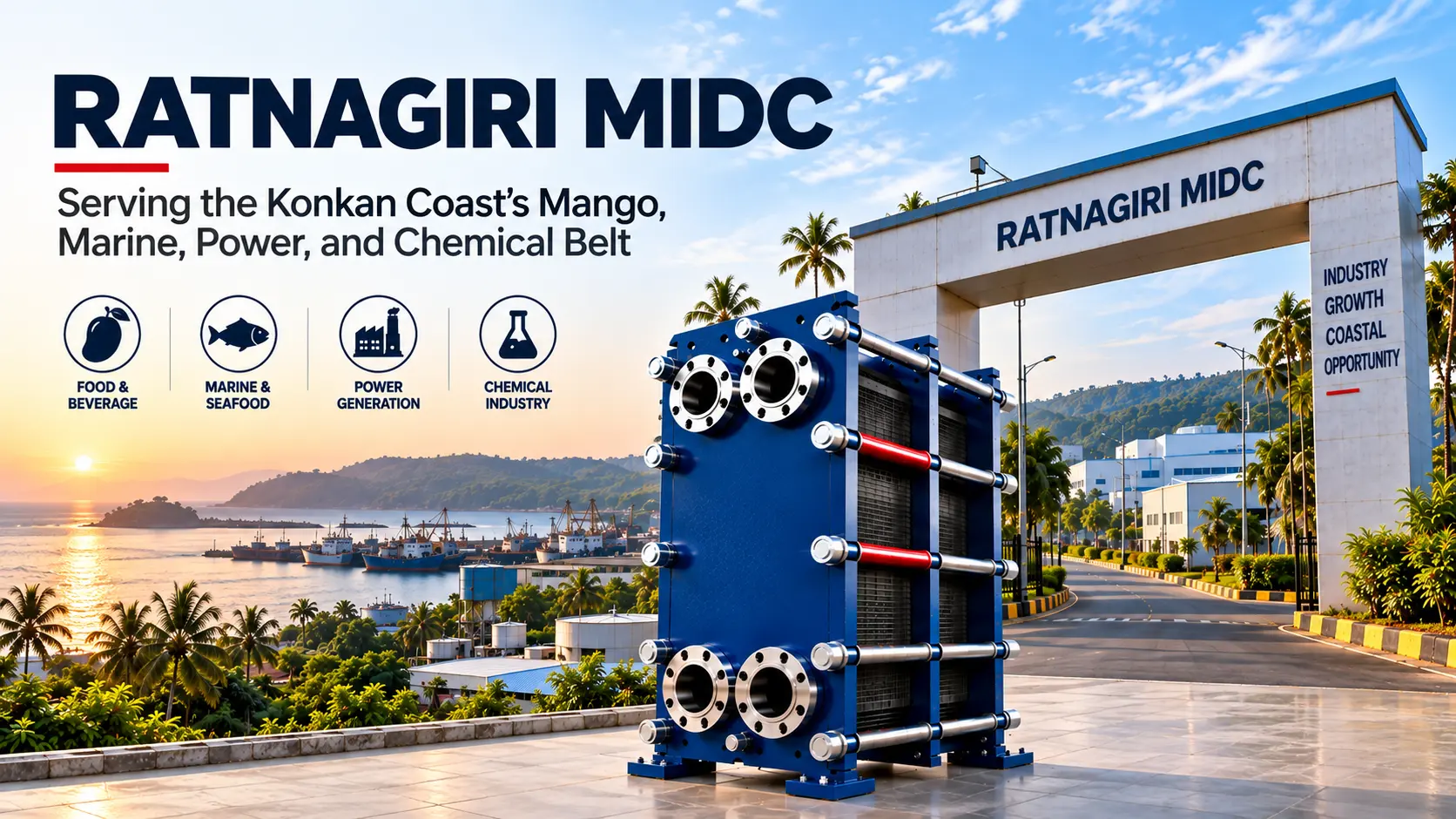
Ratnagiri is best known outside Maharashtra for the Alphonso mango — the “Mango City” reputation is well earned — but its industrial base tells a very different story. Mirjole, near Ratnagiri city, hosts a genuine marine export processing cluster. Khed is home to Lote Parshuram, one of the largest chemical industrial parks in the state, spread across roughly 2,700 acres with several hundred companies including major names in paints, agrochemicals, and specialty chemicals exporting to the Americas and Europe. Guhagar taluka, on the same coastline, hosts one of India’s largest gas-based combined-cycle power stations at Anjanwel, running an integrated LNG regasification terminal alongside nearly 2,000 MW of generation capacity. Dapoli, further along the coast, keeps a smaller agricultural economy anchored by a long-established agricultural university. Sourcing plate heat exchanger manufacturers in Ratnagiri MIDC means understanding that these are four genuinely different industrial worlds sharing one coastal district, on top of a coastal environment that adds its own consideration regardless of which one you’re in.
Comparing PHE Demand Across Ratnagiri District
| Zone | Dominant Industry | Typical PHE Duty | What Matters Most |
| Ratnagiri (Mirjole) | Marine/seafood export processing | Chilling, IQF pre-treatment, brine and ice-water systems | Food-grade, cold-chain-rated construction |
| Khed (Lote Parshuram) | Large-scale chemical, agrochemical, paints | Solvent and process-chemical cooling | Chemical-resistant plates and gaskets as default |
| Guhagar (Anjanwel/RGPPL) | Gas-based power generation, LNG regasification | Auxiliary cooling, lube-oil and closed-loop systems | High-reliability, continuous-duty construction |
| Dapoli | Agriculture, agro-research, coastal fishing | Small-scale food processing, general cooling | Remote logistics and gasket support |
Why the Konkan Coast Changes the Sourcing Conversation
Beyond the specific industries, every buyer along this coastline shares one factor that inland districts don’t: salt-laden coastal air accelerates external corrosion on frames, bolts, and fittings even when the process fluid itself is perfectly ordinary. A PHE that would perform fine for a decade inland can show frame corrosion far sooner here if the construction wasn’t specified with coastal exposure in mind. This is worth raising with any supplier quoting equipment for outdoor or semi-outdoor installation anywhere in this district, independent of what industry the unit is actually serving, and it applies as much to a small agro-processing unit in Dapoli as it does to a large chemical plant in Khed.
Plate Heat Exchanger Manufacturers in Ratnagiri
Ratnagiri city’s Mirjole industrial estate carries a genuine marine export processing presence, alongside general engineering units. Seafood export processing — chilling, IQF freezing preparation, and brine or ice-water systems — needs food-grade, corrosion-resistant construction built for near-continuous cold-chain operation, distinct from the general industrial cooling common to most engineering workshops. Processing lines here often run extended shifts during peak catch season, which means the equipment’s actual duty cycle is considerably harder than its calendar age would suggest. A plate heat exchanger manufacturer in Ratnagiri serving this cluster needs to default to food-grade SS316 with marine-appropriate frame protection, not treat it as an unusual request, and should be sizing for peak-season throughput rather than an annual average.
Plate Heat Exchanger Suppliers in Khed
Khed’s Lote Parshuram MIDC is a different scale of chemical processing entirely — several hundred companies across roughly 460 industrial plots, including major agrochemical, specialty chemical, and paint manufacturers, much of it export-oriented toward the Americas and Europe. This density of chemical processing means gasket and plate specifications here need to assume aggressive chemistry as the default rather than the exception, and export compliance documentation matters as much as the equipment itself — an international buyer auditing a Lote Parshuram supplier’s facility will expect material traceability as standard practice, not something assembled the week before an inspection. A plate heat exchanger supplier in Khed without genuine experience in this kind of chemical-duty specification is likely to undersell what the application actually needs, and the gap tends to show up as premature gasket failure well within the first year of operation.
Plate Heat Exchanger Manufacturers Serving Guhagar’s Power Sector
Guhagar taluka hosts one of India’s larger gas-based combined-cycle power stations, an integrated facility combining nearly 2,000 MW of generation capacity with its own LNG regasification terminal. A power plant of this scale runs a genuinely different heat transfer profile from anything else in the district: closed-loop cooling water systems, lube-oil coolers for turbine and generator equipment, and auxiliary heat rejection duties that need to run reliably around the clock, since unplanned downtime on a plant feeding the state grid carries a cost far beyond the equipment itself. Units supplying this kind of continuous, high-reliability duty need documented pressure ratings and material certification as standard, and a manufacturer without prior experience specifying for power-plant auxiliary systems is not the right fit for this particular corner of the district, regardless of how well they serve the chemical or marine-processing side of Ratnagiri.
PHE Gasket Manufacturers in Dapoli
Dapoli’s economy runs on a smaller scale — coastal agriculture, cashew and mango-linked processing, fishing, and a well-known agricultural university presence dating back over five decades, with more than a dozen research stations spread across the wider Konkan region, rather than the heavy chemical or marine-export processing found elsewhere in the district. That research infrastructure occasionally translates into small-scale food-processing pilot equipment alongside the area’s commercial agro-processing base. Being further from the main industrial estates, the practical concern for buyers here isn’t unusual engineering; it’s whether a PHE gasket manufacturer serving Dapoli can confirm compatibility remotely and dispatch a matching gasket set without requiring the whole unit shipped back for measurement, given how much further this stretch of coast sits from the district’s central industrial infrastructure.
Getting Plate Material and Gasket Compound Right
Marine and seafood-export duty in Ratnagiri generally needs food-grade SS316 plates with corrosion-resistant frame protection given the coastal environment. Khed’s chemical-processing density usually calls for SS316 or higher as a baseline, with welded or semi-welded construction worth considering wherever solvents or aggressive process chemistry are involved, since removing gaskets from the hot chemical path removes a common failure point. Guhagar’s power-sector auxiliary systems typically run on SS304 or SS316 depending on the specific cooling loop, but with a stronger emphasis on continuous-duty reliability and documented pressure ratings than on exotic materials. Dapoli’s agro-processing duty is usually fine on SS304 with food-grade gaskets. Whatever the duty, ask for material test certificates and pressure test documentation before accepting a quote — manufacturers working within ISO 9001 quality frameworks, and referencing thermal design practices from bodies like ASHRAE, give you something documented to rely on rather than a verbal promise. The MIDC official portal remains the authoritative reference for confirming an estate’s status anywhere in the district.
Maintenance Along a Coastal, Multi-Industry District
A gradually rising pressure drop at constant flow rate remains the universal early sign of internal fouling, but coastal buyers should also watch external hardware more closely than an inland plant would — salt exposure accelerates corrosion on frames and connection points well before it affects the plates themselves. In Ratnagiri’s marine-processing duty, organic residue from seafood handling is the typical internal fouling cause, needing a properly concentrated CIP cycle, and this is worth checking more frequently during peak catch season when throughput is highest. In Khed’s chemical units, process residue or early corrosion signals an under-specified plate grade rather than a maintenance lapse. In Guhagar’s power-plant auxiliary systems, scaling in closed-loop cooling water or oil contamination in lube-oil coolers are the more likely culprits, and given the continuous-duty nature of power generation, inspection intervals here often need to be tighter than the district average. A visual check every 3–6 months, with a full teardown and gasket inspection every 12–18 months, is a reasonable baseline everywhere, with coastal installations benefiting from an added external hardware check on the same schedule.
What a Fair Quote Should Include
Plate material, gasket compound, heat transfer area, frame/connection protection, and freight should appear as separate line items on any quote — the frame protection line matters more here than in an inland district given the corrosion consideration, and continuous-duty power-sector applications should have documented pressure ratings called out explicitly rather than assumed. SRJ Heatt Exchangers India Pvt. Ltd. builds its quoting approach around this range of duty — sizing plate and gasket selection differently for marine export processing in Ratnagiri, chemical-heavy duty in Khed, power-sector auxiliary systems in Guhagar, or general agro-processing in Dapoli, with replacement parts stocked so buyers across this coastal district aren’t left waiting weeks for a routine part.
Conclusion
Ratnagiri’s identity as mango country sits alongside a genuinely serious industrial base — marine export processing in Ratnagiri city, one of Maharashtra’s largest chemical parks in Khed, a major gas-based power station in Guhagar, and a smaller agro-coastal economy in Dapoli. Plate heat exchanger manufacturers in Ratnagiri MIDC need to match plate material and gasket compound to the actual duty at each site, account for coastal corrosion regardless of industry, and equipment performance stops being a guessing game.
FAQs
Does coastal air really affect plate heat exchanger performance? Yes — salt-laden coastal air accelerates external corrosion on frames and fittings, which is worth specifying protection against even when the internal process fluid is ordinary.
Why does Khed need a different specification than the rest of the district? Lote Parshuram MIDC’s dense chemical and agrochemical manufacturing base means aggressive process chemistry should be the default assumption, not an exception, when specifying plate and gasket materials.
Can plate heat exchangers be used in seafood export processing? Yes — chilling, IQF freezing preparation, and brine or ice-water systems commonly rely on food-grade PHEs built for near-continuous cold-chain operation.
Do power plants use plate heat exchangers? Yes — combined-cycle power stations like the one at Guhagar rely on plate heat exchangers for closed-loop cooling water, lube-oil cooling, and other auxiliary heat rejection duties that need to run reliably around the clock.
Should I choose SS304 or SS316 plates? SS304 suits general agro-processing duty in Dapoli and some power-sector auxiliary loops in Guhagar; SS316 or higher is the safer baseline for marine processing in Ratnagiri and chemical duty in Khed.
Can I get PHE gasket support quickly in Dapoli? Yes, provided the supplier stocks common plate and gasket sizes and can confirm compatibility remotely rather than requiring the full unit shipped back.
Why does peak season matter for sizing PHEs in Ratnagiri’s marine sector? Seafood processing throughput rises sharply during peak catch season, so equipment sized only for an annual average tends to underperform exactly when demand is highest.
What should I ask for before accepting a quote? Material test certificates, pressure test documentation, and a line-item breakdown covering plate material, gasket compound, frame protection, and freight.