
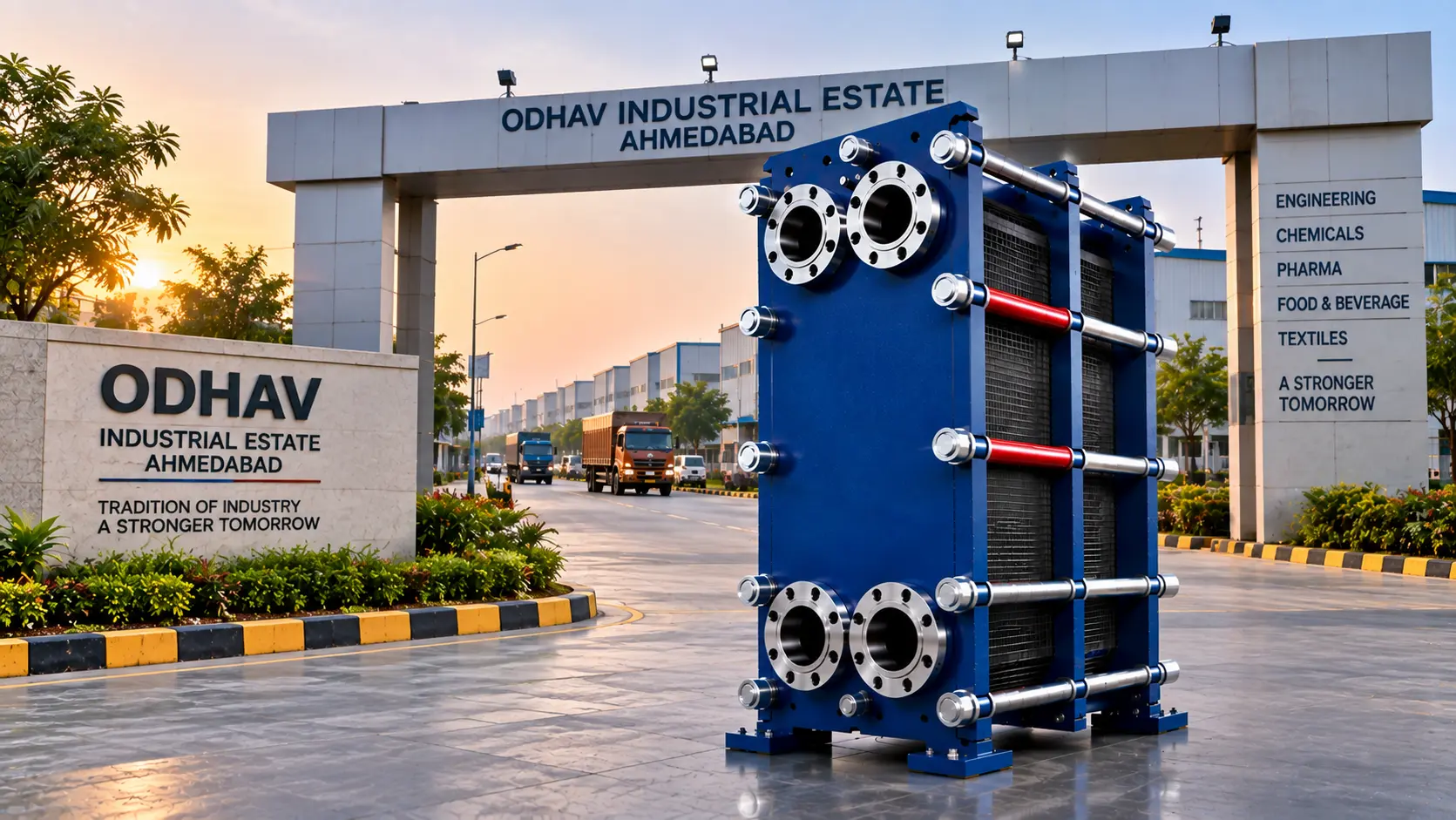
Odhav has been part of Ahmedabad’s industrial backbone since GIDC first developed the estate in 1967-68, and that history shows in what’s still manufactured there today: control panels, switchgear, textile machinery, valves, pattern works and general metal products. Plants running this kind of equipment-manufacturing and testing work need dependable process cooling just as much as any chemical unit does, which is why finding the right plate heat exchanger manufacturers in Odhav matters more than most buyers expect until a compressor test bench or hydraulic press starts running hot.
Why Odhav’s Industrial Character Demands Purpose-Built Cooling
Odhav’s manufacturing base leans heavily toward electrical and mechanical engineering. Control-panel and switchgear units building MCC, PCC and APFC panels run load-testing benches that generate real heat under simulated fault conditions, and that heat has to go somewhere fast and safely. Textile-machinery manufacturers running fabrication and assembly lines need cooling for hydraulic presses and machining centers. Valve and pattern-works units doing casting and machining generate their own thermal loads during finishing and testing.
None of this is chemical-process cooling in the traditional sense, but it’s every bit as duty-specific. A compressor test rig needs a compact, serviceable unit that opens easily for inspection between cycles. A hydraulic press cooling loop needs consistent flow with minimal pressure drop so cycle times don’t suffer. Sizing a generic exchanger for “general industrial water cooling” without accounting for these specifics is a common, avoidable mistake.
Plate Heat Exchanger Suppliers in Odhav: Know What You’re Actually Buying
Plate heat exchanger suppliers in Odhav range from full manufacturers to pure resellers, and the distance between the two matters the moment a unit needs modification. A manufacturer can adjust plate count for a testing rig that’s about to be upgraded, source a specific gasket compound for an unusual coolant additive, or turn around a replacement part without routing the order through a distributor’s parent brand. A trader, by contrast, can usually only supply what’s already on a shelf somewhere.
For general engineering and panel-testing duties common in Odhav, ask any prospective supplier for a thermal datasheet specific to your test conditions — not a standard catalogue recommendation. If they can’t produce heat load, flow rate and pressure-drop figures for your actual setup, they haven’t engineered anything; they’ve just sold you a part number.
Plate Heat Exchanger Manufacturers in Vatva: A Different Set of Demands Entirely
A short drive from Odhav, Vatva GIDC represents almost the opposite end of the thermal-duty spectrum. Vatva is home to roughly 600 dye, dye-intermediate and chemical manufacturing units, alongside a significant pharmaceutical and agrochemical presence — making it one of the largest chemical clusters in Gujarat. Reaction cooling, solvent recovery, and dye-bath temperature control here involve fluids that are corrosive, sometimes at elevated temperature, and unforgiving of the wrong material choice.
Plate heat exchanger manufacturers in Vatva need to work confidently with 316 stainless as a baseline and step up to higher alloys or welded and semi-welded plate construction when the process chemistry demands it. A gasketed unit that would perform perfectly well cooling compressor oil in Odhav can fail within weeks handling an acidic dye-bath stream in Vatva. SRJ Heatt Exchangers India Pvt. Ltd. manufactures gasketed, welded and semi-welded plate heat exchangers specifically suited to this range of duties, working from material selection through to hydro-testing before a unit ever reaches a Vatva plant floor.
Matching Plate Heat Exchanger Type to the Actual Process
For general engineering, testing rigs and compressor cooling loops typical of Odhav, a compact gasketed plate-and-frame unit usually covers the duty, provided it’s sized against real test-cycle heat loads rather than steady-state assumptions.
For chemical, dye and pharmaceutical intermediate processes typical of Vatva, welded or semi-welded designs handle aggressive or high-temperature media that would degrade a standard gasket quickly. Where the fluid is less aggressive but still needs full containment, semi-welded plates offer a middle ground — sealed on one side, serviceable on the other.
For viscous streams or fluids carrying suspended solids, wide-gap plates resist the clogging narrow standard channels are prone to.
Plate Type Heat Exchanger Manufacturers in Kerala: The Same Principles, a Different Coast
The same manufacturing logic that separates an Odhav testing-rig duty from a Vatva chemical duty applies just as directly outside Gujarat. Plate type heat exchanger manufacturers in Kerala serve process industries with their own distinct thermal character — most notably the Eloor-Edayar industrial belt near Kochi, Kerala’s largest industrial cluster, where chemical, fertilizer, petrochemical and rubber-processing-chemical units operate along the Periyar river, and the rubber-processing hub around Kottayam, where natural rubber concentration and drying involve their own steady thermal loads.
Plants in these belts face selection questions that echo Vatva’s more than Odhav’s: corrosion resistance, chemical compatibility, and reliable performance on aggressive or particulate-heavy streams. A manufacturer with genuine engineering depth in chemical-duty plate heat exchangers — built and tested for Gujarat’s dye and pharma cluster — is generally well positioned to size the same category of unit for Kerala’s plants, and pan-India dispatch means distance from the factory doesn’t have to mean weaker documentation or after-sales support.
A Practical Checklist Before You Order
- Ask for the thermal calculation behind the quote — heat load, LMTD, plate count and pressure drop for your specific duty, not a generic recommendation.
- Confirm plate material and gasket compound explicitly, and ask why each was chosen for your fluid and temperature range.
- For welded or semi-welded units, ask what welding certification and hydro-test documentation backs the specific unit being supplied.
- Check spare-parts turnaround time in writing, and confirm whether replacement plates and gaskets are stocked domestically.
- Verify ISO 9001 certification and, for pharma or food-adjacent processes, any additional compliance your product line requires.
Maintenance Realities and Common Mistakes
A rising pressure drop across the unit is usually the first sign of fouling, whether that’s scale from hard process water in Odhav or chemical residue buildup in Vatva. A falling outlet temperature on the process side points to reduced heat transfer from the same cause. Weeping at the frame edge signals a tired gasket or under-torqued tie bolts, and any sign of cross-contamination between fluids means a cracked or perforated plate needs immediate attention.
The most avoidable failures come from over-tightening the frame past the plate pack’s rated dimension, reassembling plates out of sequence after a service, and reusing gaskets well past their working life — especially critical in Vatva-type chemical duties, where a degraded gasket can mean a process-fluid leak rather than just reduced performance.
What Actually Drives Cost
Plate material is the single biggest cost driver — titanium and specialty alloys needed for aggressive Vatva-type chemistries cost substantially more than the 304 or 316 stainless that covers most Odhav engineering duties. Total heat-transfer area, design pressure and temperature rating, and frame construction round out the remaining cost factors. Gasket replacement is a recurring cost across every duty type and should be budgeted as part of total ownership rather than compared only at the point of purchase.
Frequently Asked Questions
What makes Odhav’s plate heat exchanger needs different from a typical chemical estate?
Odhav’s demand centers on general engineering, panel-testing and machinery-manufacturing cooling loads rather than corrosive process chemistry, so standard gasketed units sized for real test-cycle heat loads usually cover the duty without needing specialty alloys.
Why do Vatva’s chemical units need a different plate heat exchanger than Odhav’s engineering units?
Vatva’s roughly 600 dye, chemical and pharmaceutical units handle corrosive, sometimes high-temperature process streams that require welded or semi-welded construction and higher-grade materials, unlike the general cooling-water duties common in Odhav.
Can the same manufacturer serve both Odhav and Vatva effectively?
Yes, provided the manufacturer can engineer across both duty types — compact gasketed units for general engineering cooling and welded or semi-welded corrosion-resistant units for aggressive chemical processes — rather than offering a single standard design for everything.
Do plate type heat exchanger manufacturers in Kerala face similar challenges to Vatva’s chemical cluster?
Largely yes. Kerala’s Eloor-Edayar chemical and fertilizer belt near Kochi, and the rubber-processing units around Kottayam, deal with corrosive or particulate-heavy streams that call for the same material and construction considerations as Vatva’s chemical duties.
How do I choose between a plate heat exchanger manufacturer and a supplier in Odhav?
Ask for a thermal datasheet specific to your actual operating conditions. A manufacturer can produce one and adjust the design if needed; a pure supplier or trader typically can only offer what’s already available off the shelf.
What plate material is typically needed for Vatva’s dye and chemical processes?
316 stainless is a common baseline, with higher alloys or welded/semi-welded construction required depending on the specific acid, solvent or dye chemistry and operating temperature involved.
How often should plate heat exchanger gaskets be replaced in aggressive chemical duties?
More frequently than in general cooling-water applications — inspect on a defined schedule tied to the specific chemistry involved, and replace at the first sign of hardening, cracking or weeping rather than waiting for a visible leak.
What should I confirm before ordering a plate heat exchanger for pan-India dispatch, such as to Kerala?
Confirm the manufacturer holds ISO 9001 certification, provides full hydro-test documentation with the unit, and can commit to a clear spare-parts turnaround time regardless of distance from the factory.
Conclusion
Odhav’s engineering and panel-manufacturing base, Vatva’s chemical and dye cluster, and process plants as far away as Kerala’s Eloor-Edayar belt and Kottayam’s rubber-processing units all need the same underlying discipline — correct material selection, accurate sizing against real operating conditions, and a manufacturer who stands behind the unit after installation. SRJ Heatt Exchangers India Pvt. Ltd. manufactures gasketed, welded, semi-welded, brazed and wide-gap plate heat exchangers engineered to this range of duties, supplying plants across Ahmedabad’s GIDC estates and pan-India alike.