
If you’re evaluating plate heat exchanger manufacturers in Surendranagar GIDC, you’re probably weighing whether the unit will hold up against the mineral-heavy water common here, whether the gasket compound suits your process, and whether the supplier can support you after installation. Surendranagar district, anchored by the twin towns of Surendranagar and Wadhwan, has built a diverse base spanning cotton ginning and pressing, textile processing, chemicals, ceramics, and general engineering — each drawing on heat transfer equipment somewhere in its process line.
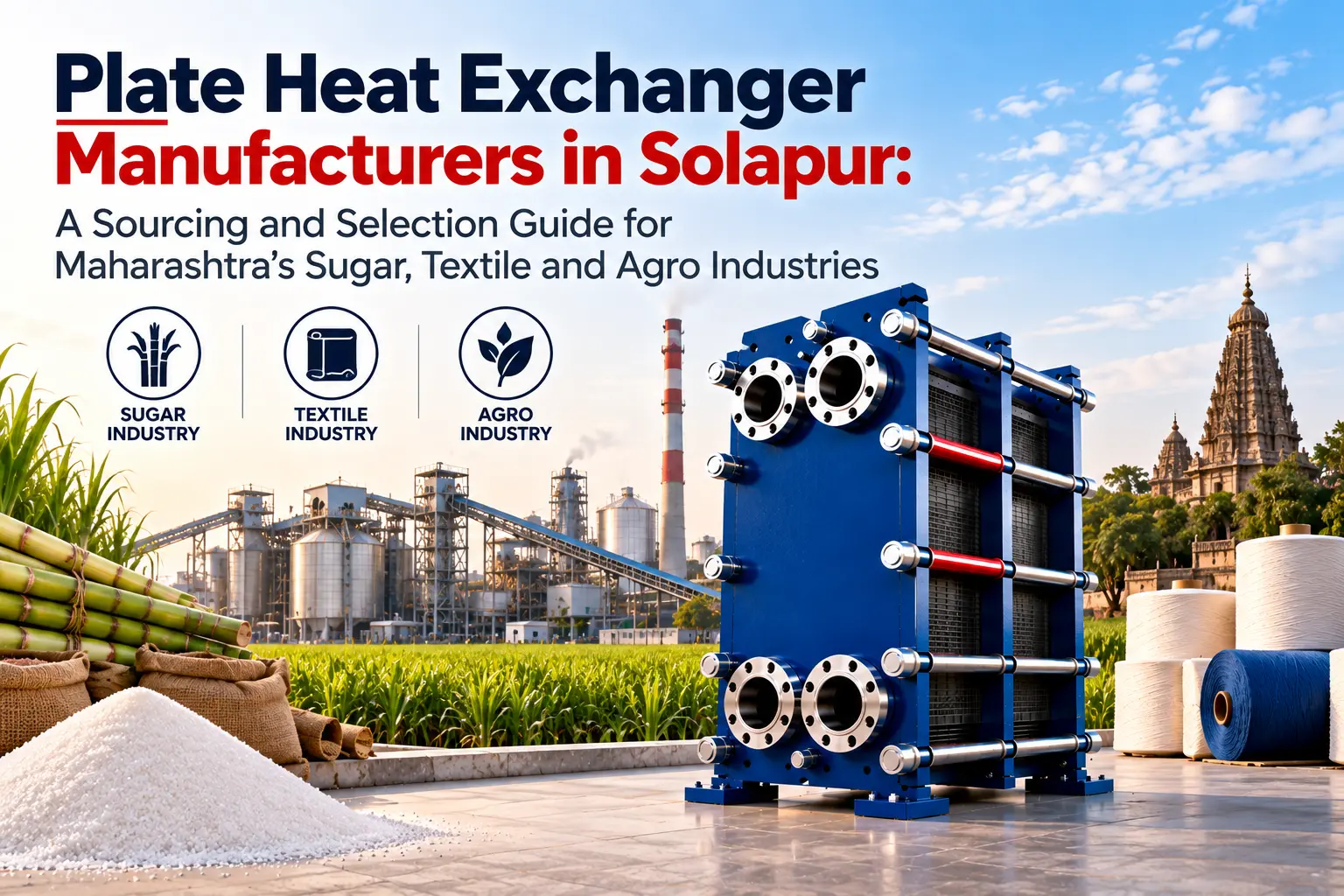
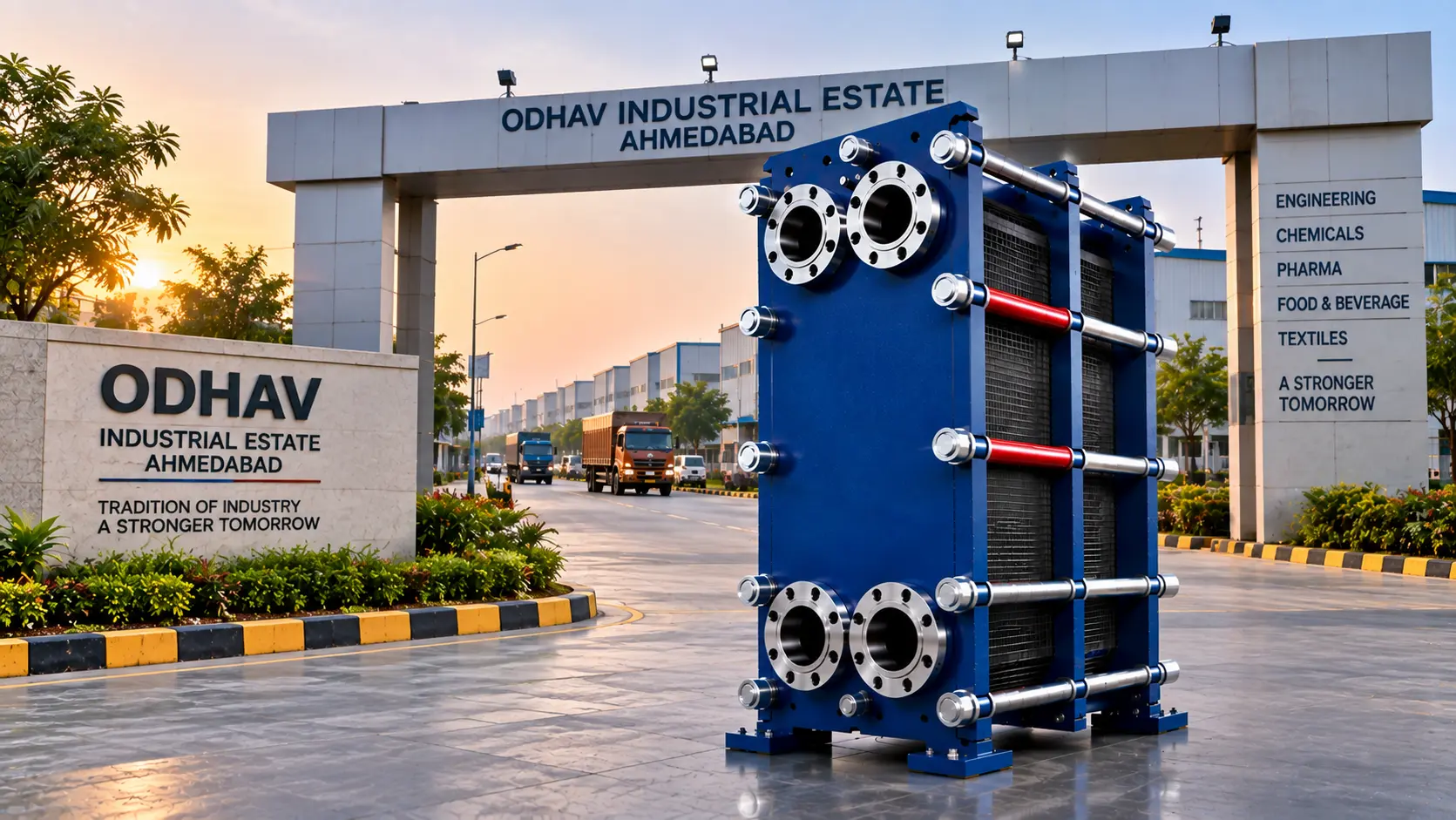
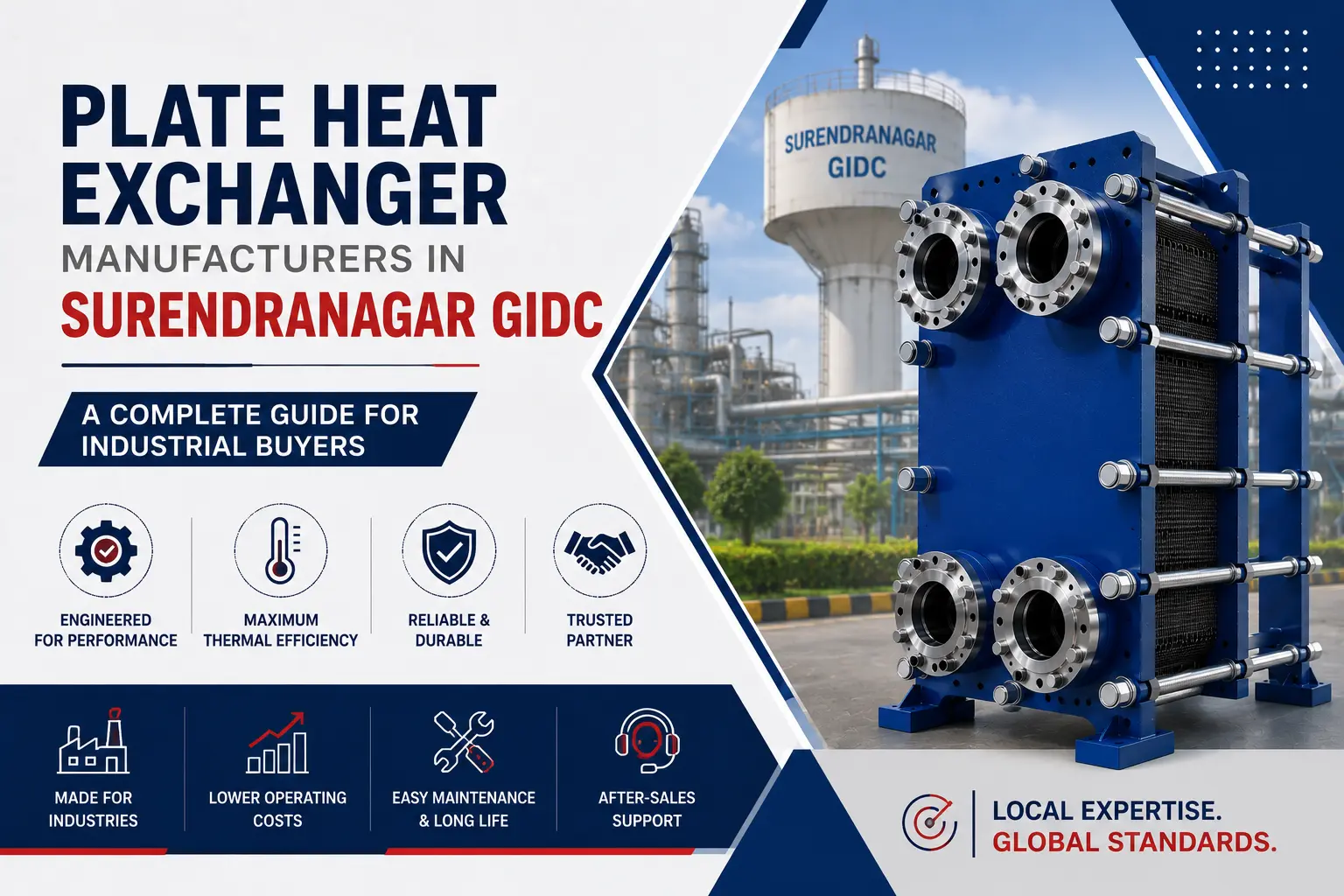
What is a plate heat exchanger? A compact heat transfer unit built from thin corrugated metal plates stacked and sealed with gaskets, with hot and cold fluids running through alternating channels. The corrugation creates turbulent flow, giving far better heat transfer per unit area than older shell-and-tube designs — why PHEs are now the default across Gujarat’s process industries.
Why Surendranagar’s Industrial Mix Changes the Sourcing Decision
Surendranagar-Wadhwan’s ginning, textile dyeing, chemical, and ceramic units each stress a PHE differently. A unit sized for simple water cooling in a ginning unit won’t survive a dye-house effluent line, and a chemical-duty plate pack is unnecessarily expensive for a basic utility cooling loop. The right plate heat exchanger manufacturer asks what your fluid actually is before quoting a plate material, rather than defaulting to a one-size-fits-all spec.
Selection Factors That Actually Matter
- Plate material: SS304 handles general water-to-water cooling well. Where dye chemicals, acids, or high-mineral process water are involved — common across this belt’s textile and chemical units — SS316/SS316L is the safer choice, with titanium reserved for the most corrosive duties.
- Gasket compound: NBR suits general water and mild-oil duties economically but degrades under sustained heat or steam. EPDM handles steam and hot water well. Viton is worth the premium for chemical-heavy or higher-temperature duty. Getting this wrong is the leading reason plants end up replacing gaskets every few months instead of every few years.
- Sizing: Share your real flow rate range, not just an average, along with maximum design temperature and pressure. Under-sizing to save upfront cost accelerates fouling and cuts efficiency within the first year of operation.
- Documentation: Ask for material test certificates and pressure test reports. Manufacturers working within ISO 9001 quality frameworks, and referencing thermal design practices from bodies like ASHRAE, give you a documented basis for acceptance instead of a verbal promise.
Plate Heat Exchanger Manufacturers in Wadhwan GIDC
Wadhwan’s industrial estate sits alongside Surendranagar’s ginning, pressing, and general engineering base, and most PHE duties here are conventional — cooling water circuits, process heating, utility loops. What separates a good plate heat exchanger manufacturer serving Wadhwan from an average one isn’t exotic engineering; it’s whether they stock common plate sizes and gasket profiles so a replacement doesn’t mean weeks of downtime.
Plate Heat Exchanger Suppliers in Halvad GIDC
Halvad’s industrial base includes ceramics-linked and general processing units that depend on steady cooling and heating cycles. For plate heat exchanger suppliers working in Halvad, responsiveness matters more than catalogue breadth — a supplier able to confirm plate compatibility and dispatch a replacement gasket set within days keeps a production line from sitting idle over what should be a routine swap.
PHE Gasket Manufacturers in Dhrangadhra GIDC
Dhrangadhra’s long-standing chemical, mineral-processing, and ceramics-linked industries put real demands on gasket chemistry — sustained heat, alkaline or acidic exposure, and higher operating pressures are common here. This is why an experienced PHE gasket manufacturer, rather than a generic rubber parts supplier, matters in Dhrangadhra. Genuine PHE gaskets are compression-moulded to match the specific plate’s corrugation profile; a compound that’s merely “close enough” causes micro-leaks that go undetected until a full teardown. Before reordering, confirm the exact plate model/generation, the elastomer your process actually needs, and whether the gasket is glued or clip-on.
PHE Gasket Suppliers in Limbdi GIDC
Limbdi’s oil mills, agro-processing, and textile units typically run PHEs on straightforward water and mild-oil duties, but gasket replacement is still a recurring maintenance item. For PHE gasket suppliers serving Limbdi, the practical value is stocking the right compound for these duties — usually NBR or EPDM — and confirming compatibility against your existing plate pack without requiring the whole unit shipped out for inspection.
Maintenance and Troubleshooting
A visual inspection every 3–6 months, with a full teardown and gasket check every 12–18 months, is a reasonable baseline for most duties here — more frequent for ceramic-linked or chemical-heavy processes. A gradually rising pressure drop at constant flow rate is the earliest reliable sign of fouling, showing up before any visible mechanical issue. Uneven bolt torque during reassembly causes early gasket failure more often than material fatigue does. External leaks almost always trace to gasket seating or tightening, not the plate itself, and a timely CIP cycle is far cheaper than a full teardown once efficiency drops.
What Influences Pricing
Expect a transparent quote to break out plate material, gasket compound, heat transfer area, and frame/connection size as separate line items — along with freight to Wadhwan, Halvad, Dhrangadhra, or Limbdi specifically, since last-mile delivery costs vary across this belt. Bundling everything into one number makes fair comparison harder.
Why Buyers Choose Established Manufacturers Like SRJ Heatt Exchangers
Sourcing a PHE is ultimately a bet on long-term reliability, not a one-time purchase. SRJ Heatt Exchangers India Pvt. Ltd. has built its manufacturing approach around matching plate material and gasket compound to actual process conditions, and stocking common configurations so units serving smaller pockets like Wadhwan, Halvad, Dhrangadhra, and Limbdi aren’t left waiting weeks for a routine part.
Conclusion
Sourcing plate heat exchanger manufacturers in Surendranagar GIDC comes down to matching plate material and gasket chemistry to your actual process — not picking whichever catalogue unit is cheapest. The right partner understands the difference between a ginning unit’s cooling loop and a chemical processor’s corrosive stream, stocks the gaskets your process genuinely needs, and supports you whether you’re in the main GIDC estate or further out in Halvad or Limbdi.
References
- ISO 9001 Quality Management — International Organization for Standardization
- ASHRAE — thermal systems and heat transfer engineering guidelines
- Bureau of Indian Standards (BIS) — Indian material and pressure equipment standards
- Gujarat Industrial Development Corporation (GIDC) — official industrial estate information for Surendranagar and other Gujarat zones
FAQs
What is a plate heat exchanger used for? Transferring heat between two fluids — cooling, heating, condensing — without them mixing, using gasketed plates instead of tubes.
SS304 or SS316 for this region? SS304 for general water duties; SS316/SS316L where dye chemicals, acids, or high-mineral process water are involved.
Which gasket — NBR, EPDM, or Viton? NBR for general/mild-oil duty, EPDM for steam and hot water, Viton for chemical-heavy or higher-temperature duty, common in Dhrangadhra’s process units.
How often should gaskets be replaced? A correctly matched gasket typically lasts 3–5 years; a mismatched compound can fail within months.
Can spares reach Halvad or Limbdi quickly? Yes, if the manufacturer stocks common plate and gasket sizes — dispatch within days without shipping the full unit back.
What causes leaks in a plate heat exchanger? Mostly uneven bolt torque or poor gasket seating, rarely plate failure.
How do I know if my PHE needs cleaning? A gradual rise in pressure drop at the same flow rate, or a drop in outlet temperature performance.