
For factories spread across the Valsad industrial belt, choosing the right thermal partner is rarely a casual decision. Plate heat exchanger manufacturers in Valsad GIDC serve a dense cluster of chemical, pharmaceutical, textile, and processing units that depend on tight temperature control to keep production running. If you operate a plant anywhere between Vapi and Umargam, this guide walks you through what genuinely matters when sourcing a plate heat exchanger (PHE), how to evaluate a supplier, and what most buyers overlook until something fails on the floor.
Why South Gujarat Runs on Plate Heat Exchangers
The stretch of GIDC zones across Valsad district handles some of India’s most heat-intensive manufacturing. Dyes, intermediates, agrochemicals, food processing, and bulk drugs all require precise heating and cooling, often with aggressive media and limited floor space.
A plate heat exchanger fits this reality well. Compared to a shell-and-tube unit, a PHE transfers heat far more efficiently per square metre, occupies a fraction of the footprint, and can be opened, cleaned, and re-gasketed without replacing the whole system. For a crowded GIDC shed where every square foot earns money, that compactness is not a luxury. It is the difference between fitting a process line and reworking the entire layout.
What Exactly Is a Plate Heat Exchanger?
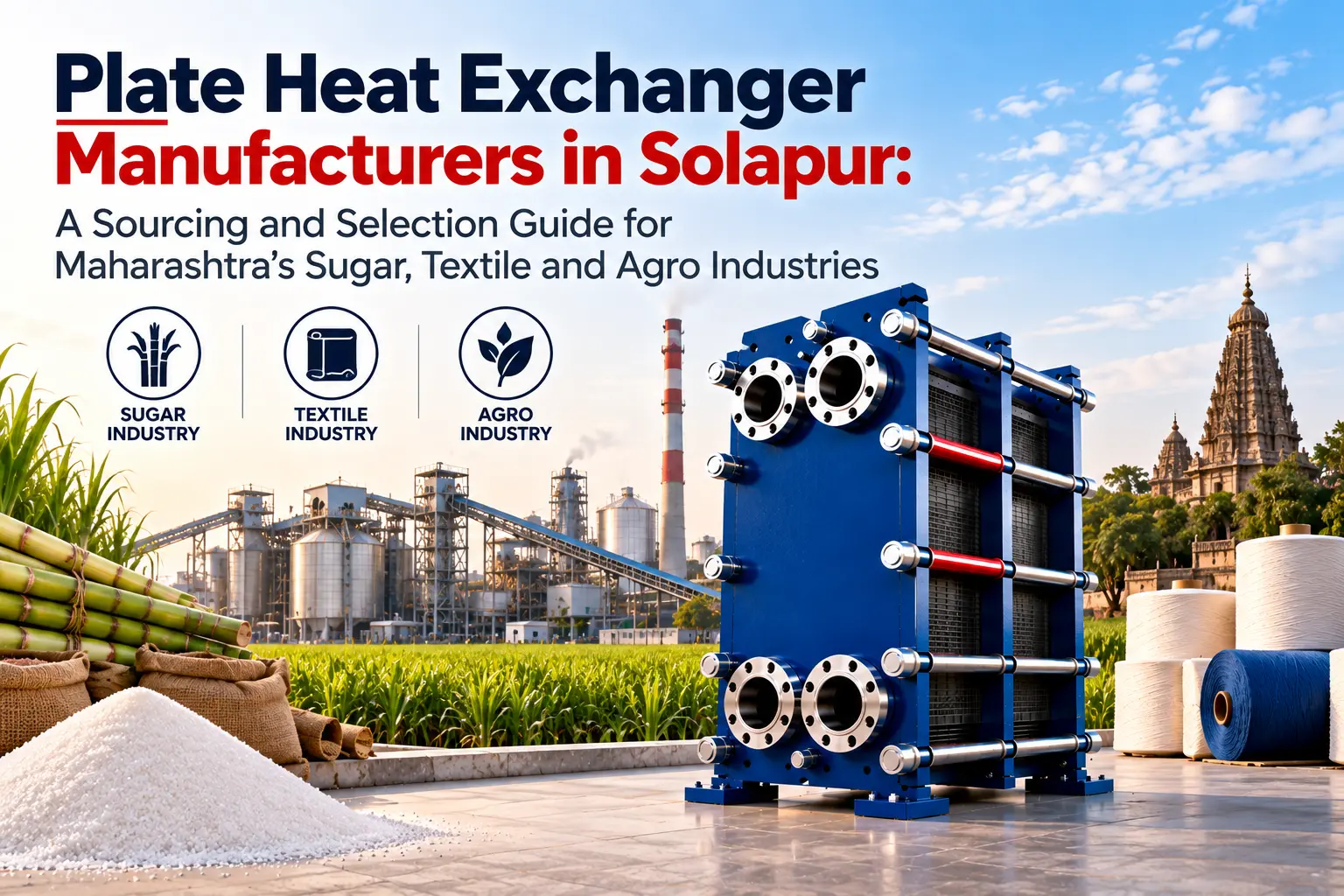
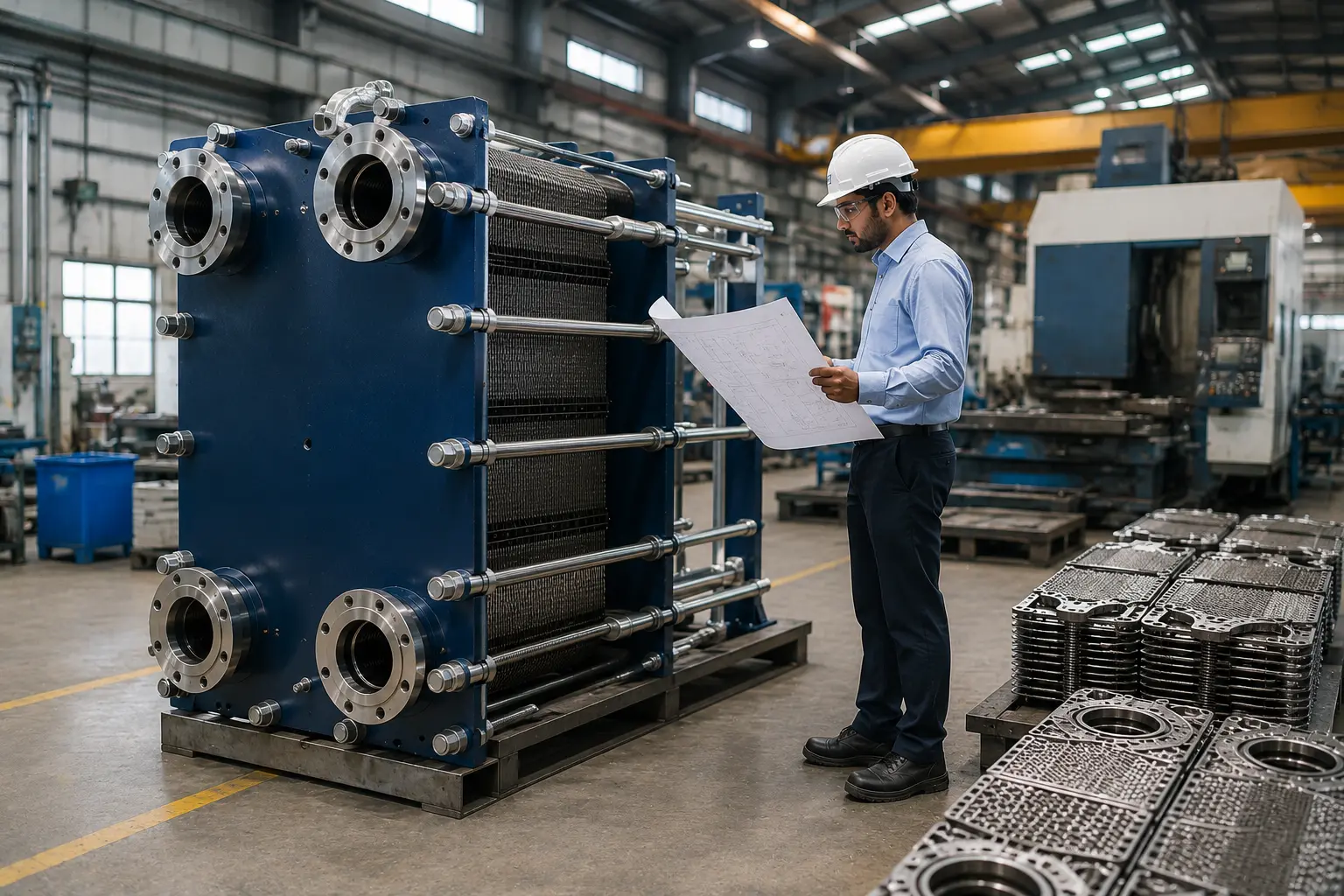
In plain terms, a plate heat exchanger is a stack of thin, corrugated metal plates clamped together inside a frame. Two fluids, usually one hot and one cold, flow through alternating channels between the plates. Heat passes through the thin metal wall from one fluid to the other while the two streams never mix. The corrugation pattern forces turbulence, which dramatically improves heat transfer and helps keep surfaces from fouling.
That simple architecture is why a PHE can hit very close temperature approaches that a shell-and-tube design struggles to match.
Choosing Among Plate Heat Exchanger Manufacturers in Vapi and the Wider Belt
Vapi sits at the heart of this industrial corridor, so it is no surprise that many buyers begin their search with plate heat exchanger manufacturers in Vapi before widening the net. Proximity matters, but it should never be the only filter. A nearby vendor who cannot supply spares within 48 hours is worth less than a slightly farther one who keeps your line alive.
When you shortlist a manufacturer, weigh these factors honestly:
Plate material and pressing capability. Stainless steel 316 handles most duties, but titanium, SMO 254, or nickel alloys become essential for chlorides, seawater cooling, or strong acids common in this region’s chemical units. Ask what alloys the manufacturer actually presses in-house versus what they outsource.
Gasket compatibility. The gasket decides chemical and temperature limits as much as the plate does. NBR, EPDM, and Viton each suit different media. A good supplier matches gasket grade to your exact process fluid, not a generic catalogue assumption.
Thermal design proof. Reputable manufacturers run your duty through proper thermal sizing software and share the heat balance, pressure drop, and plate count. If a vendor quotes a unit without asking your flow rates, temperatures, and fouling factors, treat that as a red flag.
Service turnaround. Re-gasketing, plate replacement, and cleaning are routine. The supplier’s stock of spares and their response time during a breakdown often matter more than the original purchase price.
Plate Heat Exchanger Suppliers in Sarigam: Sizing for Smaller Units
Sarigam hosts a mix of mid-sized chemical and engineering plants, many of which need compact, lower-capacity units rather than large frames. The better plate heat exchanger suppliers in Sarigam understand that an over-sized exchanger wastes capital and an under-sized one chokes the process.
The practical advice here: do not buy purely on installed area. Two units with identical plate area can perform very differently depending on plate corrugation angle (chevron pattern). High-theta plates give strong heat transfer with higher pressure drop; low-theta plates are gentler. Matching the pattern to your pump head and duty is what separates an efficient install from a constant headache.
Gaskets and Plates: The Components That Decide Reliability
Most PHE failures in the field are not catastrophic frame issues. They are leaks, and leaks almost always trace back to gaskets or plate condition. This is where component-level sourcing becomes critical.
PHE Gasket Manufacturers in Umargam and Why Gasket Quality Decides Uptime
Umargam’s industrial pocket includes units running continuous, high-temperature duties where gasket degradation is a real operational risk. Working with proven phe gasket manufacturers in umargam means you get elastomer compounds rated correctly for your temperature ceiling and chemical exposure, with consistent dimensional accuracy so the gasket seats properly in the plate groove.
A poorly cured or mismatched gasket hardens, takes a compression set, and starts weeping within months. The cost of a cheap gasket is never the gasket. It is the unplanned shutdown, the product contamination, and the cleanup.
When evaluating gaskets, confirm three things: the elastomer grade, whether it is glued or clip-on (clip-on saves enormous re-gasketing labour), and the manufacturer’s curing consistency across batches.
PHE Gasket Suppliers in Pardi: Stocking Strategy for Continuous Plants
Pardi sits close enough to the main highway that fast resupply is realistic, which is why dependable phe gasket suppliers in pardi are valued by plants that simply cannot afford to wait. The smart move for any continuous-process unit is to hold a buffer set of gaskets matched to your exact plate model. When a leak appears at 2 a.m., having the right gasket on the shelf turns a multi-day outage into a few hours of work.
Ask your supplier to document your plate model, gasket part number, and elastomer grade in a service file. It sounds obvious, yet many plants lose hours during a breakdown simply because nobody recorded which gasket the unit actually uses.
PHE Plate Manufacturers in Bhilad: Getting the Metallurgy Right
Bhilad’s manufacturing mix leans toward duties where plate metallurgy is the deciding factor. The right phe plate manufacturers in bhilad will press plates to tight tolerances and verify material certificates, because a substandard plate can pit, crack, or thin out under aggressive media far sooner than expected.
For corrosive service, insist on material traceability. A genuine 316 or titanium plate carries documentation; a downgraded substitute may look identical but fail under chloride attack. The few rupees saved on uncertified plates evaporate the first time a pinhole leak contaminates your batch.
How to Match a PHE to Your Actual Process
This is the section most competitor pages skip, and it is exactly where buyers lose money. Selecting a plate heat exchanger well comes down to giving the manufacturer accurate process data and understanding the trade-offs.
Start with your real numbers: flow rates of both streams, inlet and outlet temperatures, allowable pressure drop, design pressure, and the fouling tendency of your fluids. A manufacturer who genuinely cares will ask for all of these before quoting.
Understand the central trade-off. Pushing for a very close temperature approach increases plate count and cost. Allowing slightly more approach saves plates but may compromise efficiency. The right balance depends on your energy economics, not a generic rule.
Plan for fouling from day one. Cooling water in this region often carries silt and biological load. Specifying a sensible fouling margin and choosing a plate pattern that maintains turbulence keeps the unit performing between cleanings instead of degrading week by week.
Maintenance Realities Nobody Tells You About
A PHE is low-maintenance, not no-maintenance. Treating it as fit-and-forget is the fastest route to premature failure.
Build a simple routine. Monitor the pressure drop across the unit; a rising drop signals fouling, while a falling outlet temperature signals plate scaling or bypassing. Schedule cleaning-in-place or manual opening before performance collapses, not after.
When you open the unit, inspect plates for pitting and gaskets for hardening. Re-torque the frame to the manufacturer’s specified dimension, never by feel. Over-tightening crushes gaskets; under-tightening invites leaks. Keep that closing dimension written on the frame itself.
Standardise spares across your plant where possible. If multiple units share plate models and gasket grades, your stocking burden drops and resupply gets simpler.
What Sets a Strong Manufacturer Apart
The difference between an average supplier and a real engineering partner shows up after the sale. Look for genuine thermal design support, honest material certification, fast spare availability, and a willingness to visit the site when a problem is hard to diagnose. A vendor who treats a leaking unit as your problem rather than a shared one is the wrong vendor.
This is where SRJ Heatt Exchangers India Pvt. Ltd. has built its reputation across the Valsad corridor and the wider Indian and Middle East markets. As an established plate heat exchanger manufacturer, SRJ combines in-house plate pressing, correctly matched gaskets, and proper thermal sizing with the kind of after-sales responsiveness that continuous-process plants depend on. For units that cannot tolerate extended downtime, that blend of engineering depth and service reliability is exactly what separates a transactional supplier from a long-term thermal partner.
Common Questions From Plant Buyers
How long do PHE gaskets last? Typically three to five years depending on temperature, media, and cycling, though aggressive duties shorten this considerably. Track performance rather than relying on a fixed calendar.
Can I increase capacity later? Yes. One advantage of a gasketed plate-and-frame unit is that you can add plates within the frame’s limit, as long as the frame and ports were specified with future expansion in mind.
Is titanium always necessary for cooling water? No. Titanium becomes essential mainly with high chloride content or seawater. For ordinary cooling water, 316 stainless usually performs reliably at far lower cost.
What causes most PHE leaks? Aged or mismatched gaskets and incorrect frame torque, far more often than plate failure. Correct gasket selection and proper closing dimension prevent the majority of field leaks.
Final Thoughts
Sourcing well from plate heat exchanger manufacturers in Valsad GIDC is less about finding the cheapest frame and more about partnering with a supplier who understands your process, certifies their metallurgy, matches gaskets correctly, and stands behind the unit after installation. Give your manufacturer accurate data, plan for fouling and maintenance, keep critical spares on hand, and treat the PHE as the precision component it is. Do that, and your thermal system will quietly do its job for years while the rest of the plant gets the attention.