
Vadodara runs one of Gujarat’s densest industrial corridors — petrochemical complexes, pharmaceutical and API plants, chemical intermediates, and heavy engineering units all sit within a short radius of each other. If you’re shortlisting plate heat exchanger manufacturers in Vadodara GIDC, you’re dealing with tougher process conditions than most buyers face elsewhere: corrosive media, high viscosity, and duty cycles that can’t afford unplanned downtime. This guide covers what actually separates a dependable PHE supplier from one that’ll leave you waiting on a re-gasket during a shutdown window.
Why Vadodara’s Industrial Base Runs on Plate Heat Exchangers
Refinery-adjacent chemical units need heat recovery from corrosive, high-temperature streams. Pharma and API plants need precise, contamination-free heat transfer for reaction cooling and solvent recovery. Engineering and process units across the belt need robust, serviceable equipment that doesn’t sit idle waiting for spares. A plate heat exchanger fits all three because its compact footprint and high heat-transfer coefficient outperform shell-and-tube designs — provided it’s specified correctly for the fluid it’s actually handling.
What a Plate Heat Exchanger Does, Briefly
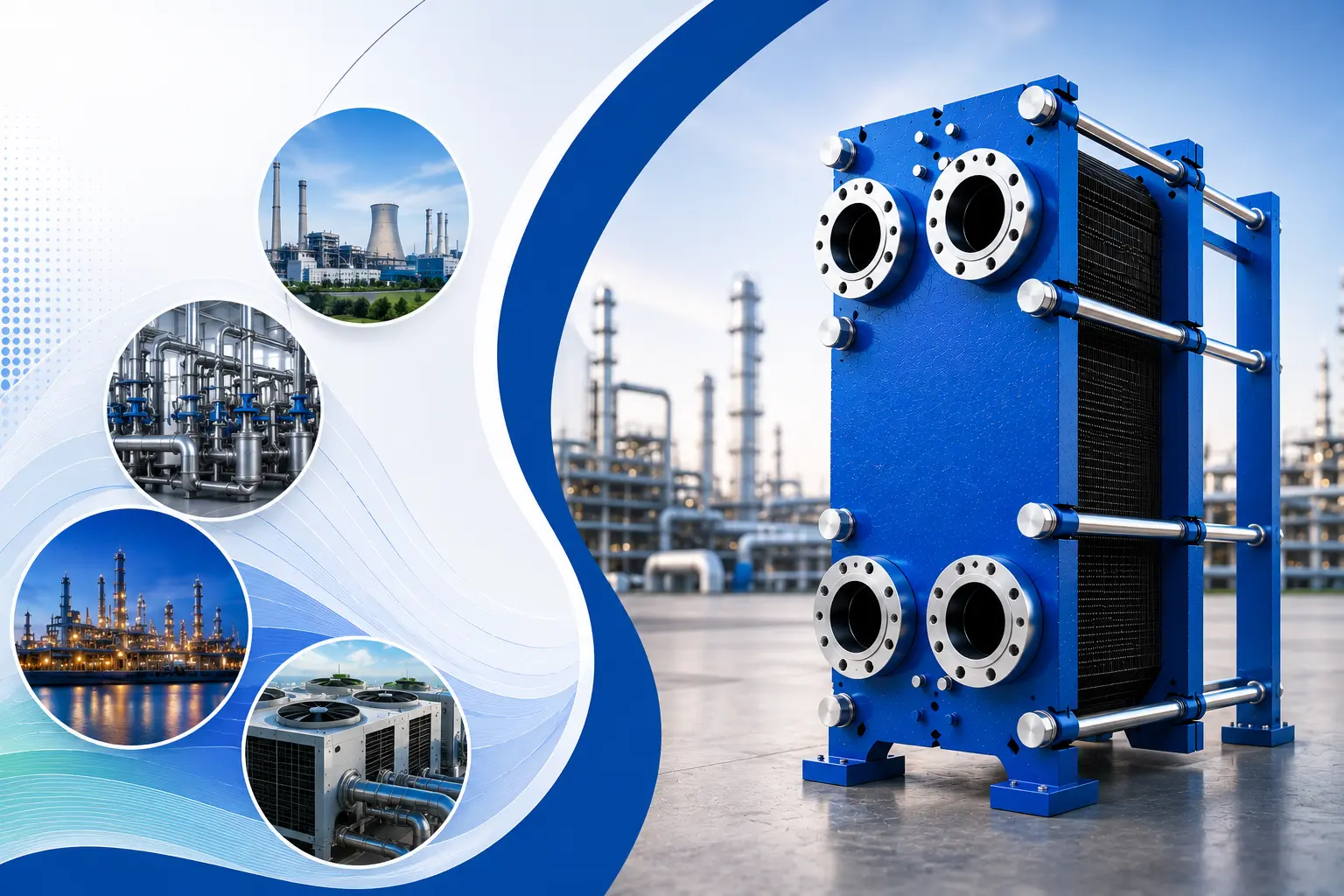
A PHE moves heat between two fluids through thin, corrugated stainless-steel plates clamped in a frame, with gaskets keeping the two streams sealed apart. The corrugation pattern creates turbulence at low velocities, which is why a PHE achieves in a compact frame what a shell-and-tube unit needs several times the space for.
Plate Heat Exchanger Manufacturers in Vadodara GIDC: What to Verify Before You Buy
Metallurgy for Corrosive and Petrochemical Service
Standard AISI 316 stainless steel handles general water and mild-chemical duty, but chloride-heavy streams, acids, or petrochemical intermediates often demand titanium, SMO 254, or a higher alloy. Under-specifying metallurgy here doesn’t show up on commissioning day — it shows up as pinhole leaks six to twelve months later, usually during peak production.
Thermal Sizing, Not Catalogue Sizing
Ask for an actual thermal datasheet: heat duty, approach temperature, pressure drop, and plate count calculated for your flow rates and fouling factor. A manufacturer who can’t produce this and instead offers you a standard catalogue model isn’t engineering a solution — they’re guessing.
Gasketed vs Semi-Welded vs Fully Welded
Gasketed units suit serviceable, moderate-pressure duty where both fluids are compatible with elastomer gaskets. Semi-welded units protect one aggressive-media side by welding those plate pairs shut while keeping the other side serviceable. Fully welded and brazed units suit high-pressure or highly corrosive duty where gaskets simply won’t survive. Getting this choice wrong in a chemical plant usually means a leak you can’t service without a full shutdown.
PHE Plate Manufacturers in Por-Ramangamdi and Plate Suppliers in Vaghodia
Por-Ramangamdi and Vaghodia both sit inside Vadodara’s extended industrial belt, and treating them as part of the same sourcing radius as the main GIDC estate widens your options considerably. When comparing PHE plate manufacturers in Por-Ramangamdi, look closely at the plate corrugation pattern — chevron angle and depth directly affect pressure drop and fouling resistance, and a plate optimised for clean water performs very differently under a viscous or particulate-laden fluid.
For PHE plate suppliers in Vaghodia, the gasket compatibility question matters just as much as the plate itself. EPDM handles hot water and steam duty; NBR suits oils and general water service; FKM (Viton) is the usual choice for aggressive chemicals and higher temperatures common in this belt. Confirm elastomer grade against recognised material standards rather than a vendor’s own claim, and check spare-gasket lead time before you commit — that lead time is what determines how long your line sits idle when a gasket eventually fails.
Industrial Heat Exchanger Manufacturers in Dabhoi and Suppliers in Sankheda
Dabhoi and Sankheda serve the smaller engineering and process units on Vadodara’s periphery, and demand here often runs toward robust, easily serviced equipment over cutting-edge design. Industrial heat exchanger manufacturers in Dabhoi working with smaller process plants should be able to advise honestly on whether a plate-and-frame unit suits your duty or whether a wide-gap or spiral design handles your fluid’s solids content better — plate exchangers struggle with slurries and fibrous fluids that a wide-gap unit passes through easily.
Working with responsive industrial heat exchanger suppliers in Sankheda matters most for turnaround time. Smaller units often can’t justify holding large spares inventory on-site, so a supplier who can turn around a re-plating or re-gasketing job quickly becomes more valuable than one offering a marginally lower unit price.
Manufacturer or Supplier? One Question Settles It
A genuine manufacturer presses plates, fabricates frames, and can re-engineer a design as your process changes. A trader stocks and resells but depends on someone else’s engineering the moment customisation is needed. Before signing with any vendor, ask directly: “If my duty changes next year, can you modify the plate pack, or do I need an entirely new unit?” The answer tells you which kind of partner you’re actually working with.
Maintenance and Compliance Practices That Extend Service Life
- Track pressure drop over time. A steadily rising differential is your earliest fouling signal — clean before efficiency drops.
- Torque to the specified plate-pack dimension, not by feel; over-tightening damages gaskets, under-tightening causes leaks.
- Keep spare gaskets on-site. The cost of holding spares is trivial compared to a day of lost production in a chemical or pharma line.
- Track effluent and discharge compliance for any process involving heat recovery from chemical streams, in line with CPCB norms.
Frequently Asked Questions
Which industries around Vadodara use plate heat exchangers most? Petrochemicals, pharmaceuticals, chemical intermediates, and general process engineering are the heaviest users, though any facility needing efficient heating, cooling, or heat recovery benefits from one.
How long does a plate heat exchanger typically last? The frame and plates commonly run 10–20 years with proper care; gaskets need periodic replacement depending on duty, temperature cycling, and cleaning frequency.
Should I source locally within the Vadodara belt or from a larger city? For process-critical duty, sourcing within Vadodara, Por-Ramangamdi, Vaghodia, Dabhoi, and Sankheda usually wins on service response and spare availability — the two factors that matter most during an actual breakdown.
Can an existing unit be refurbished instead of replaced? Yes. Re-plating and re-gasketing an existing frame often restores near-original performance at a fraction of the cost of a new unit, provided the frame itself isn’t damaged.
Final Thoughts
Choosing among plate heat exchanger manufacturers in Vadodara GIDC comes down to matching metallurgy to your fluid, choosing the right construction type for your pressure and corrosion profile, and working with a partner who can re-engineer the unit as your process evolves. Treat Vadodara’s wider industrial belt — including Por-Ramangamdi, Vaghodia, Dabhoi, and Sankheda — as one connected sourcing region, insist on a real thermal datasheet before you buy, and keep spares close to site.
Explore SRJ’s gasketed plate heat exchangers, semi-welded plate heat exchangers, wide-gap plate heat exchangers, spiral heat exchangers, and replacement plates and gaskets, or read our plate heat exchanger price guide for a broader look at cost factors. For a nearby sourcing comparison, see our guide on plate heat exchanger manufacturers in Anand GIDC. For application-specific sizing, get in touch with our team.