
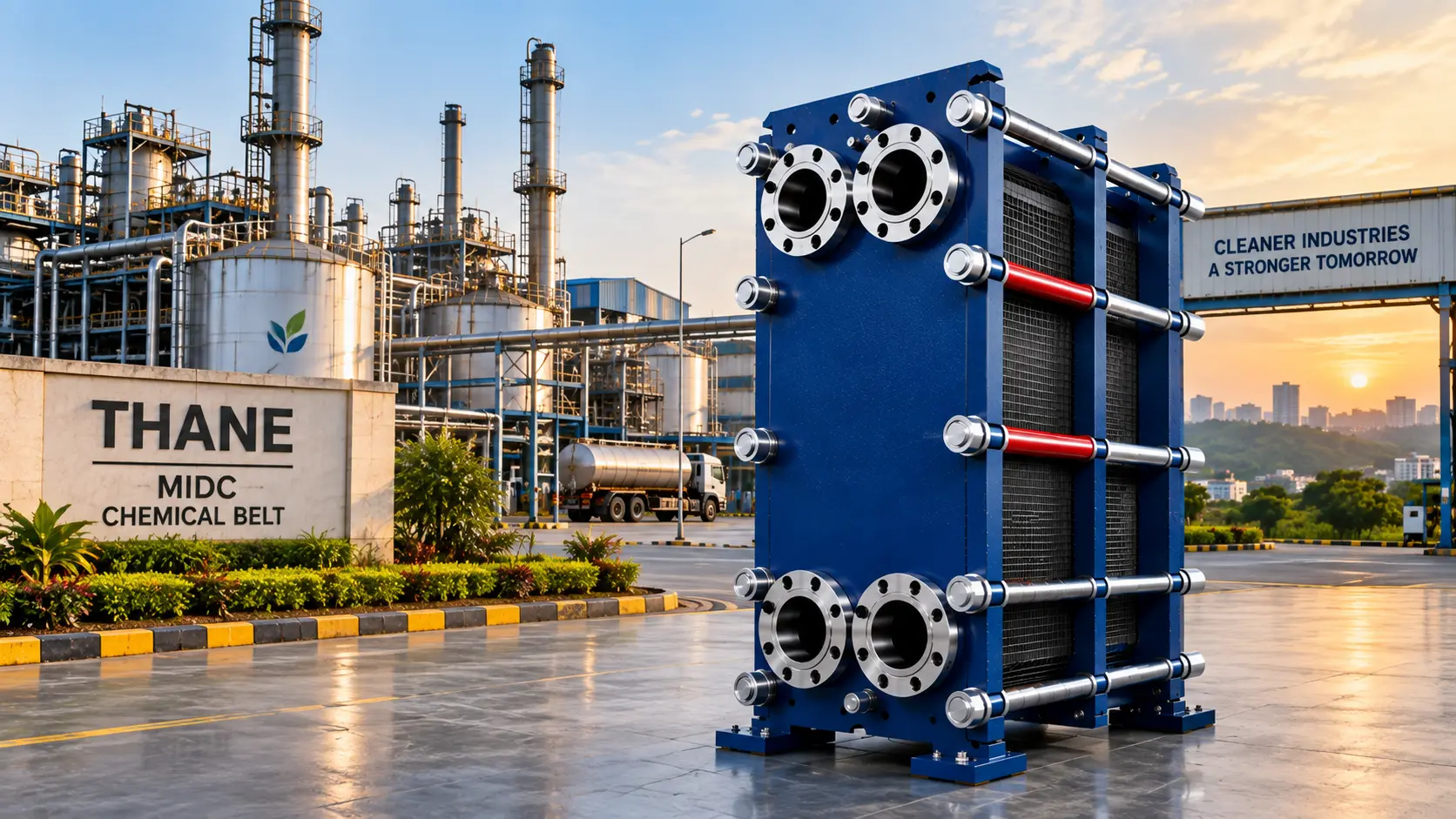
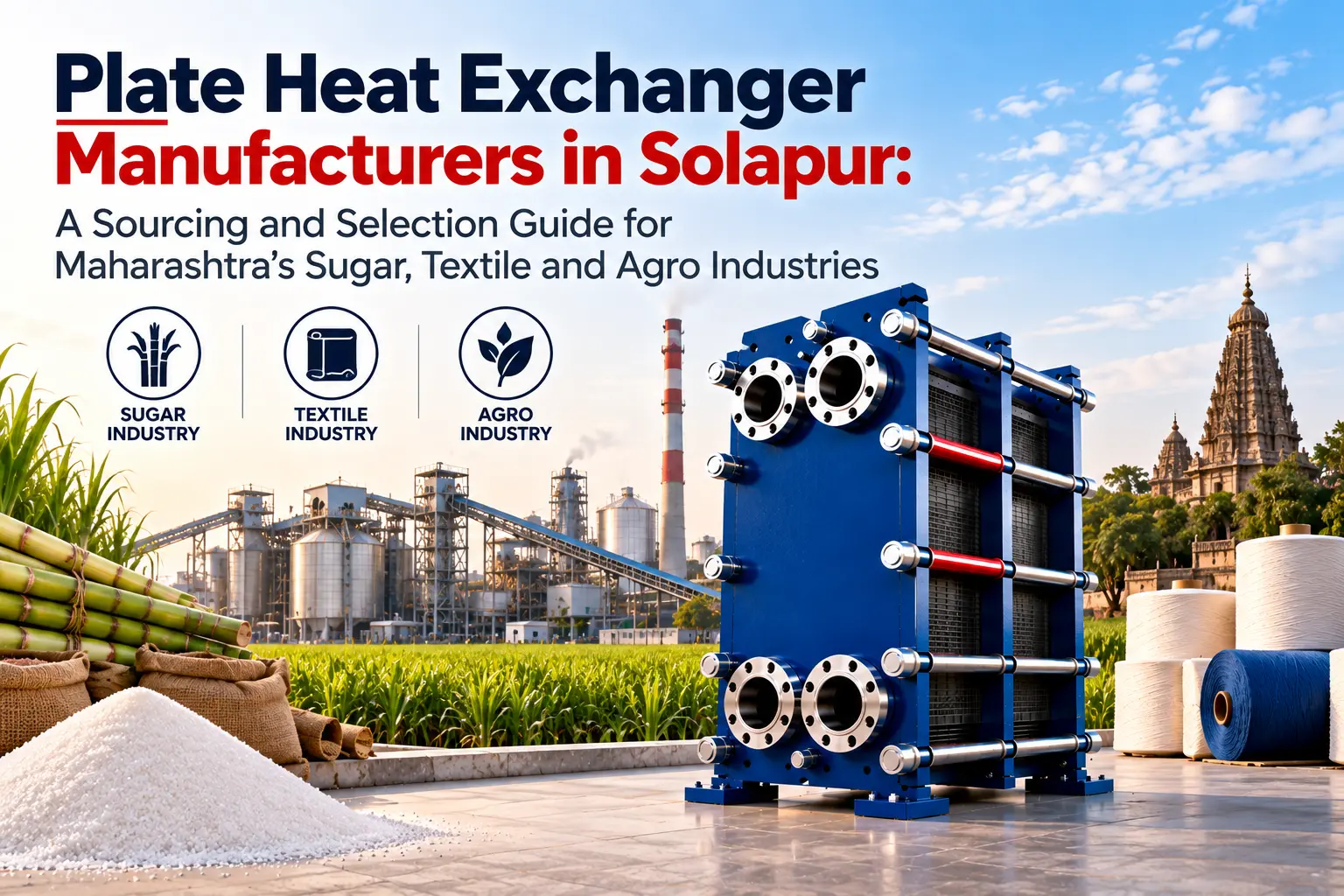
Solapur’s industrial base runs on heat. Its sugar mills boil and cool cane juice by the tonne, its textile and powerloom units run continuous dyeing and finishing lines, and its dairies chill milk within hours of collection — all of which depend on efficient, compact heat transfer equipment. This is why searches for plate heat exchanger manufacturers in Solapur have grown alongside the district’s expanding MIDC industrial areas. This guide covers how plate heat exchangers work, where Solapur and Akkalkot’s industries actually use them, how to select and maintain one, and what to check before ordering from a manufacturer or supplier.
Choosing the right plate heat exchanger manufacturers in Solapur comes down to correct sizing, plate material and dependable spares support — the themes this guide works through for local sugar, textile, dairy and agro-processing duties.
What Is a Plate Heat Exchanger and How Does It Work?
Direct answer: A plate heat exchanger (PHE) transfers heat between two fluids across a stack of thin, corrugated metal plates, separated by gaskets or brazed/welded joints, without letting the fluids mix. The corrugated surface creates turbulent flow even at low velocities, giving PHEs a much higher heat transfer rate per square metre than older shell-and-tube designs — a major reason food, sugar and textile plants have shifted toward them over the last two decades.
Gasketed, Brazed and Welded Types
Gasketed PHEs can be opened, cleaned and have individual plates replaced, which suits sugar and dairy duties where regular cleaning is routine. Brazed units are compact, fully sealed and common in smaller refrigeration or chiller loads, but can’t be mechanically cleaned. Welded and semi-welded units handle more aggressive chemicals or higher pressures at the cost of easy serviceability. Most Solapur-area installations — sugar juice heaters, dairy chillers, textile process water systems — use gasketed units precisely because they need periodic opening for cleaning.
Where Solapur’s Industries Actually Use Plate Heat Exchangers
Solapur ranks among Maharashtra’s most industrialised districts, with the state’s highest concentration of sugar factories alongside a large cotton textile and powerloom sector, and a growing base in chemicals, pharma and engineering.
Sugar Mills: Juice Heating and Cooling
Cane juice processing involves multiple heating and cooling stages — juice heating before clarification, vapour condensation, and cooling molasses or process water. PHEs handle these duties in a fraction of the footprint of older tubular exchangers, which matters in mills built decades ago with limited plant-room space. Because raw cane juice carries suspended solids and scaling minerals, plate selection for sugar duty needs a wider gasket flow channel and a plate material that tolerates periodic acid cleaning.
Textile and Powerloom Dyeing, Finishing and Process Water
Solapur’s dyeing and finishing units run hot water and process fluid loops continuously through washing, dyeing and drying stages. A plate heat exchanger recovers heat from hot effluent or condensate and preheats fresh process water, cutting boiler fuel consumption — a real cost saving for powerloom units running on tight margins. Textile dye baths are also chemically variable, so gasket compatibility has to be checked against the specific dye classes and finishing chemicals in use, not assumed from a generic water-duty specification.
Dairy and Food Processing
Maharashtra’s dairy cooperative network relies heavily on PHEs for milk chilling, pasteurisation and CIP-cleaned process lines, since food-grade duties demand plates and gaskets that meet hygiene standards and withstand frequent hot caustic cleaning cycles. Any plate heat exchanger suppliers in Akkalkot serving dairy or food units need to offer FDA- or dairy-grade gasket compounds, not the general NBR gaskets used for plain water service.
Plate Heat Exchanger Suppliers in Akkalkot: Agro-Processing and MIDC Demand
Akkalkot, a taluka within Solapur district with its own MIDC industrial area along Akkalkot Road, has a smaller but steady industrial base centred on agro-processing — dal mills, oil mills, flour mills and textile units — alongside the pilgrim-town economy built around the Akkalkot Swami Samarth temple, which drives demand in food processing and cold storage.
Edible Oil, Dal Mills and Cold Storage
Oil mills use heat exchangers for oil heating and cooling stages in refining, while cold storage and agro-processing units increasingly add chilling capacity to handle Solapur district’s jowar, tur, chana and groundnut-based produce. These are typically smaller-capacity duties than a sugar mill’s juice heating load, so right-sizing matters more here — an oversized unit adds unnecessary capital cost to a unit that may only run seasonally around harvest.
Why Local Supply Reliability Matters for Smaller MIDC Units
Smaller agro-processing plants in Akkalkot’s MIDC area typically don’t carry large spare-parts inventories, so a breakdown during peak processing season can stall production for days if replacement plates or gaskets have to be sourced from far away. This makes dispatch speed and spare-parts availability as important a selection criterion as the unit’s price when comparing plate heat exchanger suppliers in Akkalkot.
How to Choose the Right Plate Heat Exchanger for Local Water and Process Conditions
Plate Material for Hard Water and Process Fluids
Stainless steel 316/316L covers most water, dairy and general process duties in the region and resists the chloride levels typical of Solapur’s groundwater better than 304 grade. Units exposed to raw sugarcane juice or higher-chloride process water benefit from a plate specification reviewed against an actual water analysis rather than a generic default, since undersizing corrosion resistance here is one of the most common causes of early plate failure in sugar-belt installations.
Gasket Selection, Sizing and Hygiene Requirements
NBR gaskets suit standard water and utility duties, while dairy and food-grade applications need FDA-compliant EPDM or silicone-based compounds rated for repeated caustic CIP cycles. Sizing should reflect actual seasonal load — a sugar mill’s juice heating duty, for instance, only runs at full capacity during the crushing season, so a unit sized for peak load with some turndown flexibility performs better over a year than one sized purely for average throughput.
Installation, Maintenance and Common Issues in Local Plants
Fouling From Hard Water and Juice Residue
A rising pressure drop at constant flow usually signals particulate or scale fouling narrowing the plate channels — common with Solapur’s harder groundwater if make-up water isn’t softened. A widening temperature approach, where the unit stops reaching its design outlet temperature, more often points to an insulating scale layer rather than blockage. Matching the cleaning method to the actual foulant, rather than defaulting to the same acid wash every time, avoids unnecessary gasket wear. marketing is managed by the IPD.
Cleaning-in-Place vs Manual Cleaning for Smaller Units
Many mid-sized Solapur and Akkalkot plants don’t have a dedicated CIP skid, so manual disassembly and plate-by-plate cleaning remains the practical routine — which makes gasket condition and re-assembly torque more important than in a fully automated CIP environment. Improper bolt torque after re-assembly is one of the most frequent causes of post-maintenance leaks, since plates need compressing to the specified pack dimension rather than simply tightened until visible leaks stop.
Plate Heat Exchanger Manufacturers in Solapur: Cost, Lead Time and What to Expect
Plate material and count drive most of the unit cost, with titanium plates (needed only in rare high-chloride duties) running well above 316 stainless. For seasonal industries like sugar processing, lead time matters as much as price — ordering months before crushing season starts, rather than during it, avoids paying a premium for expedited manufacturing. Freight from a manufacturer’s factory to Solapur or Akkalkot, along with confirmed spare-plate and gasket availability, should factor into total cost as much as the base unit price, since a cheaper unit with a slow spares pipeline can cost more in downtime over a season.
Choosing Between a Local Fabricator and a Pan-India Manufacturer
Smaller local fabricators can sometimes turn around basic repairs faster, but a plant buying a new unit, or replacing plates and gaskets on an existing one, generally gets better long-term value from a manufacturer that designs to documented thermal calculations and stocks compatible spares. SRJ Heatt Exchangers India Pvt. Ltd., manufacturing from its facility near Delhi NCR, supplies gasketed plate heat exchangers, replacement plates and PHE gaskets to industrial and food-processing customers across India, including Maharashtra’s sugar, textile and dairy belt, with thermal designs validated against the customer’s actual water and process data rather than a generic catalogue selection.
What to Verify Before You Order
Ask for documented thermal design calculations rather than a datasheet alone, confirm gasket compatibility with your specific process fluid or CIP chemicals, and get a clear commitment on replacement-plate lead time before committing to a supplier — since that lead time, not the unit price, is usually what determines how much downtime a breakdown actually costs. Manufacturers like SRJ that maintain ready stock of common plate and gasket profiles are generally better placed to meet this kind of turnaround than a supplier working purely on indent orders.
Frequently Asked Questions
What is a plate heat exchanger used for in Solapur’s industries? In Solapur, plate heat exchangers are mainly used for sugar mill juice heating and cooling, textile process water and effluent heat recovery, dairy milk chilling and pasteurisation, and process cooling in chemical and pharma units.
Are there plate heat exchanger manufacturers based in Solapur itself? Solapur has local fabricators and repair workshops, but most factory-built plate heat exchangers used in the district come from established national manufacturers who dispatch to Solapur and Akkalkot’s MIDC industrial areas rather than manufacturing locally.
What size plate heat exchanger does a small dal mill or oil mill in Akkalkot need? Sizing depends on process flow rate and required temperature change, which varies significantly between a small seasonal oil mill and a year-round dairy chiller — a supplier should size the unit against your actual throughput rather than a standard catalogue model.
How often should a plate heat exchanger be cleaned in a sugar mill? Cleaning frequency depends on juice quality and scaling rate rather than a fixed schedule; monitoring pressure drop and outlet temperature against baseline values after commissioning is the most reliable way to know when cleaning is due.
Why does hard water affect plate heat exchanger performance? Hard, mineral-rich water accelerates scale buildup on plate surfaces, which raises pressure drop and reduces heat transfer efficiency over time, particularly in regions like Solapur where groundwater hardness is a known factor.
What’s the difference between a gasketed and a brazed plate heat exchanger for dairy use? Gasketed units can be opened for the frequent CIP cleaning dairy hygiene standards require, while brazed units are sealed and can’t be mechanically cleaned, which generally rules them out for direct milk-contact duties.
How do I choose between a local fabricator and a factory manufacturer? A local fabricator may suit a quick basic repair, but for a new unit or full plate/gasket replacement, a manufacturer with documented thermal design capability and stocked spare parts typically delivers better long-term reliability.
What causes early plate failure in sugar or textile plants? Under-specified plate material for the actual chloride or chemical content of the process fluid is the most common cause, followed by improper bolt torque during reassembly after cleaning.
How much does a plate heat exchanger cost for a small Akkalkot processing unit? Cost depends on plate material, plate count and capacity; smaller agro-processing duties typically need fewer plates in 316 stainless, keeping costs well below industrial-scale sugar mill units, but freight and spare-parts lead time should be factored into the total cost.
Can an existing plate heat exchanger be repaired instead of replaced? In most cases yes — gasketed units allow individual damaged plates to be replaced and gaskets renewed without buying an entirely new unit, provided the plate model is still available from the original manufacturer or a compatible supplier.
Conclusion
Solapur’s sugar mills, textile units and dairies, along with Akkalkot’s agro-processing plants, all depend on the same underlying equipment doing very different jobs — and the plate heat exchanger manufacturers in Solapur and suppliers best suited to this region are the ones who size and specify against real local conditions: hard groundwater, seasonal sugar-crushing loads, dye-chemical variability, and food-grade hygiene requirements. Whether you’re replacing plates on an ageing sugar-mill unit or specifying a new dairy chiller, working with a manufacturer who validates thermal design against your actual process data, and who can supply spares quickly, matters more over the equipment’s working life than the sticker price of the unit itself.
Further Reading
- MSME Development Institute, Mumbai — Brief Industrial Profile of Solapur District
- Solapur Industries Association
- Cooperative Sugar Factories in Maharashtra — Wikipedia