
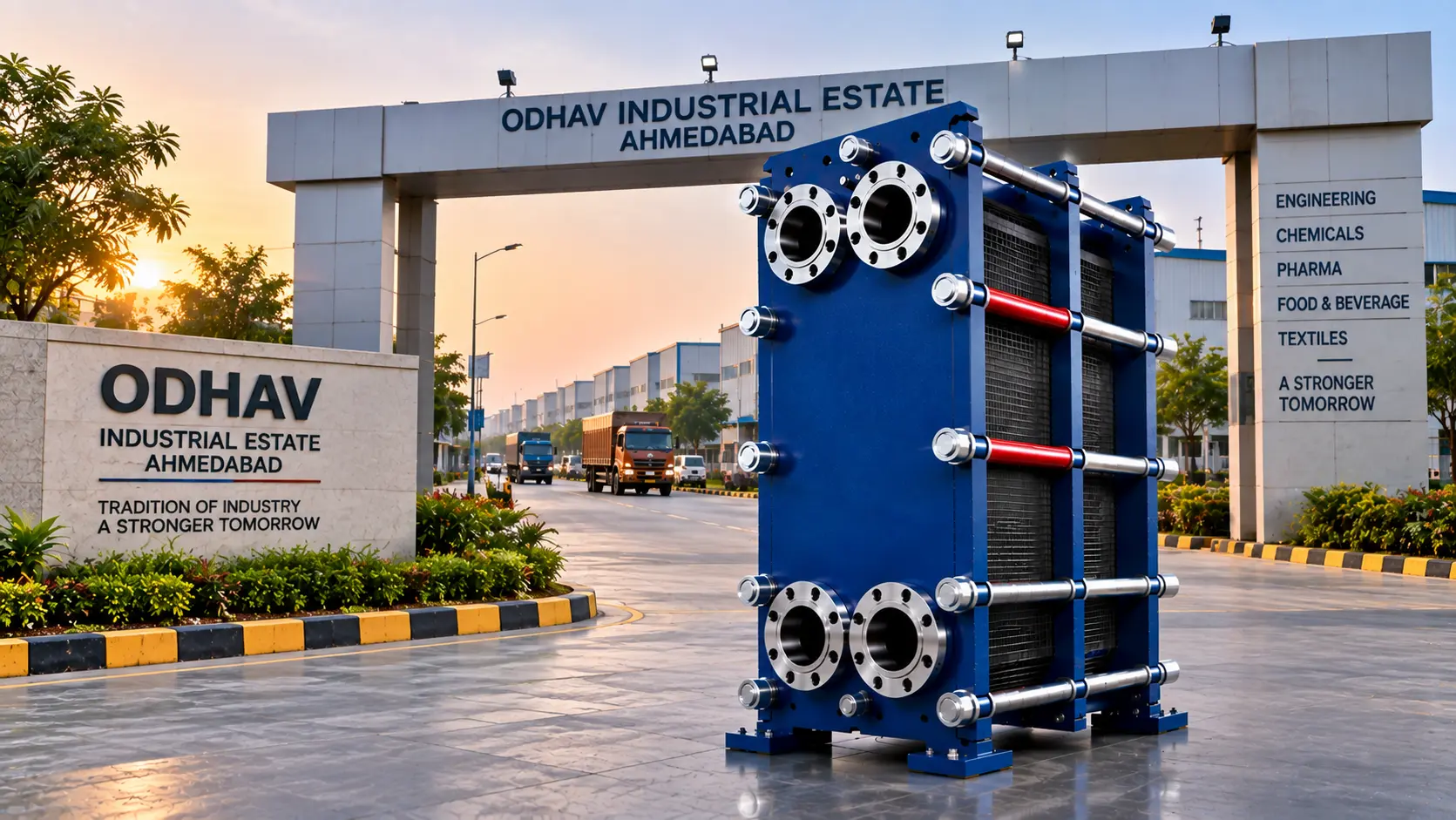
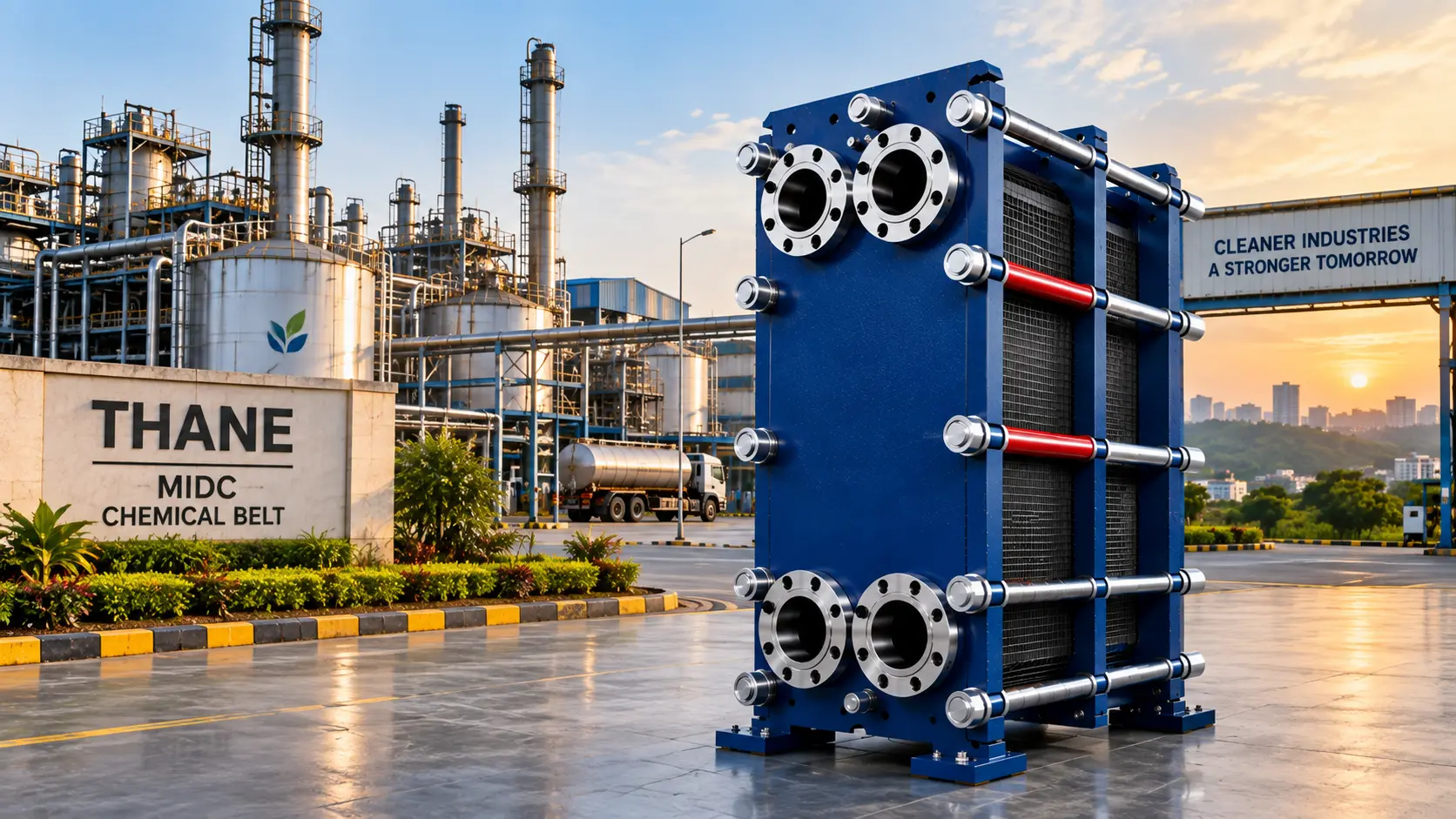
If you’re comparing plate heat exchanger manufacturers in Thane, your plant probably sits somewhere along the Ambernath-Badlapur-Kalyan-Dombivli corridor – one of Maharashtra’s densest stretches of chemical, pharma, and engineering units. This belt runs harder than most industrial zones near Mumbai: batch reactors, API lines, and metal-finishing baths all depend on heat exchangers that survive aggressive, often corrosive process streams. Get the sourcing decision wrong, and a gasket failure mid-batch inside a GMP unit means a scrapped lot, not just a maintenance ticket.
Why Thane’s Industrial Belt Needs a Different Approach
Thane is the third most industrialised district in Maharashtra, home to more than 20,000 manufacturing units across MIDC Ambernath, Additional Ambernath, and the Kulgaon-Badlapur estate – chemical processing, pharma manufacturing, petrochemicals, engineering, and food-processing side by side. Many are RED-category operations under strict MPCB consent, with effluent norms pushing plants toward zero-discharge, closed-loop cooling.
That mix means a heat exchanger here has to survive acids, solvents, and cleaning-in-place cycles without becoming the weak point in the line.
What Plate Heat Exchanger Manufacturers in Thane Actually Supply
A plate heat exchanger transfers heat between two fluids across a stack of thin, corrugated metal plates, keeping the fluids separated while maximising surface area for heat transfer. Compared to shell-and-tube units, PHEs give a much smaller footprint – valuable inside crowded MIDC plots.
Gasketed PHEs for Batch Chemical and Pharma Lines
For batch processes – the norm across Ambernath’s pharma and specialty chemical units – a gasketed plate heat exchanger is usually the right starting point. Plates can be added, removed, or reconfigured as duty changes, and the unit opens for CIP validation without cutting into piping. SRJ’s gasketed plate heat exchangers are built around this flexibility, sized to match batch cycles rather than a fixed catalogue duty.
Welded and Semi-Welded Units for Aggressive Media
Where the fluid is too corrosive or hot for standard elastomer gaskets – common in Ambernath’s specialty chemical units – a semi-welded or fully welded plate heat exchanger removes the gasket from the equation on the aggressive side, while keeping the compact plate-pack advantage over shell-and-tube designs.
PHE Plate Manufacturers in Badlapur: Material Choices That Matter
Badlapur’s Kulgaon-Badlapur MIDC belt leans toward metals, foundries, switchgear, and general engineering alongside its chemical units – so plate material has to handle both chemical exposure and abrasive, particulate-heavy washwater. Standard SS304 suits many utility and water-side duties, but process-side applications touching acids, chlorides, or high-chloride cooling water usually call for SS316 or SS316L, and titanium for the most demanding duties.
Corrugation depth and angle control turbulence, driving both heat-transfer efficiency and pressure drop. Foundries running continuous, high-fouling duties generally do better with a wider-gap corrugation that resists blockage, even at a modest efficiency trade-off – the logic behind SRJ’s wide-gap plate heat exchangers, built for fluids carrying suspended solids or fibrous content.
PHE Gasket Suppliers in Ambernath: Matching Elastomers to Your Process Stream
Gasket material is where avoidable downtime usually originates, and it’s easy to get wrong if a supplier defaults to whatever’s in stock. NBR handles mineral oils and utility water well but degrades against many solvents used across Ambernath’s chemical units. EPDM suits steam, hot water, and mild chemical service; Viton (FKM) is usually necessary for aggressive solvents, aromatic oils, and higher-temperature petrochemical duties.
A gasket rated for the fluid but undersized on temperature margin still fails early – usually through compression set after repeated CIP thermal cycling, not chemical attack. Plants running frequent CIP schedules should track gasket replacement against actual cycle counts, not calendar time; a unit doing three CIP cycles a day burns through gasket life several times faster than one running continuous duty.
Sourcing PHE Plate Suppliers in Thane: Compatibility with What You Already Run
A large share of demand across this belt is for replacement plates and gaskets matching an existing PHE – often supplied years ago by an OEM with no local presence anymore. SRJ manufactures cross-reference-compatible plates and gaskets for major OEM patterns, including SRJAL and APV/SPX style units, sized to the original plate’s port positions. For plants in Ambernath or Badlapur, sourcing locally rather than importing typically cuts lead time from weeks to days.
How to Choose the Right Plate Heat Exchanger Manufacturer in Thane
A few checks are worth running before placing an order, whatever a quote promises:
- Material traceability – mill test certificates, especially for pharma or food-grade duties.
- Pressing capability – confirm the manufacturer presses its own plates rather than trading imported ones.
- CIP and validation support – documentation for pharma CIP validation, not just a datasheet.
- Local service and spares – stock held in Maharashtra matters more than a national distributor’s catalogue during an emergency.
- Thermal design review – a supplier that reviews your actual flow rates and fouling factor, not a standard frame size.
SRJ Heatt Exchangers works through each of these points directly with plants across the Ambernath-Badlapur-Thane belt, sizing plate packs to the specific duty and stocking commonly replaced plates and gaskets for faster turnaround.
Maintenance Considerations Specific to This Region
Thane’s humid, coastal-influenced climate accelerates external corrosion on carbon-steel frames, even when the plate pack itself is stainless. Check bolts and tie-rods twice a year, and recheck fouling factors periodically since hard water is common across the belt. Plants with seasonal production should plan a pre-season CIP and gasket inspection rather than waiting for a failure at peak throughput.
Frequently Asked Questions
What’s a realistic price range for a plate heat exchanger in Thane? Pricing depends on plate material, count, and whether the unit is gasketed, semi-welded, or fully welded – a small SS304 unit and a titanium fully-welded unit can differ by several multiples. A proper quote needs your actual flow and fluid data, not a rough guess.
Should I choose a gasketed or welded PHE for a chemical process? If the fluid suits an elastomer gasket and you want flexibility to reconfigure the plate pack later, gasketed is usually more economical and easier to service. If the fluid is too aggressive or hot for any gasket, semi-welded or fully welded removes that failure point.
How often should PHE gaskets be replaced in a chemical plant? It varies by fluid, temperature, and CIP frequency rather than a fixed calendar interval – tracking actual CIP cycle counts against the gasket’s rated cycle life gives a far more accurate window.
Can I get OEM-compatible replacement plates without importing them? Yes. Cross-reference plates matching common OEM patterns can be manufactured locally in Maharashtra and sized to fit existing frames without modification.
Final Word
For plants across MIDC Ambernath, Badlapur, and the wider Thane belt, the right plate heat exchanger manufacturer in Thane treats your process conditions – not a catalogue size – as the starting point for design. Whether you need a gasketed unit for a pharma batch line, a welded exchanger for an aggressive stream, or OEM-compatible replacement plates for an existing unit, SRJ Heatt Exchangers designs and manufactures against your actual duty data, with local stock and service across the region. Get in touch with your fluid specifications for a sizing review.