
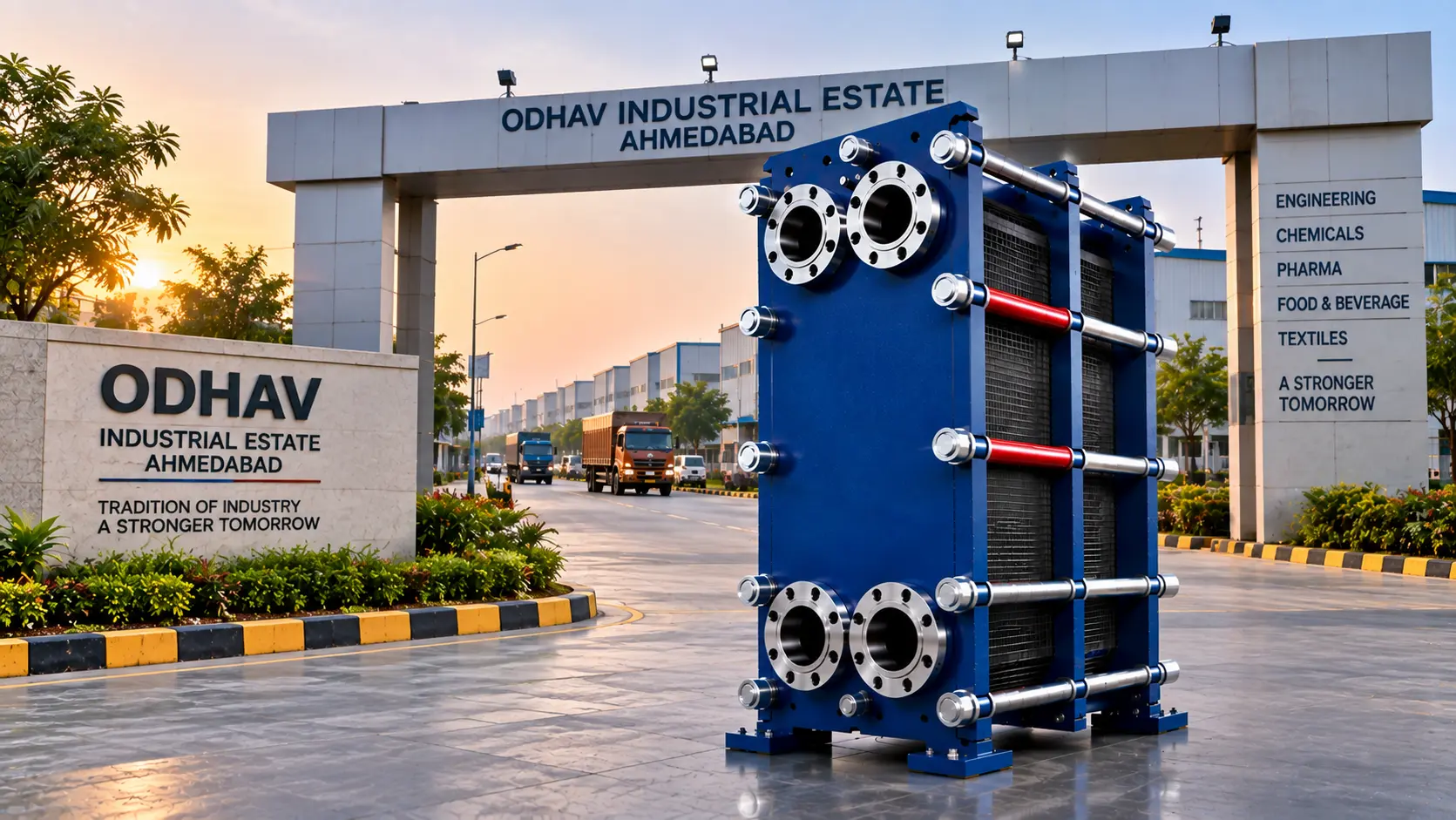
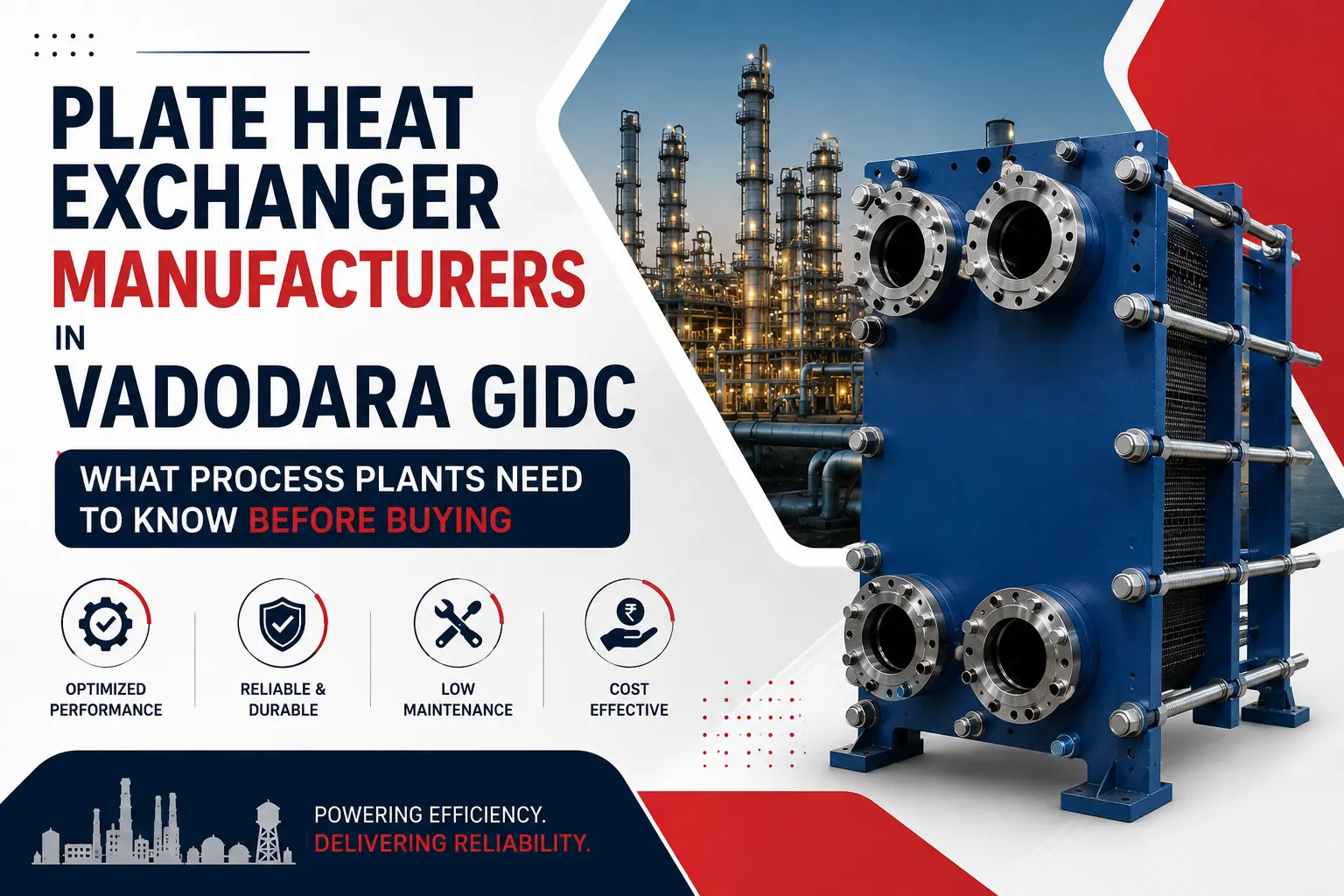
Plate heat exchanger manufacturers in Vadodara GIDC support chemical, petrochemical, pharmaceutical and process industries across Makarpura, Nandesari, Savli and Ranoli with engineered thermal solutions designed for demanding industrial applications. Vadodara is not an ordinary industrial city. It sits at the heart of Gujarat’s chemical and petrochemical corridor, home to giants like GSFC, GACL, and IOCL’s refinery complex, alongside hundreds of mid-sized process units spread across Makarpura, Nandesari, and Savli. That concentration of chemical, pharma, and process manufacturing is exactly why plate heat exchanger manufacturers in Vadodara GIDC see a different kind of demand than a purely textile or engineering cluster would. If you’re sourcing a PHE for a plant anywhere in this belt, the stakes around material selection, chemical compatibility, and service turnaround are noticeably higher than in a generic industrial zone, and this guide covers what actually matters.
Vadodara’s Industrial Character and Why It Shapes PHE Buying
Ask any plant engineer who has worked across Gujarat’s industrial belts, and they’ll tell you Vadodara runs hotter and more corrosive than most. The GIDC estates here host fertiliser plants, chlor-alkali units, petrochemical derivatives, pharmaceutical bulk drug manufacturing, and specialty chemical formulators. Each of these processes pushes fluids through heat exchangers that are far from benign water or mild oils.
This matters enormously for PHE selection because a heat exchanger designed for a textile dyeing unit in Surat and one designed for a chlor-alkali plant in Nandesari have almost nothing in common beyond the basic plate-and-frame architecture. Vadodara buyers need manufacturers who understand chemical process duties specifically, not generalist suppliers who treat every enquiry the same way.
What Is a Plate Heat Exchanger, and Why Does Vadodara Rely on It?
In simple terms, a plate heat exchanger is a stack of thin, corrugated metal plates clamped inside a frame, with two fluids flowing through alternating channels between them. Heat passes through the plate wall from the hotter fluid to the cooler one while the streams stay completely separate. The corrugation pattern creates turbulence, which is what makes a PHE transfer heat far more efficiently, per square metre, than an older shell-and-tube design.
For Vadodara’s process industries, that efficiency translates directly into lower energy bills and a smaller equipment footprint inside crowded plant sheds, both of which matter in a district where floor space and utility costs are under constant scrutiny.
Sourcing From Plate Heat Exchanger Manufacturers in Makarpura
Makarpura’s industrial estate is one of the older, more established zones in Vadodara, with a strong base of engineering, machine tool, and light process manufacturing alongside chemical units. Buyers here often need PHEs for cooling water circuits, hydraulic oil cooling, and process fluid temperature control in batch operations.
The practical guidance for this segment: don’t assume every duty needs an exotic alloy. A large share of Makarpura’s demand is straightforward water-to-water or water-to-oil cooling, where 304 or 316 stainless steel plates with standard NBR or EPDM gaskets handle the job reliably and economically. Where Makarpura buyers go wrong is skipping proper thermal sizing altogether and simply ordering “the same size as last time,” which often leaves capacity on the table or, worse, under-delivers as production scales up.
Ask any credible manufacturer to run your actual flow rates and temperatures through their sizing calculation rather than quoting from memory. It costs nothing extra and prevents a mismatch that shows up only after installation.
How Do You Know If You Need a Bigger PHE Than Last Time?
If your process has added capacity, changed batch sizes, or shifted to a different product mix, your old heat load numbers are probably stale. The honest way to check is to recalculate the required plate area against your current flow rates and target temperatures rather than assuming the existing frame still fits. A five-minute conversation with your supplier’s design team, backed by real numbers, avoids ordering a unit that quietly throttles your production.
Plate Heat Exchanger Suppliers in Nandesari: Handling Aggressive Chemical Media
Nandesari is where PHE sourcing gets genuinely technical. This estate is dense with chlor-alkali, pesticide intermediate, dye, and specialty chemical plants, many of which run fluids that would eat through a standard stainless plate in months. Working with plate heat exchanger suppliers in Nandesari who actually understand corrosive service, rather than defaulting to a catalogue stainless unit, is the difference between a five-year asset and a repeated warranty claim.
For chloride-heavy streams, brine, or acidic process fluids common in this belt, 316 stainless steel often isn’t enough. Titanium, SMO 254, or nickel-based alloys become necessary depending on the exact chemistry. The right approach is never to guess; it’s to share your fluid’s full chemical profile, including concentration, temperature range, and any trace contaminants, and let the manufacturer recommend a material grade backed by real corrosion data, not a sales assumption.
Why Do PHEs Fail Faster in Nandesari-Type Chemical Duties?
The short answer is chloride attack and gasket incompatibility. Chlorides cause pitting and crevice corrosion in stainless steel far faster than most buyers expect, especially at elevated temperatures. Meanwhile, a gasket elastomer that isn’t rated for your specific chemical will swell, harden, or degrade long before the metal plate shows any wear. Both problems are entirely preventable at the specification stage, which is exactly why sharing complete fluid data upfront matters more here than in almost any other application.
Plate Heat Exchanger Manufacturers Serving Savli’s Growing Process Belt
Savli has expanded rapidly as an extension of Vadodara’s industrial base, attracting automotive component makers, pharmaceutical formulators, and process manufacturing units that need reliable thermal utilities without the legacy infrastructure constraints of older estates. This growth brings a slightly different buying pattern: newer plants, cleaner utility water in many cases, but also tighter commissioning timelines where delays in equipment delivery directly delay production start-up.
For Savli buyers, lead time and installation support often matter as much as the unit’s specifications. A manufacturer who can confirm delivery windows honestly, provide commissioning assistance, and stand behind the thermal design during startup troubleshooting is worth more than one offering a marginally lower price with vague delivery promises.
PHE Gaskets: The Component That Decides Whether Your Exchanger Survives
Across every estate in Vadodara, the single most common cause of PHE downtime isn’t the plates or the frame. It’s the gasket. A mismatched or aged gasket leaks long before the metal shows any real degradation, and in a chemical-heavy district like this, gasket selection deserves as much attention as plate metallurgy.
PHE Gasket Manufacturers in Savli: Getting Elastomer Selection Right
Reliable phe gasket manufacturers in savli understand that gasket choice isn’t a one-size-fits-all decision. NBR handles general water and oil duties economically. EPDM tolerates hot water and many chemicals but degrades quickly if exposed to oils. Viton handles higher temperatures and aggressive media but comes at a real cost premium. The mistake many plants make is ordering a “standard” gasket without checking it against their actual fluid and temperature, only to find it hardening and leaking within a year.
When ordering from a Savli-area gasket manufacturer, confirm the elastomer grade, whether the gasket is glued or clip-on, and the manufacturer’s batch-to-batch curing consistency. A clip-on gasket, while sometimes costing a bit more upfront, dramatically cuts labour time during re-gasketing since there’s no adhesive curing wait.
PHE Gasket Suppliers in Ranoli: Building a Reliable Spares Strategy
Ranoli’s industrial pocket includes a mix of chemical and process units that, like their neighbours, cannot afford extended downtime when a gasket fails. Dependable phe gasket suppliers in ranoli are valuable precisely because continuous-process plants need fast resupply, not a multi-week wait for a re-order.
The smart operational move is to maintain a documented buffer stock of gaskets matched exactly to your plate model, with the part number and elastomer grade recorded in a maintenance file. When a leak shows up mid-shift, having the correct gasket already on the shelf turns what could be a production-halting emergency into a routine repair completed within hours.
Matching a PHE to Your Actual Process: The Step Most Buyers Skip
This is the section that separates a well-specified heat exchanger from an expensive mistake, and it’s where most competitor content stays frustratingly generic. Selecting a PHE properly starts with giving your manufacturer complete, accurate process data rather than a rough estimate.
At minimum, share the flow rates of both fluids, their inlet and outlet temperatures, allowable pressure drop, design pressure, and the fouling characteristics of your process stream. A manufacturer who asks for all of this before quoting is doing their job properly; one who quotes without asking is guessing.
Understand the core trade-off in sizing. Chasing a very close temperature approach between your two streams improves thermal efficiency but increases plate count, cost, and pressure drop. Accepting a slightly wider approach saves on plates and pumping energy but sacrifices some efficiency. The right balance depends on your specific energy economics, not a generic industry rule, and a competent manufacturer will walk you through that trade-off rather than just handing you a quote.
Plan for fouling from the outset. Many of Vadodara’s process fluids carry suspended solids, scaling minerals, or biological load depending on the industry. Specifying a realistic fouling margin, and choosing a plate corrugation pattern that maintains turbulence, keeps the unit performing well between cleaning cycles instead of degrading steadily from day one.
Maintenance Practices That Actually Extend PHE Life
A plate heat exchanger is a low-maintenance asset, not a zero-maintenance one, and treating it as fit-and-forget is the fastest way to shorten its working life in a chemical-heavy environment like Vadodara.
Build a simple monitoring habit around two signals: a rising pressure drop across the unit usually points to fouling building up between plates, while a falling outlet temperature or declining thermal performance often signals scaling or internal bypassing. Track these over time and schedule cleaning before performance collapses, not after production is already affected.
When you do open the unit for inspection, check every plate for pitting, cracking, or thinning, and check gaskets for hardening or compression set. Close the frame back to the manufacturer’s specified dimension using a measured closing length, never by feel or a guessed torque value. Over-tightening crushes gaskets prematurely; under-tightening invites leaks almost immediately. Recording that closing dimension directly on the frame saves the next technician from guessing.
Where a plant runs multiple PHE units, standardising plate models and gasket grades across them significantly reduces the spares inventory burden and speeds up emergency repairs.
What Separates a Strong Manufacturer From an Average One
The real test of a plate heat exchanger manufacturer shows up after the sale, not during the quotation stage. Look for genuine thermal design support backed by real calculations, honest material certification with traceable documentation, fast spare parts availability, and a willingness to visit the site when a problem is difficult to diagnose remotely. A supplier who treats a leaking unit as solely your problem, rather than a shared one, isn’t the right long-term partner.
This is precisely where SRJ Heatt Exchangers India Pvt. Ltd. has earned its standing across Gujarat’s industrial belt, including the Vadodara GIDC corridor. As an established plate heat exchanger manufacturer, SRJ combines in-house plate pressing, correctly matched gasket selection, and rigorous thermal sizing with the kind of responsive after-sales support that chemical and process plants in this region genuinely depend on. For units running continuous, high-value processes where downtime carries a real cost, that combination of engineering depth and service reliability makes a measurable difference.
Frequently Asked Questions From Vadodara Plant Buyers
How often should PHE gaskets be replaced? Typically every three to five years, though aggressive chemical duties or high-temperature cycling can shorten that considerably. Monitor actual performance rather than relying purely on a fixed calendar.
Can an existing PHE frame be expanded for higher capacity? Yes, in most cases, as long as the original frame and connection ports were sized with future expansion allowance. Adding plates within that limit is far more economical than buying an entirely new unit.
Is titanium always required for chemical process duties? No. Titanium becomes necessary mainly for high-chloride streams, strong acids, or seawater-adjacent duties. For many process fluids common in Makarpura and Savli, 316 stainless steel performs reliably at a significantly lower cost.
What’s the most common cause of PHE downtime in Vadodara’s chemical units? Gasket failure from chemical incompatibility or incorrect frame torque, far more often than plate corrosion itself. Correct elastomer selection and precise frame closing dimensions prevent most field failures.
Final Thoughts
Choosing among plate heat exchanger manufacturers in Vadodara GIDC comes down to finding a partner who genuinely understands chemical process duties, not just a vendor selling standard frames. Share your real process data, insist on proper material certification, match your gasket elastomer to your actual fluid chemistry, and keep critical spares on hand across Makarpura, Nandesari, Savli, and Ranoli. Do that consistently, and your thermal systems will run reliably for years while the rest of your plant gets the attention it deserves.