
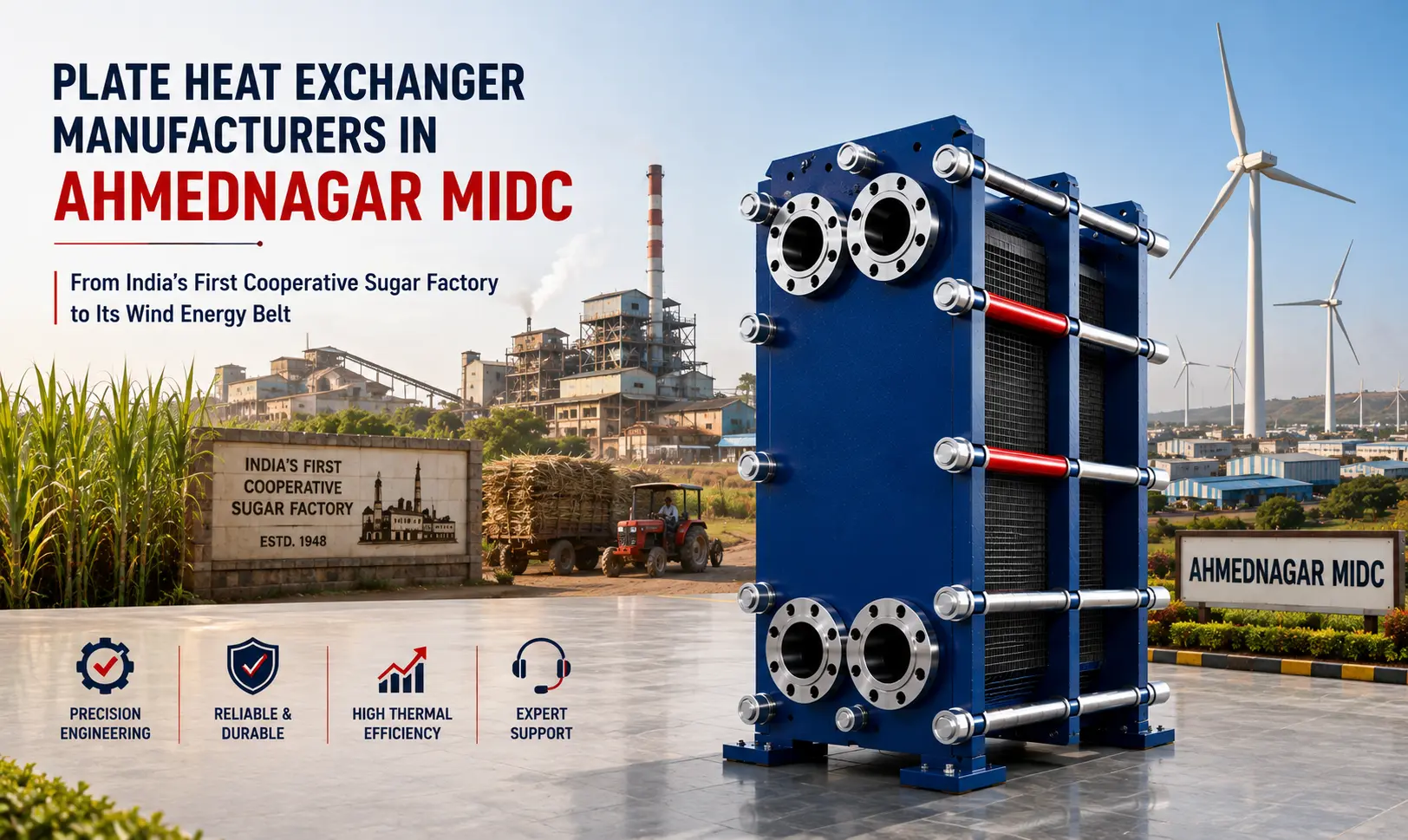
Ahmednagar — officially renamed Ahilyanagar in 2023, though “Ahmednagar” remains in everyday and search use — carries an unusual industrial identity for a single district. It’s where the cooperative sugar movement in Asia began, at Pravaranagar in the late 1940s, and today it produces roughly a tenth of Maharashtra’s sugar exports from around two dozen sugar factories. It’s also home to Supa, one of the state’s more prominent wind-energy clusters, alongside a growing base of auto-component, pharma, and general engineering manufacturing. That combination means sourcing plate heat exchanger manufacturers in Ahmednagar MIDC covers genuinely different ground depending on whether you’re asking about a sugar mill, a wind-belt manufacturing unit, or a general engineering workshop.
Why Sugar Processing Still Shapes PHE Demand Here
Sugar milling runs on a chain of heat transfer stages — juice heating before clarification, evaporation to concentrate the juice, and condensate recovery through the process — and cooperative sugar factories across this district have relied on this equipment for decades. Molasses byproduct feeding into distillery operations adds another heat transfer stage downstream. These duties run hot, continuous, and often at higher pressure than general industrial cooling, which means gasket compounds need to handle sustained steam and hot-juice exposure without degrading on a compressed seasonal timeline — sugar mills run intensely during the crushing season and need equipment that starts up reliably after months of downtime, not gaskets that have hardened or perished while idle.
Plate Heat Exchanger Manufacturers in Ahmednagar
Ahmednagar’s own MIDC base runs a genuine mix — general engineering, pharmaceutical manufacturing, and auto-component units alongside the sugar-adjacent demand described above. A plate heat exchanger manufacturer in Ahmednagar needs to be equally comfortable quoting a steam-rated unit for sugar-mill duty and a straightforward SS304 water-cooling unit for a general engineering workshop, and should be asking which one applies before sending a quote rather than defaulting to a single standard spec across every inquiry from the district.
Plate Heat Exchanger Suppliers in Supa
Supa, in Parner taluka, has grown into an MIDC industrial hub sitting right alongside one of Maharashtra’s more established wind-energy belts, with dozens of turbines spread across the surrounding hills. The estate itself hosts auto-component manufacturing, pharmaceutical production, and metal-treatment and battery-manufacturing units — a genuinely varied industrial base for its size. A plate heat exchanger supplier in Supa needs the flexibility to serve that range: conventional process cooling for general manufacturing on one order, and potentially more specialized oil-cooling duty tied to power-generation and battery-manufacturing processes on the next, without treating every inquiry as identical.
PHE Gasket Manufacturers in Shrirampur
Shrirampur is home to one of the district’s established sugar factories, and gasket demand here reflects sugar-milling duty specifically — steam exposure, hot juice, and molasses handling call for EPDM or an equally heat-resistant compound, not a general-purpose NBR gasket that degrades under sustained steam contact. The broader Shrirampur-Rahata belt’s significant onion cultivation and trade adds a second, entirely different demand: onion dehydration and processing equipment needs food-grade gasket chemistry suited to a completely different fluid and temperature profile than sugar-mill steam duty. An experienced PHE gasket manufacturer in Shrirampur should be asking which of these two duties your plant runs before quoting a compound.
PHE Gasket Suppliers in Nagar
Ahmednagar city’s own industrial base — general engineering, pharmaceutical, and auto-component manufacturing — runs more conventional PHE duty than the sugar-mill and wind-belt applications described above. For a PHE gasket supplier in Nagar, the differentiator is less about exotic engineering and more about stocking common compounds and confirming compatibility quickly, since most local units run standard water or mild-process cooling rather than the specialized steam or oil duty found elsewhere in the district.
Getting Plate Material and Gasket Compound Right
Sugar-mill duty across Ahmednagar and Shrirampur generally needs SS304 or SS316 plates depending on juice chemistry, paired with EPDM or other steam-rated gaskets — and for continuous, high-pressure evaporation stages, a welded plate heat exchanger construction often holds up better than a standard gasketed unit. Supa’s mixed manufacturing base is usually fine on SS304 for general cooling, moving to SS316 wherever battery-manufacturing or metal-treatment chemistry is involved. Whatever the duty, ask for material test certificates and pressure test documentation before accepting a quote — manufacturers working within ISO 9001 quality frameworks, and referencing thermal design practices from bodies like ASHRAE, give you something documented to rely on rather than a verbal promise. Indian material and pressure equipment standards from the Bureau of Indian Standards are worth checking any documentation against, and the MIDC official portal remains the authoritative reference for confirming an estate’s status anywhere in the district.
Maintenance Across Very Different Seasonal and Duty Patterns
Sugar-mill PHEs face a maintenance challenge most industrial equipment doesn’t: long idle periods between crushing seasons, during which gaskets can dry out or harden if not stored or maintained correctly. A pre-season inspection before startup matters as much as routine mid-season checks here. In Supa’s general manufacturing base, a gradually rising pressure drop at constant flow rate remains the standard early warning sign of fouling, with a visual check every 3–6 months and a full teardown every 12–18 months a reasonable baseline. External leaks trace back to gasket seating or uneven bolt torque far more often than to the plates themselves, regardless of duty.
What a Fair Quote Should Include
Plate material, gasket compound, heat transfer area, and frame/connection size should appear as separate line items on any quote. Sugar-mill and onion-processing duty in particular should have gasket compound broken out clearly, since a steam-rated EPDM gasket costs meaningfully more than general-purpose NBR and that difference should be visible, not buried. SRJ Heatt Exchangers India Pvt. Ltd. builds its quoting approach around this range of duty — sizing plate and gasket selection differently for sugar-mill steam service in Shrirampur, mixed manufacturing in Supa, or general engineering in Ahmednagar and Nagar, with replacement parts stocked so buyers across the district aren’t left waiting weeks for a routine part, especially with a crushing season deadline on the calendar.
Conclusion
Ahmednagar’s dual identity — birthplace of India’s cooperative sugar movement and home to one of Maharashtra’s established wind-energy belts — means plate heat exchanger manufacturers in Ahmednagar MIDC need to cover genuinely different duty across sugar milling in Shrirampur, mixed manufacturing in Supa, and general engineering in the district’s core. Match plate material and gasket compound to the actual process, plan maintenance around seasonal shutdowns where relevant, and equipment performance stops being unpredictable.
FAQs
Why do sugar mills need a different gasket than general industrial cooling? Sugar milling runs on sustained steam and hot-juice exposure, which degrades general-purpose NBR gaskets quickly — EPDM or another steam-rated compound is the safer standard.
Does seasonal shutdown affect plate heat exchanger maintenance in sugar mills? Yes — gaskets can dry out or harden during the off-season between crushing periods, so a pre-season inspection before startup is as important as routine mid-season checks.
What makes Supa’s sourcing needs different from a typical MIDC estate? Supa combines general manufacturing with proximity to a major wind-energy belt and battery/metal-treatment production, which can call for both conventional and more specialized cooling duty within the same estate.
Should I choose SS304 or SS316 plates? SS304 for general water duty in Ahmednagar and Nagar; SS316 wherever sugar-juice chemistry, battery manufacturing, or metal-treatment processes are involved.
Is Ahmednagar still the right name to search for this district? The district was officially renamed Ahilyanagar, though “Ahmednagar” remains in wide everyday and search use, including for its MIDC estates.
What should I ask for before accepting a quote? Material test certificates, pressure test documentation, and a line-item breakdown covering plate material, gasket compound, frame, and freight.