

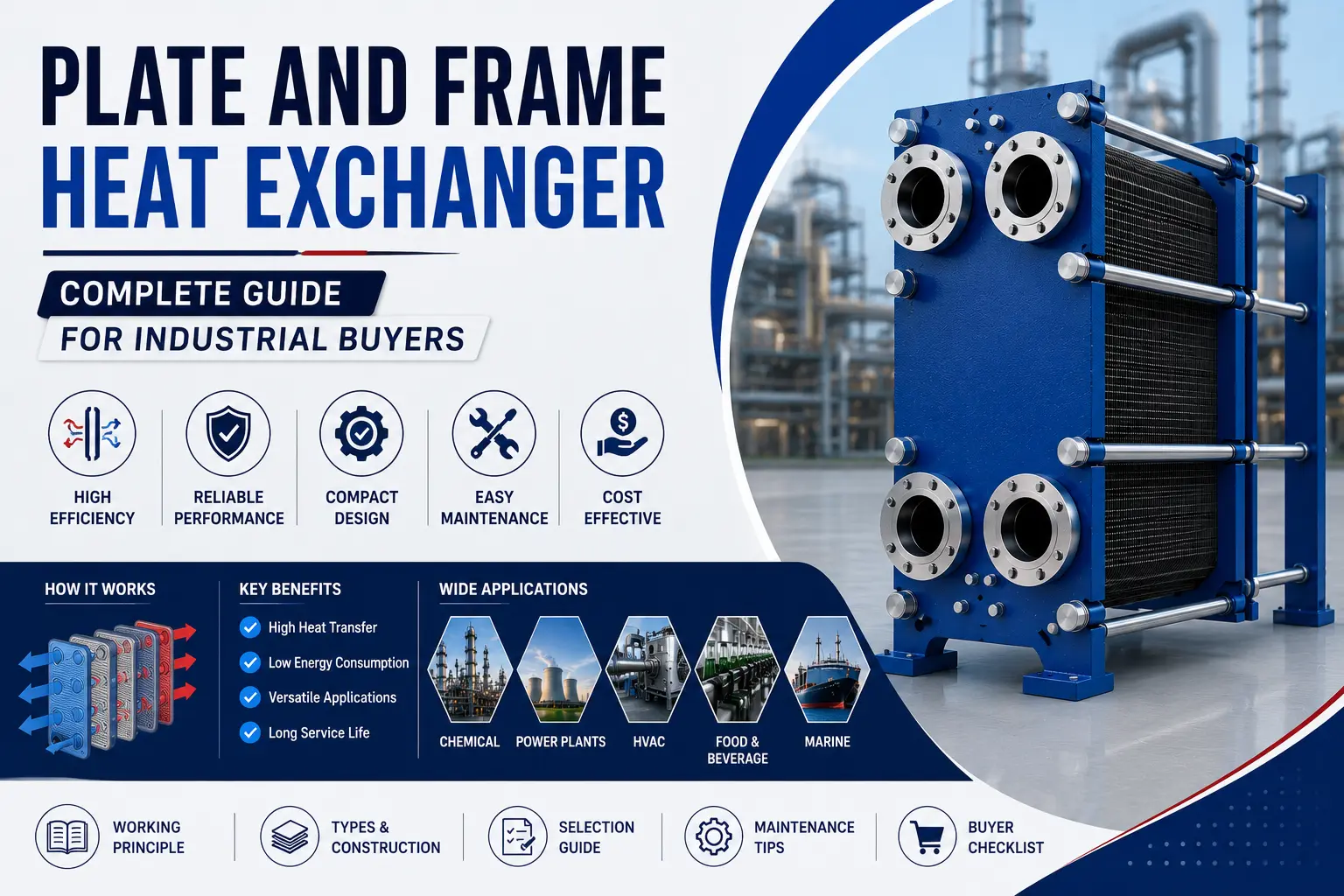
If you work in a chemical plant, a power station, a food processing unit, or an HVAC facility, you have likely heard of a plate and frame heat exchanger. It is one of the most efficient and compact devices for transferring heat between two fluids. But what exactly is it? How does it work? And why should you choose one over a shell-and-tube design?
This article answers all those questions. We explain the basics, the working principle, the types of heat transfer, and the key performance parameters like NTU and LMTD. We also cover practical buying information for PHE plate heat exchanger users in India. Whether you are a plant engineer, a procurement manager, or a student, this guide is for you.
What is a Plate and Frame Heat Exchanger?
A plate and frame heat exchanger is a type of heat exchanger that uses a series of thin, corrugated metal plates stacked together and clamped within a frame. The plates create alternating channels for two fluids. One fluid flows through the odd-numbered channels. The other fluid flows through the even-numbered channels. Heat transfers from the hot fluid to the cold fluid through the plate walls.
The plates are held together by tightening bolts on a frame. Gaskets seal the channels and direct the fluids. This design allows you to add or remove plates easily, which changes the heat transfer area. You can also disassemble the entire unit for cleaning and maintenance.
Compared to traditional shell-and-tube heat exchangers, a plate and frame heat exchanger offers a much larger surface area in a smaller footprint. The corrugated plate pattern creates turbulence even at low flow speeds, which improves heat transfer efficiency. This is why PHE plate heat exchanger technology has become the preferred choice for thousands of industrial applications worldwide.
What is the Purpose of a Plate Heat Exchanger?
The purpose of a plate heat exchanger is to transfer thermal energy from one fluid to another without allowing the fluids to mix. The plates act as a physical barrier. The heat passes through the metal, but the fluids stay separate.
Industries use plate heat exchangers for many duties. Heating cold water with hot steam. Cooling hot oil with cooling water. Condensing refrigerant vapors in a chiller. Evaporating a liquid to concentrate a product. Recovering waste heat from an exhaust stream to preheat incoming feed.
Without plate heat exchangers, most industrial processes would be inefficient. You would need larger equipment, more energy, and longer processing times. By transferring heat effectively, these devices save fuel, reduce emissions, and lower operating costs.
In simple terms, the purpose is to move heat from where you have too much to where you need it – as efficiently as possible.
How Does a Plate and Frame Heat Exchanger Work?
The working principle is straightforward. Hot fluid enters through one port and flows into alternate channels between the plates. Cold fluid enters through another port and flows into the remaining channels. The fluids travel in opposite directions – counterflow – which maximizes the temperature difference along the entire length of the plates.
The corrugated plate pattern creates a turbulent flow. Turbulence breaks up the boundary layer that normally resists heat transfer. This gives a much higher heat transfer coefficient compared to smooth tubes. Some plate designs also create a rotational flow on the plate surface, which shortens the residence time of the liquid and reduces fouling.
The gaskets around the edges of each plate seal the channels. They also direct the fluid from the port into the correct channels. By changing the gasket arrangement, you can achieve different flow patterns – single-pass, two-pass, or multi-pass. Multi-pass designs increase the fluid velocity for better heat transfer but also increase pressure drop.
If you need to handle aggressive fluids or high pressures, manufacturers offer semi-welded and fully welded plate heat exchangers. In semi-welded units, one side is laser-welded to eliminate gasket leakage risk. In fully welded units, there are no gaskets at all.
What are the 4 Types of Heat Transfer?
Before you select a plate and frame heat exchanger, it helps to understand the four fundamental modes of heat transfer. These principles govern how heat moves from one fluid to another.
Conduction
Conduction is the transfer of heat through a solid material. In a plate heat exchanger, heat travels through the metal plate from the hot fluid on one side to the cold fluid on the other side. The thermal conductivity of the plate material determines how easily heat passes through. Stainless steel has lower conductivity than copper, but it is stronger and more corrosion-resistant.
Convection
Convection is the transfer of heat between a solid surface and a moving fluid. In a plate heat exchanger, convection happens twice. First, heat transfers from the hot fluid to the plate surface. Then, heat transfers from the opposite plate surface to the cold fluid. The corrugations on the plates enhance convection by creating turbulence.
Radiation
Radiation is the transfer of heat through electromagnetic waves. In most industrial plate heat exchangers operating below 400 degrees Celsius, radiation is negligible. However, in very high temperature applications like furnace heat recovery, radiation becomes significant.
Phase Change (Latent Heat Transfer)
Phase change occurs when a fluid evaporates or condenses. During evaporation, the fluid absorbs a large amount of heat without changing temperature. During condensation, it releases that same amount of heat. Plate heat exchangers are excellent for evaporators and condensers because the plates provide a large surface area for phase change. For example, a PHE plate heat exchanger used as a refrigerant evaporator in a chiller can achieve very high heat transfer coefficients.
Understanding these four types helps you specify the right plate and frame heat exchanger for your application. For single-phase liquid-to-liquid duty, conduction and convection dominate. For two-phase duty, phase change is the key mechanism.
What is NTU and LMTD in Heat Exchanger Design?
When engineers design a plate and frame heat exchanger, they use two important concepts: LMTD and NTU. You do not need to become an expert, but understanding the basics helps you communicate with suppliers.
LMTD – Log Mean Temperature Difference
LMTD stands for Log Mean Temperature Difference. It represents the average temperature difference between the hot and cold fluids along the entire length of the heat exchanger. In a counterflow plate and frame heat exchanger, the hot fluid cools down gradually while the cold fluid heats up gradually. The temperature difference is not constant. LMTD gives a single value that accounts for this changing difference.
The formula for LMTD in counterflow is:
LMTD = (Delta T1 – Delta T2) / ln(Delta T1 / Delta T2)
Where Delta T1 is the temperature difference at one end and Delta T2 is the temperature difference at the other end.
A higher LMTD means a larger driving force for heat transfer. For the same duty, a higher LMTD allows you to use fewer plates. However, you cannot arbitrarily increase LMTD because it is determined by your process inlet and outlet temperatures.
NTU – Number of Transfer Units
NTU stands for Number of Transfer Units. It is a dimensionless parameter that indicates the size of the heat exchanger relative to the heat transfer required. NTU is calculated as:
NTU = (U x A) / (m_dot x Cp)_min
Where U is the overall heat transfer coefficient, A is the heat transfer area, m_dot is the mass flow rate, and Cp is the specific heat capacity.
A higher NTU means a larger heat exchanger or better heat transfer performance. For a given set of fluids, you can increase NTU by adding more plates (increasing A) or by choosing a plate design with higher U.
In practice, engineers use LMTD and NTU together. The basic heat transfer equation is:
Q = U x A x LMTD x Correction Factor
For counterflow plate and frame heat exchangers, the correction factor is usually close to 1. For crossflow or mixed flow arrangements, it is lower.
If you ask a Plate Heat Exchanger manufacturer in India for a quote, they will calculate these values for you. You only need to provide your fluid properties, flow rates, and desired temperatures.
Types of Plate and Frame Heat Exchangers
Not all plate heat exchangers are the same. Here are the main types available in the market.
Gasketed Plate and Frame Heat Exchanger
This is the most common type. Plates are sealed with elastomeric gaskets. The frame has fixed and movable covers. Tightening bolts compress the plate pack. Gasketed units are easy to open for cleaning and plate replacement. They are suitable for pressures up to 15 bar and temperatures up to 180 degrees Celsius depending on the gasket material.
Semi-Welded Plate Heat Exchanger
In a semi-welded unit, pairs of plates are laser-welded together along the edges. The welded pairs are then assembled with gaskets between them. This design is used when one fluid is aggressive or hazardous. The welded side has no gaskets, so there is no leakage risk. The other side remains gasketed for easy maintenance. Semi-welded units handle higher pressures than fully gasketed designs.
Brazed Plate Heat Exchanger
Brazed plate heat exchangers have no frame and no gaskets. The plates are vacuum-brazed together using copper or nickel. They are extremely compact and low-cost. However, they cannot be opened for cleaning. They are ideal for clean fluids like water, oil, or refrigerant in HVAC and refrigeration applications. Brazed units are also called PHE plate heat exchanger in many catalogs, but they are actually a specific subset.
Fully Welded Plate Heat Exchanger
In a fully welded design, the entire plate pack is welded together and then inserted into a pressure vessel. There are no gaskets at all. These units handle the highest pressures and temperatures – up to 400 degrees Celsius and 40 bar or more. They are used in petrochemical plants, refineries, and high-pressure process heating.
Wide Gap Plate Heat Exchanger
Wide gap units have larger gaps between plates. They are designed for fibrous fluids, slurries, and liquids containing coarse particles. The smooth port design prevents fibers from snagging. Wide gap units are used in sugar mills, distilleries, pulp and paper plants, and wastewater treatment.
Spiral Heat Exchanger
Although not a plate type, spiral heat exchangers are often compared to plate units. They use coiled metal sheets to form a single channel. The spiral design is self-cleaning. Hinged covers allow easy access. Spiral units excel with sludges, slurries, and high-viscosity liquids.
Finned Tube Heat Exchanger vs Plate and Frame
You may also consider a finned tube heat exchanger for some applications. How do they compare?
A finned tube heat exchanger uses tubes with extended surfaces (fins) to increase the heat transfer area. Air or gas typically flows across the finned side, while a liquid flows inside the tubes. Finned tube units are common for air coolers, radiators, and gas-to-liquid duties.
Plate and frame heat exchangers are generally more efficient for liquid-to-liquid duties. They have higher heat transfer coefficients and smaller footprints. However, finned tube heat exchangers are better when one fluid is air or a gas because plates are not effective for gases.
For liquid-to-gas or gas-to-gas applications, choose a finned tube heat exchanger. For liquid-to-liquid applications, choose a plate and frame heat exchanger. Some hybrid designs exist, but that is the general rule.
Plate Heat Exchanger Fittings – What You Need to Know
When you purchase a plate and frame heat exchanger, the fittings are the connection points where pipes attach to the unit. Fittings include the inlet and outlet nozzles on the fixed and movable covers. They may also include drain ports, vent ports, and instrument connections.
Standard fittings are usually flanged (ANSI, DIN, or BS) or threaded (NPT, BSP). The fitting size and type must match your existing piping. Most Plate Heat Exchanger manufacturers in India offer custom nozzle positions and sizes at an additional cost.
The material of the fittings should match the plate material to avoid galvanic corrosion. Stainless steel 304 and 316 are common. For aggressive service, fittings may be lined with PTFE or made from Hastelloy.
Gasket fittings are a separate category. These are the grooves on the plates that hold the gaskets. The groove design is critical for a leak-free seal. Always use genuine gaskets from the same manufacturer who made the plates. Aftermarket gaskets often have incorrect profiles and fail quickly.
Plate Heat Exchanger Price – What Determines Cost
If you are searching for plate heat exchanger price information, you will quickly learn that prices vary widely. A small brazed unit for a residential HVAC system may cost a few thousand rupees. A large gasketed unit for a chemical plant may cost several lakhs. A fully welded titanium unit for a desalination plant may cost crores.
The main factors that affect plate heat exchanger price are:
Plate Material
Stainless steel 304 is the cheapest. Stainless steel 316 is slightly more expensive. Titanium is significantly more expensive. Hastelloy and SMO 254 are the most expensive. The material must resist corrosion from your fluids.
Plate Count
More plates mean more heat transfer area and higher cost. However, adding plates also increases pressure drop. The optimal plate count balances capital cost against pumping cost.
Frame Size
Larger frames with heavier materials cost more. Frames for high pressure applications are thicker and more expensive.
Gasket Material
EPDM is the least expensive. NBR is moderate. Viton and PTFE-coated gaskets are the most expensive. The correct gasket material depends on your fluid chemistry.
Customization
Standard units with off-the-shelf plates are cheaper. Custom units with special plate patterns, nozzle positions, or high-alloy materials cost more.
Quantity
Single unit prices are higher per unit. Bulk orders for multiple identical units get volume discounts.
Brand
Global brands command premium prices. Local manufacturers in India offer lower prices. SRJ offers manufacturer-direct pricing without distributor markup.
To get an accurate plate heat exchanger price for your application, you need to provide detailed specifications. Do not rely on generic online quotes. Contact a manufacturer directly.
How to Choose a Plate Heat Exchanger Manufacturer in India
India has many plate heat exchanger manufacturers. Some are large, established companies. Others are small workshops. Here is what to look for.
Manufacturing Capability
Does the manufacturer press their own plates or buy from elsewhere? In-house plate pressing ensures quality control. Ask about their ISO certification.
Product Range
Do they offer only gasketed units, or do they also offer semi-welded, fully welded, spiral, and wide gap? A wider range indicates deeper engineering capability.
Material Options
Can they supply titanium, Hastelloy, or super duplex? Many manufacturers only work with stainless steel. If you need high-alloy materials, check first.
Gasket Quality
Do they manufacture their own gaskets or source from third parties? Genuine manufacturer gaskets are always better. Ask for material test certificates.
Spare Parts Availability
What is their policy on spare plates and gaskets? A good manufacturer stocks spares for at least ten years. Avoid suppliers who discontinue models quickly.
Reference Installations
Ask for a list of customers in your industry. Call those references. Ask about reliability, support, and lead times.
If you search for a Plate Heat Exchanger manufacturer in India, you will find many options. Do your homework. A cheaper upfront price often leads to higher long-term costs.
Common Applications of Plate and Frame Heat Exchangers
Chemical Processing
Heating and cooling corrosive chemicals. Condensing solvents. Recovering waste heat from reactor jackets.
HVAC and District Cooling
Chilled water systems. Condenser water heat rejection. Heat recovery from exhaust air.
Food and Beverage
Pasteurization of milk and juice. Cooling of beer and wine. Heating of edible oils.
Pharmaceuticals
Heating purified water. Cooling fermentation vessels. Solvent recovery.
Power Generation
Lube oil cooling. Generator cooling. Heat recovery from flue gases.
Desalination
Brine preheating. Distillate cooling. Heat recovery in multi-effect distillation.
Pulp and Paper
Black liquor heating. White water cooling. Tall oil recovery.
Sugar and Distilleries
Juice heating. Spent wash cooling. Molasses heating.
In each application, the plate and frame heat exchanger provides efficient, compact, and maintainable heat transfer.
Frequently Asked Questions
Question 1 – What is the difference between a plate heat exchanger and a shell-and-tube heat exchanger?
A plate heat exchanger uses stacked plates, while a shell-and-tube unit uses tubes inside a shell. Plate units have higher heat transfer coefficients, smaller footprints, and easier maintenance. Shell-and-tube units handle higher pressures and are more tolerant of fouling.
Question 2 – Can I use a plate heat exchanger for steam?
Yes, but with caution. Steam condensing in a plate heat exchanger is very efficient. However, the steam side must be properly designed to avoid water hammer and pressure pulsations. Use a gasketed or brazed unit rated for steam pressure.
Question 3 – How do I clean a plate and frame heat exchanger?
For gasketed units, open the frame, remove the plates, and clean them individually. Use a pressure washer (below 50 bar) or a soft brush. For chemical cleaning, circulate a cleaning solution through the unit without disassembling. For brazed units, chemical cleaning is the only option.
Question 4 – What is the typical lifespan of a plate heat exchanger?
With clean fluids and proper maintenance, a gasketed unit lasts 15 to 20 years. Plates may need replacement after 10 years if corrosion occurs. Gaskets last 3 to 5 years depending on temperature and chemical exposure.
Question 5 – How do I calculate the number of plates I need?
You do not need to calculate it yourself. Provide your duty conditions to a manufacturer. They will use software to calculate the required plate count based on LMTD, NTU, and pressure drop constraints.
Question 6 – What is the maximum pressure for a gasketed plate heat exchanger?
Typically 15 to 20 bar. For higher pressures, use semi-welded or fully welded units. Always check the nameplate rating.
Question 7 – What is the difference between counterflow and parallel flow?
In counterflow, the fluids travel in opposite directions. This gives the highest LMTD and best performance. In parallel flow, they travel in the same direction. Parallel flow is rarely used because the temperature difference drops quickly.
Conclusion
A plate and frame heat exchanger is an essential piece of equipment for modern industry. It transfers heat efficiently, saves space, and allows easy maintenance. Understanding the basics – what it is, its purpose, the four types of heat transfer, and the concepts of NTU and LMTD – helps you make better purchasing decisions.
Whether you need a PHE plate heat exchanger for a small HVAC system or a large chemical plant, choose a reliable manufacturer. Consider the plate material, gasket quality, and spare parts availability. Do not focus only on the lowest plate heat exchanger price. Look at total cost of ownership.
For finned tube heat exchanger applications, remember that plate units are better for liquid-to-liquid duty. For plate heat exchanger fittings, always match materials and use genuine gaskets.
This guide covers everything you need to know. Use it to specify your next heat exchanger with confidence.