
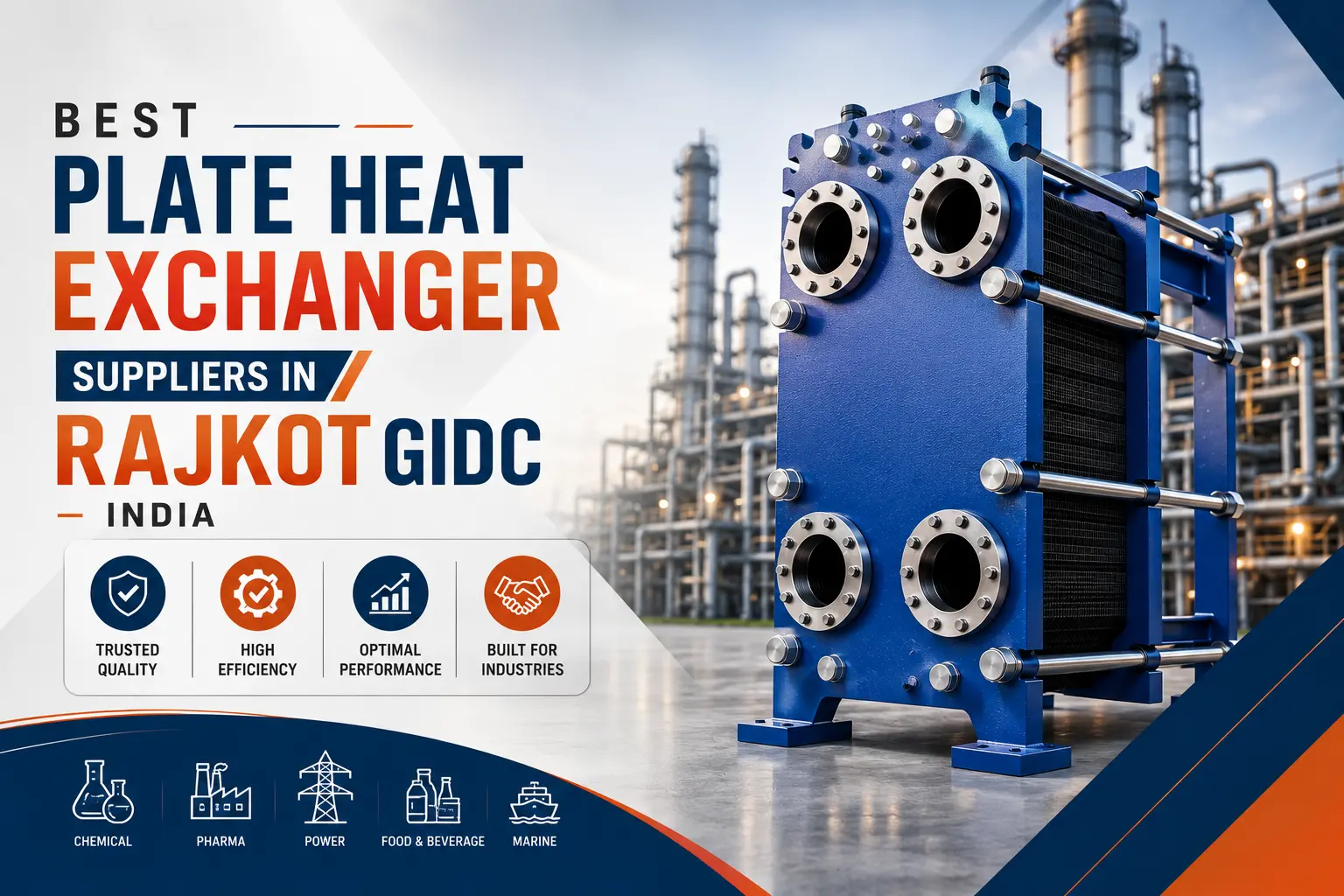
Looking for a reliable plate heat exchanger distributor in Rajkot GIDC? SRJ India is a trusted plate heat exchanger manufacturer and supplier serving Metoda, Lodhika, Bhaktinagar, Dared, Gondal Road, and all GIDC areas. Get semi-welded, spiral, brazed, fully welded, and wide gap heat exchangers for chemical, refrigeration, sugar, distillery, pulp and paper, and petrochemical industries.
INTRODUCTION – WHY RAJKOT GIDC NEEDS HIGH-QUALITY PLATE HEAT EXCHANGERS
Rajkot’s GIDC (Gujarat Industrial Development Corporation) estates – including Metoda, Lodhika, Bhaktinagar, Dared, and Gondal Road – are home to thousands of engineering, chemical, pharmaceutical, and food processing units. These industries depend heavily on efficient thermal management. That is where plate heat exchangers become indispensable.
But finding the best plate heat exchanger suppliers in Rajkot GIDC is not easy. Many local distributors offer low-quality, high-maintenance units that fail under high pressure or with corrosive fluids. Some suppliers do not stock specialized variants like semi-welded or wide gap models, forcing buyers to compromise on performance.
SRJ Heat Exchangers India Pvt Ltd (formerly SRJ Engineers Pvt Ltd) is a premier plate heat exchanger manufacturer with a strong supply chain reaching every GIDC zone in Rajkot. The company has decades of experience in designing and manufacturing heat transfer equipment for challenging applications.
In this article, we explore why SRJ is a trusted plate heat exchanger distributor in Rajkot GIDC, the types of heat exchangers available, detailed technical specifications, industry-wise applications across Rajkot’s industrial sectors, how to select the right model, and how to source directly from the manufacturer.
COMPANY OVERVIEW – SRJ HEAT EXCHANGERS INDIA PVT LTD
SRJ Heat Exchangers India Pvt Ltd was formerly known as SRJ Engineers Pvt Ltd. The company is an ISO 9000-certified manufacturer with a strong focus on quality assurance in design, procurement, production, and final inspection. Their factory is strategically located at Plot 139, Udyog Vihar Extension, Ecotech-II, Greater Noida, and their distribution and supply network efficiently covers every GIDC area in Rajkot.
Although the main manufacturing facility is in Noida, SRJ regularly supplies to Rajkot GIDC via dedicated logistics and channel partners. For bulk and industrial orders, direct manufacturer pricing is available. The company has a proven track record of supplying heat exchangers to sugar mills, chemical plants, pharmaceutical units, and petrochemical refineries across Gujarat.
SRJ’s engineering team specializes in ripple-type plate design, laser welding for semi-welded units, and hinged cover technology for easy maintenance. Their products are widely used in H2SO4 coolers, evaporators, condensers, desuperheaters, economizers, and subcoolers.
WHY SRJ IS AMONG THE BEST PLATE HEAT EXCHANGER SUPPLIERS FOR RAJKOT GIDC
As a plate heat exchanger manufacturer, SRJ offers several advantages over local fabricators or third-party distributors. Below is a detailed breakdown of their competitive strengths.
Quality Assurance: SRJ follows ISO 9000 compliance in every stage – from design and material sourcing to production and final inspection. Each plate heat exchanger undergoes pressure testing and performance validation before dispatch.
Advanced Plate Technology: SRJ uses ripple-type plates that promote deep membrane heat conduction. This unique plate pattern creates a special channel geometry that induces strong turbulence even at low flow speeds. The rotational flow on the plate surface shortens the residence time of liquid, reducing fouling and enabling self-purification.
Higher Pressure and Temperature Handling: Standard gasketed plate heat exchangers have limitations on pressure and temperature. SRJ’s semi-welded and fully welded models eliminate gasket-related risks. The semi-welded units use laser-welded sealed plate channels for aggressive refrigerants, while the other channel uses gasketed construction for brine or secondary fluids. This hybrid design allows much higher design pressures.
Fouling Resistance for Difficult Fluids: Many industries in Rajkot GIDC handle sludges, slurries, wastewater, high-viscosity liquids, and fluids containing fibers or solids. For such applications, SRJ offers spiral heat exchangers and wide gap plate heat exchangers. Spiral units use coiled metal sheets instead of tube bundles, creating a single-channel design that is self-cleaning. Accumulated deposits create localized velocity increases, producing a scrubbing effect that loosens fouling.
Easy Maintenance and Cleaning: Some process media are so challenging that periodic cleaning is unavoidable. SRJ has addressed this by designing hinged covers sealed with C-clamps. These swing doors can be opened and closed without any special tools, allowing full access to the entire coil for inspection and cleaning. This feature is particularly valuable for plants that cannot afford long shutdowns.
Delivery to Rajkot GIDC: SRJ ships directly to Metoda, Lodhika, Dared, Bhaktinagar, and Gondal Road. For urgent requirements, express delivery options are available. Spare plates and gaskets are also stocked for popular models.
If you are an industrial buyer in Rajkot GIDC searching for a plate heat exchanger distributor, SRJ gives you manufacturer-direct quality along with distributor-level service responsiveness.
TYPES OF PLATE HEAT EXCHANGERS SUPPLIED TO RAJKOT GIDC
Based on SRJ’s official technical documentation, here are the five main types of plate heat exchangers available for industries in Rajkot’s GIDC zones. Each type is designed for specific fluid characteristics and operating conditions.
SEMI-WELDED PLATE HEAT EXCHANGERS
Best for: Sulfuric acid coolers, refrigeration systems (ammonia, freon), evaporators, condensers, desuperheaters, and economizers.
Technical description: In a semi-welded heat exchanger, one fluid flows through laser-welded, sealed plate channels, while the other fluid flows through gasketed channels. This construction is used when gaskets are not compatible with one of the process media. The welded side eliminates gasket leakage risk for aggressive or hazardous fluids, while the gasketed side allows easy disassembly for cleaning.
Key advantages: Higher design pressure compared to fully gasketed units. No risk of gasket permeation on the welded side. Ideal for phase change applications like evaporation and condensation.
Ideal for: Chemical plants in Lodhika GIDC handling H2SO4, and refrigeration plants in Metoda GIDC.
SPIRAL HEAT EXCHANGERS
Best for: Sludges, slurries, wastewater treatment, fouling liquids, high-viscosity liquids (up to several thousand centipoise), and liquids containing fibers or solids.
Technical description: Instead of tube bundles, SRJ uses coiled metal sheets to form two concentric spiral channels. One fluid flows through the inner spiral, the other through the outer spiral in true countercurrent flow. This design allows very close temperature approaches (as low as 1-2 degree Celsius). The single-channel design means there are no dead zones where solids can accumulate.
Key advantages: Self-cleaning effect – as deposits build up, the local flow velocity increases, creating a scrubbing action that loosens fouling. Can operate for very long sessions without maintenance. The hinged cover design (with C-clamps) allows easy access to the entire coil when cleaning is finally needed.
Ideal for: Textile effluent treatment plants in Metoda GIDC, food processing units in Dared GIDC, and distilleries in Lodhika GIDC.
BRAZED PLATE HEAT EXCHANGERS
Best for: General heating and cooling where compact size, high efficiency, and low cost are priorities. Common in HVAC, refrigeration, and small process applications.
Technical description: A brazed plate heat exchanger consists of corrugated stainless steel plates vacuum-brazed together using copper or nickel. There are no gaskets or frame plates. The fluids are separated by the plates and flow in alternate channels. The ripple-type corrugation induces high turbulence, giving heat transfer coefficients that are three to five times higher than shell-and-tube exchangers.
Key advantages: Under the same heat transfer coefficient, pressure losses are within one third of tubular heat exchangers. The self-purifying effect reduces fouling. Extremely compact footprint.
Ideal for: HVAC systems in pharmaceutical units across Bhaktinagar GIDC, and refrigerant evaporators/condensers in small-scale industries.
FULLY WELDED PLATE HEAT EXCHANGERS
Best for: High temperature and high pressure applications where gasket failure is a risk. Also used for toxic or expensive fluids that cannot leak.
Technical description: In a fully welded plate heat exchanger, the heat transfer plates are welded together around the edges, forming a plate pack that is then inserted into a pressure vessel. There are no gaskets at all. The weld joints are typically made by laser or TIG welding. This construction eliminates the two main limitations of gasketed units – temperature and pressure.
Key advantages: Can handle temperatures up to 400 degree Celsius and pressures up to 40 bar or more depending on design. No gasket replacement costs. No risk of permeation or chemical attack on elastomers.
Ideal for: Petrochemical and refinery applications in Gondal Road GIDC, and high-pressure process heating in chemical plants.
WIDE GAP PLATE HEAT EXCHANGERS
Best for: Fibrous fluids (pulp and paper), fluids containing coarse particles (sugar juice, distillery spent wash, fruit pulp), and wastewater with stringy solids.
Technical description: Wide gap gasketed plate heat exchangers have significantly larger gaps between plates compared to standard units. They can be configured with wide-wide channels (both sides wide) or wide-narrow channels (one wide, one standard). The ports are designed with smooth contours to prevent fibers from snagging at the entrance.
Key advantages: Fibers and particles pass through with minimum clogging. The wide gaps also reduce pressure drop. Suitable for heating, cooling, and heat recovery duties.
Ideal for: Sugar mills near Metoda GIDC, distillery spent wash cooling in Lodhika GIDC, and pulp and paper applications in larger Gujarat-based mills.
INDUSTRY-WISE APPLICATIONS ACROSS GIDC ZONES IN RAJKOT
Each GIDC zone in Rajkot has a distinct industrial profile. SRJ has mapped its product range to meet these specific needs.
Metoda GIDC: This is one of the largest GIDC estates near Rajkot. Major industries include engineering, chemical manufacturing, and textile processing. Textile processing generates hot wastewater that needs cooling before disposal – spiral heat exchangers are ideal here because they handle sludge and fibers without clogging. Engineering units use brazed plate heat exchangers for hydraulic oil cooling and machine cooling.
Lodhika GIDC: This zone has a strong presence of chemical and pharmaceutical plants, as well as sugar by-product industries. Chemical plants handling sulfuric acid require semi-welded heat exchangers for acid coolers. Distilleries producing ethanol from molasses need wide gap heat exchangers for spent wash cooling. Pharmaceutical units use brazed or fully welded units for clean utility heating and cooling.
Bhaktinagar GIDC: This older GIDC area houses auto component manufacturers, pharmaceutical formulation units, and food processing companies. HVAC systems in pharma clean rooms rely on brazed plate heat exchangers for chilled water and hot water duty. Auto component plants use plate heat exchangers for quench bath cooling and paint shop temperature control.
Dared GIDC: Agro-products, packaging materials, and plastic processing units dominate this zone. Spiral heat exchangers are used for waste heat recovery from plastic extrusion lines. Brazed plate heat exchangers cool hydraulic systems in injection molding machines. Food processing units (edible oil, spices) use wide gap units for viscous products.
Gondal Road GIDC: This area has petrochemical storage terminals, ceramic manufacturing, and refractory units. Petrochemical applications require fully welded plate heat exchangers for high-temperature heat recovery. Ceramic plants use spiral units for slurry heating and cooling. Refractory material processing often involves abrasive slurries that would damage tube bundles – spiral units handle them well.
As a plate heat exchanger distributor covering all these zones, SRJ ensures quick turnaround and on-site technical support through its channel partners.
TECHNICAL SELECTION GUIDE – HOW TO CHOOSE THE RIGHT PLATE HEAT EXCHANGER FOR YOUR RAJKOT PLANT
Selecting the correct heat exchanger type is critical for long-term reliability and low total cost of ownership. Here is a decision framework based on fluid properties and operating conditions.
Step 1 – Analyze the fluid on both sides
If one fluid is aggressive, toxic, or a refrigerant: Choose semi-welded or fully welded.
If the fluid contains fibers, solids, or has high viscosity: Choose spiral or wide gap.
If both fluids are clean and non-corrosive: Brazed plate heat exchangers are the most economical.
If pressure exceeds 15 bar or temperature exceeds 180 degree Celsius: Avoid gasketed units. Use fully welded or semi-welded.
Step 2 – Determine the required temperature approach
If you need a close approach (less than 5 degree Celsius difference): Spiral heat exchangers with true countercurrent flow are best.
If approach is not critical: Brazed or gasketed plate heat exchangers work well.
Step 3 – Consider maintenance frequency
If cleaning is required weekly or monthly: Choose hinged cover spiral units for easy access.
If cleaning is annual or less frequent: Standard brazed or gasketed units are fine.
Step 4 – Evaluate pressure drop constraints
If pumping power is expensive: Wide gap units have lower pressure drop than narrow-gap plates.
If pressure drop is not a concern: Standard plates give higher heat transfer coefficients.
Step 5 – Check material compatibility
For H2SO4, hydrochloric acid, or caustic: Use high-alloy materials like Hastelloy, titanium, or SMO 254.
For clean water or steam: Stainless steel 304 or 316 is sufficient.
SRJ provides full material certification and can recommend the optimal plate material and gasket elastomer (NBR, EPDM, Viton, or PTFE-coated).
PERFORMANCE COMPARISON – SRJ VS LOCAL FABRICATORS VS OTHER BRANDS
SRJ India: Manufacturer-direct. Offers semi-welded, spiral, wide gap, brazed, and fully welded. ISO 9000 certified. Hinged covers on spiral units. Direct support for Rajkot GIDC with stock of spares. Technical team available for site visits.
Local Fabricators in Rajkot: Mostly traders or small workshops. They rarely offer semi-welded or spiral technology. Wide gap units are not available. Most are not ISO certified. No hinged cover designs. Limited technical support. They often buy standard plates from larger manufacturers and assemble locally.
Other National Brands: Large Indian brands often sell through distributors, not directly. They have limited semi-welded or spiral options. Wide gap units are made only on order with long lead times. They are ISO certified, but hinged covers are expensive add-ons. Support is through third-party service providers, which adds delays.
Conclusion: For non-standard fluids (corrosive, viscous, fibrous) and high-fouling applications, SRJ is clearly among the best plate heat exchanger suppliers for Rajkot GIDC.
LONG-TERM BENEFITS OF BUYING FROM A MANUFACTURER LIKE SRJ
Direct pricing: No distributor markup. For a typical 100 square meter plate heat exchanger, distributor margins can add 15 to 25 percent to the cost. Buying directly from SRJ eliminates this.
Faster customization: When you need non-standard plate materials, gasket types, or nozzle orientations, a manufacturer can respond in days, not weeks. Local distributors have to place orders with their own suppliers, adding lead time.
Better warranty support: Manufacturer-direct warranties cover both workmanship and materials. If a plate fails due to a manufacturing defect, replacement is faster.
Access to engineering: SRJ’s engineers can perform thermal design calculations using HTRI or other software. They can recommend exact plate count, channel configuration, and pressure drop estimates before you buy.
Spare parts availability: When you buy from the manufacturer, you have a direct line for replacement plates, gaskets, and tightening bolts. Distributors often change brands, leaving customers stranded for spares after a few years.
FREQUENTLY ASKED QUESTIONS
Question 1: Does SRJ have a stockist or branch office in Rajkot GIDC?
SRJ primarily operates as a manufacturer with direct shipping. However, they work with channel partners in Metoda and Lodhika for fast spare parts support. For new equipment, orders are processed directly from the factory.
Question 2: Can I get a semi-welded heat exchanger for sulfuric acid cooling in my Rajkot plant?
Yes. SRJ’s semi-welded units are specifically designed for H2SO4 coolers. They use laser-welded channels on the acid side to eliminate gasket corrosion. Many chemical plants in Lodhika GIDC are already using these units.
Question 3: What is the typical lead time for delivery to Rajkot GIDC?
For standard brazed and gasketed models, lead time is 10 to 15 working days from order confirmation. For semi-welded, spiral, or fully welded units, lead time is 25 to 30 working days. Express delivery can be arranged for emergency replacements at an additional cost.
Question 4: Are spare plates and gaskets available for older models?
SRJ maintains a buffer stock of plates and gaskets for their most popular models for at least ten years after the last production run. For older or discontinued models, they can fabricate replacements if drawings are available.
Question 5: How do I verify the quality of SRJ’s products before purchasing?
You can request a factory audit or visit the Greater Noida facility. Alternatively, SRJ can provide a list of reference installations in Gujarat, including in Rajkot, so you can speak directly to existing customers.
Question 6: Does SRJ provide installation and commissioning support?
Yes, SRJ can send a service engineer to your Rajkot plant for commissioning. For smaller units, they provide detailed manuals and video support. For larger projects, on-site commissioning is included.
Question 7: What is the typical lifespan of a plate heat exchanger?
With proper maintenance and clean fluids, a brazed or gasketed plate heat exchanger can last 15 to 20 years. For fouling or corrosive services, lifespan may be 5 to 10 years depending on maintenance frequency. SRJ designs for repairability – plates and gaskets can be replaced individually.
MAINTENANCE BEST PRACTICES FOR PLATE HEAT EXCHANGERS IN RAJKOT GIDC
Rajkot’s climate and water quality can accelerate fouling and corrosion. Here are practical tips for extending equipment life.
Water treatment: If you use cooling tower water or raw well water, ensure proper filtration and chemical treatment. Hard water scaling reduces heat transfer rapidly. SRJ recommends a maximum hardness of 50 ppm for plate heat exchangers with narrow gaps.
Regular inspection: For gasketed units, check for leaks at the gaskets every three months. Tightening bolts should be re-torqued according to the manufacturer’s schedule. Over-tightening damages plates.
Cleaning schedule: For spiral units with hinged covers, open and inspect the coil every six months in fouling service. Use high-pressure water jetting (below 50 bar) to avoid damaging the coils. For brazed units, chemical cleaning with appropriate solvents is required because the unit cannot be opened.
Gasket replacement: EPDM gaskets last 3 to 5 years in water service. Viton gaskets last longer in aggressive chemical service but are more expensive. NBR gaskets are for oil service only. Replace gaskets as soon as they become hard or show cracks.
Plate replacement: If a plate is punctured or deeply corroded, replace it immediately. SRJ stocks individual plates for all current models. Always replace in pairs to maintain compression balance.
CONCLUSION – YOUR TRUSTED PLATE HEAT EXCHANGER PARTNER IN RAJKOT GIDC
Whether you need a plate heat exchanger distributor for routine HVAC duty or a specialized semi-welded unit for aggressive chemicals, SRJ Heat Exchangers India Pvt Ltd delivers manufacturer-grade quality to every GIDC zone in Rajkot – Metoda, Lodhika, Bhaktinagar, Dared, and Gondal Road.
By choosing SRJ, you get verified plate heat exchanger suppliers backed by ISO standards, a direct plate heat exchanger manufacturer with no middleman markup, local GIDC coverage with fast reliable logistics, and real engineering expertise.
For your next heat exchanger requirement – new plant, replacement, or spare parts – contact SRJ directly. Their team will help you select the right type, size, and material for your specific application, and provide a competitive quote without distributor overheads.