
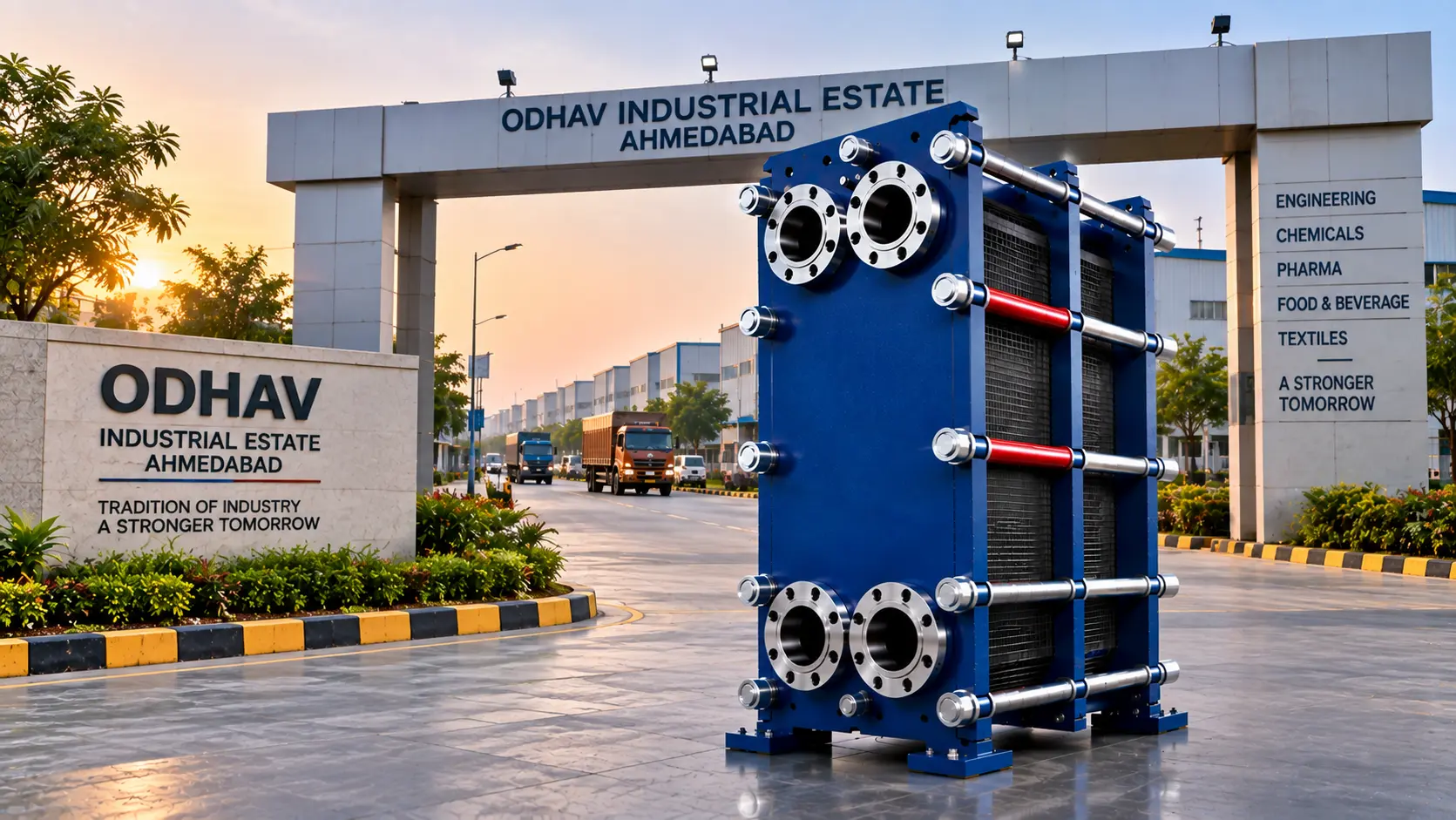
Most industrial belts in India grow around a single town. Navi Mumbai’s MIDC base grew around a road — the Thane-Belapur corridor, stretching roughly from Nerul up to Kalwa and Airoli, with Taloja sitting slightly apart in neighbouring Raigad district. That’s not a small distinction for buyers. It means plate heat exchanger manufacturers in Navi Mumbai MIDC are actually serving six or seven distinct industrial personalities strung along one road — chemical processors in one pocket, pharma exporters in another, general engineering and food-adjacent trade in a third — and treating the whole corridor as one uniform market is exactly how buyers end up with equipment that’s technically a PHE but wrong for the job. Proximity to Jawaharlal Nehru Port, roughly 15 km from the TTC belt, adds another layer: a meaningful share of what’s manufactured here is headed for export, which raises the documentation bar most local buyers never think to ask about until an audit forces the question.
The Thane-Belapur Corridor: One Belt, Several Personalities
The TTC (Trans Thane Creek) industrial area is classified under MIDC’s Category A grading — the corporation’s highest development tier — and covers Turbhe, Pawane, Kopar Khairane, Mahape, Ghansoli, Rabale, Digha, Kalwa, and Airoli in a more or less continuous stretch along Thane-Belapur Road. Pharma, chemicals, food processing, and general engineering have historically anchored this belt, though pockets like Ghansoli and Mahape have increasingly filled in with IT and corporate offices alongside the original industrial plots. What that means practically: two units a few kilometres apart on the same road can have completely different PHE requirements, and a manufacturer quoting from a single generic spec sheet across the whole corridor is guessing at half of them.
Plate Heat Exchanger Manufacturers in Turbhe
Turbhe carries a genuinely unusual mix for an industrial estate — it’s home to one of Mumbai’s largest wholesale agricultural markets (the APMC market), alongside a dense base of chemical, pharmaceutical, and general engineering units. That combination means demand here splits two ways: food-adjacent processing and cold-chain-linked operations tied to the produce trade, and conventional industrial cooling for the chemical and engineering units that make up the rest of the estate. A plate heat exchanger manufacturer in Turbhe needs to be equally comfortable quoting a food-grade gasketed plate heat exchanger for a processing or chilling application and a standard SS304 industrial-duty unit for a general engineering workshop — and needs to ask which one you actually need rather than assuming.
Plate Heat Exchanger Suppliers in Kopar Khairane
Kopar Khairane sits further into the residential-industrial mix that characterises the middle of the TTC corridor, with lighter manufacturing and logistics-adjacent operations more common here than heavy process industry. For a plate heat exchanger supplier in Kopar Khairane, the practical differentiator is less about engineering complexity and more about turnaround — most duties are conventional water or mild-process cooling, and a supplier who can confirm compatibility over a call and dispatch from stock beats one who treats every order as custom, especially for buyers running lean maintenance teams without dedicated engineering staff on-site.
PHE Gasket Manufacturers in Pawane
Pawane’s industrial base runs a solid mix of general engineering and chemical-adjacent manufacturing, and gasket demand here reflects that mix — some units need nothing more than economical NBR for general water duty, while others sit right next to chemical processors needing far more resistant compounds. An experienced PHE gasket manufacturer in Pawane asks about your specific process chemistry before quoting a compound, rather than defaulting to whatever’s cheapest to stock, because a gasket that’s the wrong chemistry for even mild chemical exposure fails within months instead of years.
PHE Gasket Suppliers in Rabale
Rabale has developed into one of the corridor’s more premium industrial pockets, with a notably dense concentration of chemical and pharmaceutical manufacturing — and a correspondingly higher bar for gasket chemistry than the corridor average. Chemical processing units here regularly involve solvents, acids, or process conditions that degrade a standard NBR gasket quickly; Viton or another chemical-resistant compound is usually the safer starting point. A PHE gasket supplier in Rabale who defaults to general-purpose compounds without checking your actual process chemistry is setting you up for a repeat maintenance call within the first year.
PHE Plate Manufacturers in Ghansoli
Ghansoli’s identity has shifted over the past decade — large corporate and IT campuses, including major office parks, have grown up alongside its original industrial plots, and the area increasingly functions as a hybrid of manufacturing and back-office operations. The industrial units that remain still run genuine process duties, though, and a PHE plate manufacturer in Ghansoli needs to size correctly for whichever kind of buyer is asking — a smaller-footprint utility cooling system for a mixed-use campus, or a full process-duty unit for a manufacturing plant that predates the area’s corporate growth. Heat exchanger plates sized without confirming which category applies tend to be either oversized and wasteful or undersized and failure-prone.
PHE Plate Suppliers in Taloja
Taloja sits apart from the core TTC belt, technically in Raigad district, and has grown into one of the region’s most concentrated chemical and pharmaceutical manufacturing clusters — dyes, agrochemicals, bulk drugs, and specialty chemicals all have a real presence here. This is the pocket in the entire Navi Mumbai region where plate and gasket selection matters most: standard SS304 plates and NBR gaskets simply don’t hold up against the process chemistry common to Taloja’s chemical units, and a PHE plate supplier in Taloja needs to default to SS316 or higher, with chemical-resistant gasket compounds, as the starting assumption rather than the upgrade option. Buyers here should expect — and ask for — a genuinely different baseline specification than anywhere else on this list.
Industrial Heat Exchanger Manufacturers and Suppliers in Navi Mumbai: The Export Angle
A meaningful share of what’s produced across this corridor, particularly the pharma and specialty chemical output from Rabale and Taloja, is manufactured for export through nearby JNPT. That changes what buyers should expect from industrial heat exchanger manufacturers in Navi Mumbai: documentation that would pass an international audit isn’t optional paperwork, it’s part of the product. Material test certificates, pressure test reports, and a documented quality system aren’t just good practice here — for export-oriented units, missing documentation can hold up a shipment as easily as a mechanical failure can. Industrial heat exchanger suppliers in Navi Mumbai who understand this distinction tend to have their paperwork ready by default, not assembled after the fact when a customer or auditor asks for it.
Getting Plate Material and Gasket Compound Right
Across this entire corridor, two decisions carry most of the weight in how long a PHE actually lasts: plate material matched to the real fluid chemistry, and gasket compound matched to temperature and chemical exposure. SS304 covers Kopar Khairane’s and much of Ghansoli’s general-duty cooling well. Turbhe’s food-adjacent applications need food-grade construction regardless of plate grade. Pawane and Rabale increasingly call for SS316 given their chemical-processing density, and Taloja should generally start there rather than treat it as an upgrade. On the gasket side, NBR is economical for general and mild-oil duty, EPDM handles steam and hot water reliably, and Viton earns its premium wherever solvents, acids, or sustained chemical exposure are involved — for chemical-heavy applications, a welded or semi-welded construction that removes gaskets from the aggressive fluid path is often worth the extra cost over a fully gasketed unit. Ask for material test certificates and pressure test documentation as standard practice — manufacturers working within ISO 9001 quality frameworks, and referencing thermal design guidelines from bodies like ASHRAE, give you something documented to fall back on. Indian material and pressure equipment standards from the Bureau of Indian Standards are worth checking any documentation against, and MIDC’s official portal is the authoritative source if you’re evaluating plot or estate status anywhere along this corridor.
Maintenance Across a Corridor With This Much Variation
A gradually rising pressure drop at constant flow rate is the universal early warning sign of fouling, but the cause varies by node. In Rabale and Taloja’s chemical-heavy duty, it’s usually process residue or early-stage corrosion if the plate grade was under-specified. In Turbhe’s food-adjacent applications, it’s typically organic residue that needs a properly concentrated CIP cycle to clear. In Pawane, Kopar Khairane, and Ghansoli’s more general-duty units, ordinary water-side scaling is the usual culprit. A visual check every 3–6 months, with a full teardown and gasket inspection every 12–18 months, is a reasonable baseline everywhere on this corridor — chemical and pharma units in Rabale and Taloja often need the shorter end of that range given process intensity. External leaks trace back to gasket seating or uneven bolt torque far more often than to the plates themselves.
What a Fair Quote Should Include
Plate material, gasket compound, heat transfer area, and frame/connection size should appear as separate line items on any quote, regardless of which node along the corridor you’re sourcing for. A bundled single number makes it far harder to tell whether a Taloja-grade chemical-duty specification and a Kopar Khairane general-duty specification are actually being compared fairly, or whether one supplier has quietly downgraded the spec to win on price. SRJ Heatt Exchangers India Pvt. Ltd. builds its quoting approach around exactly this range of duty — sizing plate and gasket selection differently for a chemical-processing unit in Rabale or Taloja versus a general engineering line in Kopar Khairane or Ghansoli, rather than defaulting to one catalogue spec, and keeping common configurations along with replacement parts in stock so buyers across the corridor aren’t left waiting weeks for a routine part.
Conclusion
The Thane-Belapur corridor isn’t one market — it’s several, strung along a single road, and sourcing plate heat exchanger manufacturers in Navi Mumbai MIDC well means recognising that Turbhe’s food-adjacent duty, Rabale and Taloja’s chemical-heavy processing, and the general engineering common to Pawane, Kopar Khairane, and Ghansoli all call for genuinely different specifications. Match plate material and gasket compound to the actual duty at each node, ask for documentation as standard practice — especially where export compliance is involved — and equipment life stops being unpredictable.
FAQs
Why does Taloja need a different plate heat exchanger specification than the rest of the corridor? Taloja’s chemical and pharmaceutical manufacturing density means standard SS304 plates and NBR gaskets typically don’t hold up; SS316 or higher with chemical-resistant gasket compounds should be the starting assumption.
Does Turbhe’s APMC market affect PHE sourcing there? Yes — food-adjacent and cold-chain-linked operations near the market need food-grade construction, distinct from the conventional industrial cooling duty common elsewhere on the same estate.
Why does documentation matter more for exporters in this belt? A significant share of production from Rabale and Taloja in particular is export-oriented through nearby JNPT, and missing material or pressure test documentation can hold up a shipment as easily as an equipment failure.
Should I choose SS304 or SS316 plates? SS304 for general water duty in areas like Kopar Khairane and Ghansoli; SS316 or higher wherever chemical processing is involved, which is common in Pawane, Rabale, and especially Taloja.
When should I choose a welded or semi-welded PHE over a standard gasketed unit? For chemical-heavy or solvent-exposed duty common in Rabale and Taloja, removing gaskets from the aggressive fluid path reduces a common failure point.
What’s the earliest sign a plate heat exchanger needs cleaning? A gradual rise in pressure drop at constant flow rate — worth checking more frequently in chemical or pharma operations given how much faster fouling shows up under process-intensive duty.
What should I ask for before accepting a quote? Material test certificates, pressure test documentation, and a line-item breakdown covering plate material, gasket compound, frame, and freight.