
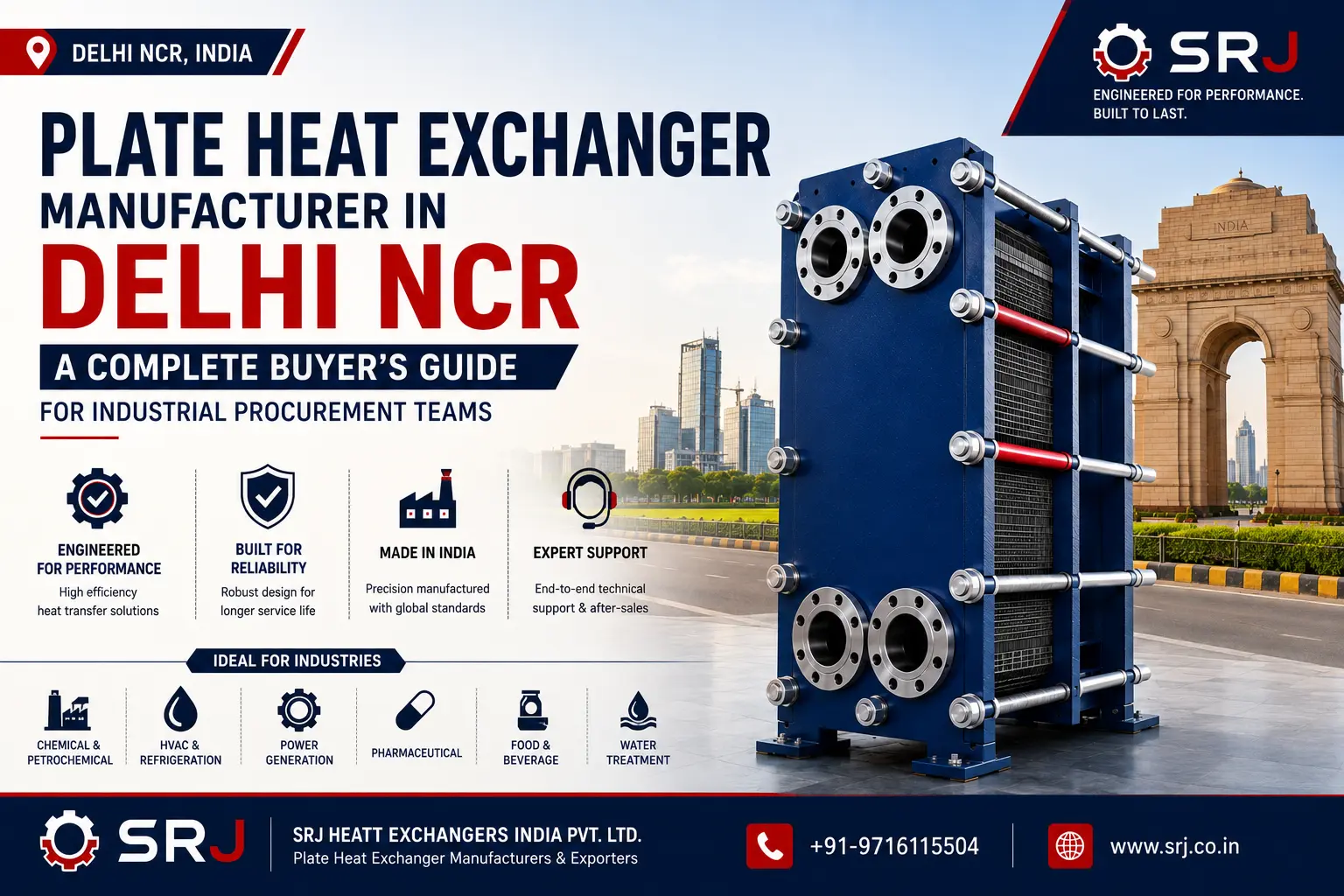
If you’re searching for a dependable plate heat exchanger manufacturer in Delhi NCR, you’re probably dealing with one of three situations: an ageing unit losing thermal efficiency, a new process line needing accurate heat-transfer design, or a shutdown that can’t wait weeks for an imported spare. Delhi NCR’s industrial base — spread across Noida, Gurgaon, Faridabad, Ghaziabad and Manesar — runs on process heating and cooling equipment that has to keep pace with dairy, pharmaceutical, chemical, steel and HVAC operations that rarely pause for a maintenance window. This guide covers what separates a competent manufacturer from an average one, how manufacturers, suppliers and distributors differ, and what to verify before committing budget to a vendor.
What Is a Plate Heat Exchanger, and Why Does NCR Industry Rely on It?
A plate heat exchanger (PHE) transfers heat between two fluids through a stack of thin, corrugated stainless steel or titanium plates, without the fluids ever mixing. Hot and cold streams flow through alternating channels, and the corrugation pattern creates turbulence that sharply increases heat transfer per unit area compared with shell-and-tube designs.
That efficiency is why PHEs dominate industrial heat transfer across the NCR belt: a smaller footprint than an equivalent shell-and-tube unit, the ability to be opened and re-plated instead of scrapped, and faster response to load swings — useful in dairy pasteurization lines or batch chemical processes where temperatures shift constantly through a shift.
Delhi NCR’s Industrial Corridor: Where Plate Heat Exchanger Demand Is Concentrated
Demand isn’t spread evenly across the region — it clusters around specific industrial belts, each with a different process profile.
| Industrial Zone | Dominant Industries | Typical PHE Use |
| Noida & Greater Noida | Electronics, FMCG, packaging, dairy | Process cooling, chilled water, HVAC |
| Ecotech (Greater Noida) | Electronics, engineering, warehousing | Data centre and process cooling |
| Okhla Industrial Area (Delhi) | Garments, printing, light engineering | Effluent heat recovery, water heating |
| Naraina Industrial Area (Delhi) | Auto components, light manufacturing | Compressor and hydraulic oil cooling |
| Bawana Industrial Area (Delhi) | Chemicals, plastics, pharmaceuticals | Reactor jacket cooling, CIP systems |
| Gurgaon / Udyog Vihar | Auto ancillary, electronics assembly | Process water and coolant systems |
| Manesar / IMT Manesar | Automotive OEM and Tier-1 suppliers | Paint shop heating, quench cooling |
| Faridabad | Steel fabrication, engineering goods | Furnace waste-heat recovery |
| Ghaziabad / Sahibabad Industrial Area | Steel re-rolling, dairy, food processing | Pasteurization, boiler feed pre-heating |
| Surajpur Industrial Area | Auto components, electricals | Compressor cooling, hydraulic systems |
For plants in Faridabad’s steel belt or Ghaziabad’s dairy units, the deciding factor is usually spare-part turnaround, not just unit price. That’s why sourcing here leans toward manufacturers and suppliers with a physical NCR presence rather than importers routing everything through one national depot.
Manufacturer, Supplier or Distributor: Which Sourcing Route Fits Your Plant?
These terms are often used interchangeably, but picking the wrong one usually shows up later as a lead-time or warranty problem. A manufacturer designs the thermal duty, presses the plates, fits the gaskets and assembles the frame in-house. Manufacturers such as SRJ Heatt Exchangers India Pvt. Ltd., which fabricates gasketed, semi-welded and brazed units from its Noida facility, control the full production chain, which usually means shorter lead times on customised duties and direct accountability if a design underperforms.
A plate heat exchanger supplier typically stocks manufactured units plus spare plates and gaskets, often across multiple brands, and focuses on availability over custom design — a good fit for a fast like-for-like replacement. A plate heat exchanger distributor operates under a formal arrangement with one OEM brand, managing regional stock and warranty support — useful for multi-site operators standardising on a single brand. For a new capex project, a manufacturer relationship gives more control; for an emergency breakdown, a well-stocked local supplier matters more than brand loyalty.
How to Identify the Best Plate Heat Exchanger Suppliers in Delhi NCR
“Best” stays subjective until you define it against your own operating conditions. The suppliers worth shortlisting share a few traits thinner, marketing-led websites rarely mention:
- Material traceability — mill test certificates for SS304/SS316 or titanium plates, not just a spec-sheet claim.
- Gasket compound matched to the media — NBR for water, EPDM for steam and CIP chemicals, Viton for oils and aggressive chemicals; a wrong compound is a common cause of early failure.
- Thermal design validated in software, not scaled off a similar past project.
- Hydro-testing and pressure certification documented per unit, especially for boiler-connected duties, in line with the ASME Boiler and Pressure Vessel Code.
- After-sales response time — ask how many days a plate-and-gasket replacement set takes from local stock, not just whether it’s “in stock.”
Before finalizing a supplier, ask for the mill test certificate on your order, the gasket compound rationale for your media, confirmation the thermal design uses your actual flow rates, and the real spare-part lead time from Delhi NCR stock.
Types of Plate Heat Exchangers Manufactured for NCR Industries
Gasketed Plate Heat Exchangers
The most widely used configuration for dairy, food and general utility duties — bolted plates with elastomer gaskets that open easily for CIP-heavy lines around Noida and Ghaziabad.
Semi-Welded Plate Heat Exchangers
One side of each plate pair is laser-welded, the other gasketed — suited to ammonia and chemical cooling duties across Bawana and Faridabad.
Welded Plate Heat Exchangers
Fully welded, gasket-free construction for high-pressure or aggressive media where an elastomer gasket won’t hold up.
Wide-Gap Plate Heat Exchangers
Wider inter-plate channels handle fibrous or particulate-laden fluids without clogging, relevant to food and effluent-treatment duties across Okhla and Bawana.
Brazed Plate Heat Exchangers
Compact, copper-brazed units for HVAC and refrigeration duties, common in commercial cooling systems across Gurgaon and Manesar.
Installation, Maintenance and Common Troubleshooting Issues
A plate heat exchanger’s real cost is the total cost across its service life. Fouling is the most common efficiency killer — a gradual rise in pressure drop, or a widening gap between design and actual inlet/outlet temperatures, almost always signals scale or biofilm build-up rather than a design fault; routine CIP cycles matched to your actual fouling tendency extend service life considerably. Gasket degradation is the second most frequent issue, usually from a compound mismatch or thermal cycling beyond rating — weeping at the plate edges or a hardened, cracked gasket at the next opening are the practical signs.
Common mistakes: reassembling plates in the wrong sequence, over- or under-torquing tie bolts, mixing gasket batches instead of replacing a full set, and ignoring a slow pressure-drop rise until cleaning alone can’t fix it.
What Affects Plate Heat Exchanger Pricing in Delhi NCR?
- Plate material — titanium and high-grade alloys cost more than SS304/SS316 but are essential for seawater, brine or corrosive media.
- Heat transfer area — driven by flow rate and approach temperature; a conservative fouling margin adds cost but reduces cleaning frequency.
- Gasket compound and certification — EPDM and Viton cost more than NBR; pressure-vessel certification adds documentation cost.
- Standard vs custom frame size — a standard-frame duty is considerably cheaper than a custom-fabricated one.
- Freight and handling — stainless plate packs are heavy; an NCR-based manufacturer removes the freight and import-duty component that applies to imported units.
A detailed breakdown of these variables is available in our plate heat exchanger price guide.
Industry Applications Driving Demand Across the Region
Dairy and food plants across Noida, Greater Noida and Ghaziabad rely on gasketed PHEs for pasteurization and CIP-heavy lines. Pharmaceutical units in Bawana and Faridabad need tighter fouling control, often via welded or semi-welded configurations. Steel and engineering units across Faridabad and Ghaziabad use PHEs for furnace waste-heat recovery and quench-water cooling. Automotive OEM and Tier-1 plants around Manesar, IMT Manesar and Udyog Vihar depend on brazed and gasketed units for paint-shop heating and hydraulic-oil cooling.
Why Local Manufacturing and After-Sales Support Matter
An imported plate heat exchanger can look identical to a locally manufactured one on a spec sheet, right up until a gasket needs replacing and the nearest stock is three time zones away. Manufacturers with an actual production base inside Delhi NCR — SRJ Heatt Exchangers India Pvt. Ltd. among them, operating out of Noida — can generally turn around plate and gasket replacements, site visits and thermal re-design faster than a purely import-and-resell model, because the plate press, gasket stock and engineering team sit within the same industrial belt as the plants they serve. For a facility running continuous operations across Noida, Gurgaon, Faridabad, Ghaziabad or Manesar, that proximity often matters more over the equipment’s life than a marginal difference in upfront price.
Conclusion: Choosing a Plate Heat Exchanger Manufacturer in Delhi NCR
Selecting the right plate heat exchanger manufacturer in Delhi NCR comes down to matching your process duty, media and urgency against a vendor’s design capability, material traceability and local after-sales reach — not just a price quote. Whether you’re sourcing directly from a manufacturer for a new capex project, working with a supplier for a fast breakdown replacement, or standardising across sites through a distributor, the NCR belt’s industrial density means there’s rarely a shortage of options. The buyers who get the best long-term outcome ask about gasket compounds, mill certificates and spare-part lead times before they ask about price. For a specific duty or a quote, you can get in touch directly.
Frequently Asked Questions
What is a plate heat exchanger used for? A plate heat exchanger transfers heat between two fluids — typically for heating, cooling or pasteurizing — without the fluids mixing, and is widely used in dairy, chemical, HVAC and process industries.
How is a plate heat exchanger manufacturer different from a supplier? A manufacturer designs and fabricates the plates, gaskets and frame in-house, while a supplier typically stocks manufactured units and spare parts, often across multiple brands, without doing the original design work.
Which plate heat exchanger type suits dairy and food processing best? Gasketed plate heat exchangers are generally preferred for dairy and food applications because they open easily for cleaning-in-place and hygienic inspection.
How often should PHE gaskets be replaced? Replacement frequency depends on the gasket compound and process temperature, but weeping at the plate edges, visible hardening or cracking at a scheduled opening are the practical signs it’s due.
How much does a plate heat exchanger cost in Delhi NCR? Cost depends on plate material, heat transfer area, gasket compound and whether the frame is standard or custom — titanium plates and pressure-vessel certification both add meaningfully to price.
What certifications should a plate heat exchanger manufacturer have? Look for mill test certificates on plate material, hydro-test or pressure certification per unit, and a quality system certification such as ISO 9001.
Can a semi-welded plate heat exchanger handle corrosive chemicals? Yes — semi-welded designs are often chosen specifically because one side can be fully welded to handle an aggressive or refrigerant-based fluid while the other side stays gasketed for the utility medium.
How long does it typically take to get a replacement plate heat exchanger part in Delhi NCR? Turnaround depends on whether the manufacturer or supplier holds local stock; NCR-based manufacturers with plates and gaskets in-house generally turn around replacements faster than import-only vendors.
What causes reduced efficiency in an existing plate heat exchanger? The most common causes are fouling — scale or biofilm build-up raising pressure drop — and gasket degradation from a compound mismatch or repeated thermal cycling.
Which industrial zones in Delhi NCR have the highest demand for plate heat exchangers? Noida, Greater Noida, Ghaziabad’s Sahibabad belt, Faridabad, Gurgaon’s Udyog Vihar and Manesar/IMT Manesar collectively account for the bulk of demand, driven by dairy, steel, chemical and automotive processing.