
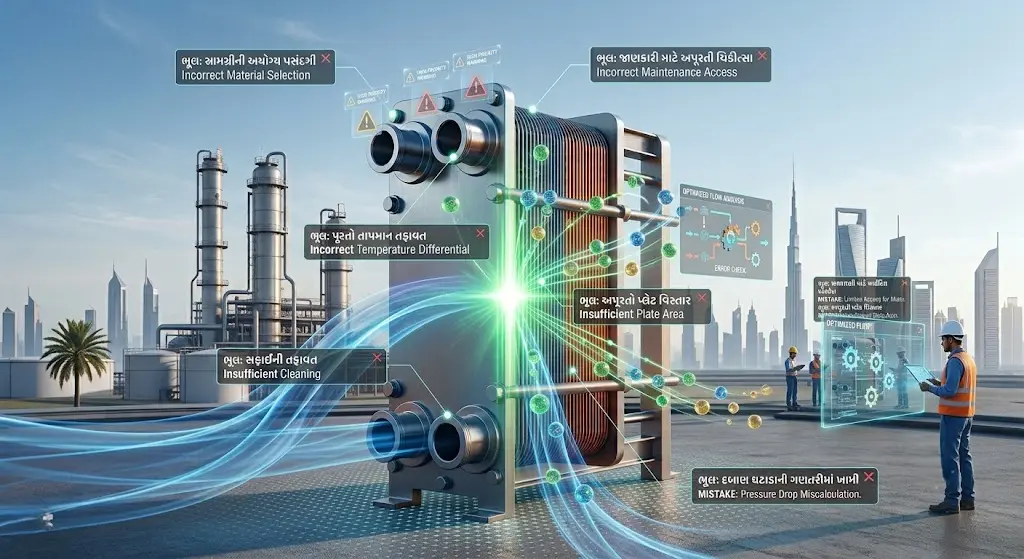
Most people searching for plate heat exchanger manufacturers in Navsari GIDC aren’t buying their first PHE — they’re replacing one that didn’t last as long as it should have. Navsari’s industrial base has grown well beyond its agricultural roots in sugarcane, chikoo, and floriculture: the proposed Surat-Navsari industrial corridor is already pulling in textile, chemical, pharmaceutical, and food-processing units, each with its own heat transfer demands. Bilimora, on the Ambika river, adds textile and general trade-linked units, while Unai’s industrial estate handles smaller-scale processing further from the main hub. Across all three, the same handful of buying mistakes keep showing up — and they’re almost entirely avoidable.
Mistake 1: Treating Every PHE Duty as Interchangeable
A cooling loop in a food-processing unit and a chemical-adjacent duty in a textile finishing line put completely different demands on a plate heat exchanger, even if both look like “general cooling” on paper. SS304 plates are fine for straightforward water-to-water duty, but once dye chemicals, acids, or high-mineral process water are involved, SS316 or SS316L becomes the safer baseline. A plate heat exchanger manufacturer in Navsari worth shortlisting will ask about your fluid chemistry before quoting a plate spec — not hand you a standard catalogue unit and hope it holds up.
Mistake 2: Reordering Gaskets by Shape Instead of Chemistry
This is where most repeat maintenance calls originate, and it’s exactly why PHE gasket manufacturers in Unai see steady demand from processing units in that belt. A gasket that looks like a drop-in replacement can still be the wrong compound for your actual operating temperature or chemical exposure. NBR is economical for general water and mild-oil duty but breaks down under sustained heat. EPDM handles steam and hot water reliably. Viton costs more but earns its keep in chemical-heavy or higher-temperature applications. Before reordering, confirm the plate model and generation your unit actually uses, not just what was fitted last time — press tooling changes over the years, and a “close enough” gasket causes micro-leaks that stay hidden until a full teardown.
Mistake 3: Picking the Lowest Quote Instead of the Lowest Total Cost
A cheaper unit that’s undersized for your actual peak flow — not your average flow — will foul faster and lose efficiency within its first year, costing more in downtime and CIP cycles than it saved upfront. Ask for material test certificates and pressure test documentation as a baseline. Manufacturers working within ISO 9001 quality systems, and referencing thermal design practices published by bodies like ASHRAE, give you something documented to lean on if a warranty issue comes up later — a verbal assurance won’t hold up in a dispute.
Mistake 4: Underestimating Logistics for Units Outside the Main Hub
Bilimora’s textile and general trading units, sitting slightly apart from Navsari’s core industrial estate, run into a specific problem: a delayed spare part means a delayed production run, and shipping a full unit back for measurement isn’t practical on a tight schedule. A dependable plate heat exchanger supplier in Bilimora is one that can confirm plate and gasket compatibility over a call and dispatch from stock — not one that treats every replacement like a custom order.
Getting the Basics Right Before You Order
Two things decide most of a PHE’s working life: plate material matched to actual fluid chemistry, and gasket compound matched to actual temperature and exposure. Everything else — frame size, connection type, certification paperwork — supports those two decisions but doesn’t substitute for them. If a supplier quotes a price before asking what’s flowing through the unit, that’s worth noticing.
A Simple Pre-Order Checklist
- Have you shared your peak flow rate — not just the average — along with maximum design temperature and pressure?
- Does the quoted plate material match your actual fluid chemistry, including any cleaning chemicals used in CIP cycles?
- Is the gasket compound suited to your temperature range, not simply whatever was used last time?
- Has the supplier provided material test certificates and pressure test documentation?
- Can the supplier confirm plate and gasket compatibility remotely, without requiring the full unit shipped back?
- Is the quote broken into separate line items — plate, gasket, frame, freight — rather than one bundled number?
SRJ Heatt Exchangers India Pvt. Ltd. builds its own quoting process around exactly this checklist — sizing plate and gasket selection to the buyer’s actual process conditions and keeping common configurations in stock, so units serving smaller belts like Bilimora and Unai aren’t left waiting weeks for a routine replacement.
Conclusion
Most problems with plate heat exchanger manufacturers in Navsari GIDC trace back to one of the four mistakes above, and all four are avoidable by asking the right questions before you order — not after something fails. Match plate material and gasket compound to your actual process, get documentation upfront, and choose a supplier who can support you whether you’re in the main Navsari estate or further out in Bilimora or Unai.
References
- ISO 9001 Quality Management — International Organization for Standardization
- ASHRAE — thermal systems and heat transfer engineering guidelines
- Bureau of Indian Standards (BIS) — Indian material and pressure equipment standards
- Gujarat Industrial Development Corporation (GIDC) — official industrial estate information for Navsari and other Gujarat zones
FAQs
What’s the most common reason plate heat exchangers fail early in Navsari’s industrial units? A mismatch between plate material or gasket compound and the actual process fluid — usually because the buyer wasn’t asked about fluid chemistry before the unit was quoted.
Should I choose SS304 or SS316 plates? SS304 for general water duties; SS316/SS316L wherever dye chemicals, acids, or high-mineral water are involved.
How do I choose between NBR, EPDM, and Viton gaskets? Match the compound to temperature and chemical exposure — NBR for general/mild-oil duty, EPDM for steam and hot water, Viton for aggressive chemicals or higher heat.
Can I get plate heat exchanger spares delivered quickly to Bilimora or Unai? Yes, if the supplier stocks common plate and gasket sizes and can confirm compatibility remotely rather than requiring the full unit shipped back.
What should I ask for before accepting a quote? Material test certificates, pressure test documentation, and a line-item breakdown of plate material, gasket compound, frame, and freight.
How often should a plate heat exchanger be inspected? A visual check every 3–6 months and a full teardown with gasket inspection every 12–18 months is a reasonable baseline for most duties.