
If you operate a refinery near Mundra, a dairy plant outside Gandhidham, or a chemical facility in the Anjar industrial belt, finding dependable plate heat exchanger manufacturers in Kutch is not a casual procurement decision. It directly affects your plant uptime, thermal efficiency, and long-term operating cost. Yet most buyers in this region end up making choices based on price alone — and pay for it later through frequent gasket failures, mismatched plate specifications, and poor after-sales support.
This article breaks down the factors that actually matter when sourcing PHE systems and components from within the Kutch district, and explains how to evaluate manufacturers based on technical merit rather than marketing noise.
Why Kutch Has Become a Serious Industrial Zone for Heat Transfer Equipment
Kutch is no longer the remote, arid district it was two decades ago. After the 2001 earthquake, a wave of government incentives accelerated industrialisation across Gandhidham, Anjar, Mundra, Bhuj, and Kandla at a pace few Indian districts have matched. Today, the region houses steel pipe mills, cement plants, edible oil refineries, power stations, and chemical processing units — all of which depend on plate heat exchangers for routine heating, cooling, and condensation duties.
Mundra alone handles roughly 11 percent of India’s maritime cargo and hosts a sprawling Special Economic Zone with energy, manufacturing, and logistics operations. Kandla’s port-driven economy supports import-export businesses that require industrial-grade process equipment year-round. When equipment fails in these environments, spare parts need to arrive in hours, not weeks. That is precisely why local and regionally connected plate heat exchanger manufacturers in Kutch hold a distinct advantage over distant suppliers.
Plate Heat Exchanger Manufacturers in Gandhidham: Proximity to Port and Rail Infrastructure
Gandhidham sits at the intersection of rail connectivity and port access, making it a natural hub for industries that ship bulk raw materials or finished goods. For buyers here, sourcing PHE units and replacement components from plate heat exchanger manufacturers in Gandhidham means shorter delivery timelines and easier coordination for on-site commissioning.
What many procurement teams overlook, however, is the difference between a trading firm that resells branded PHE units and a manufacturer that actually presses plates and moulds gaskets in-house. A genuine manufacturer will hold their own tooling dies, operate hydraulic presses calibrated for specific plate thicknesses (typically 0.4 mm to 1.0 mm), and conduct flatness inspections on finished plates. If a supplier cannot explain their pressing tolerances or gasket curing process when asked, that is a reliable sign they are intermediaries, not producers.
How to Evaluate PHE Gasket Manufacturers in Bhuj
Gaskets are the most frequently replaced component in any gasketed plate heat exchanger. They are also the component most buyers treat as an afterthought — until a seal failure causes a costly unplanned shutdown.
PHE gasket manufacturers in Bhuj and the surrounding Kutch area should be evaluated on three specific criteria that most catalogues will not highlight:
Elastomer formulation. The gasket material must match your process fluid. EPDM works well for hot water and steam applications. NBR (nitrile) suits oil-based fluids. FKM (Viton) handles aggressive chemicals and higher temperatures. A competent manufacturer will ask about your operating temperature, pressure, and media composition before recommending a compound — not simply offer a “standard” gasket.
Dimensional accuracy. Replacement gaskets must match the original equipment manufacturer’s groove profile precisely. Even a 0.5 mm deviation in cross-section or a misaligned bolt hole can cause premature failure. Manufacturers with their own mould tooling — rather than those cutting gaskets from generic sheet material — consistently deliver better fitment.
Clip-in vs. glue-on attachment. Clip-in (glueless) gaskets reduce plate reassembly time significantly, which matters during scheduled maintenance windows. However, for very large PHE frames, glued gaskets may provide more secure positioning during plate stacking. A manufacturer who offers both options, and knows when to recommend each, demonstrates genuine application experience.
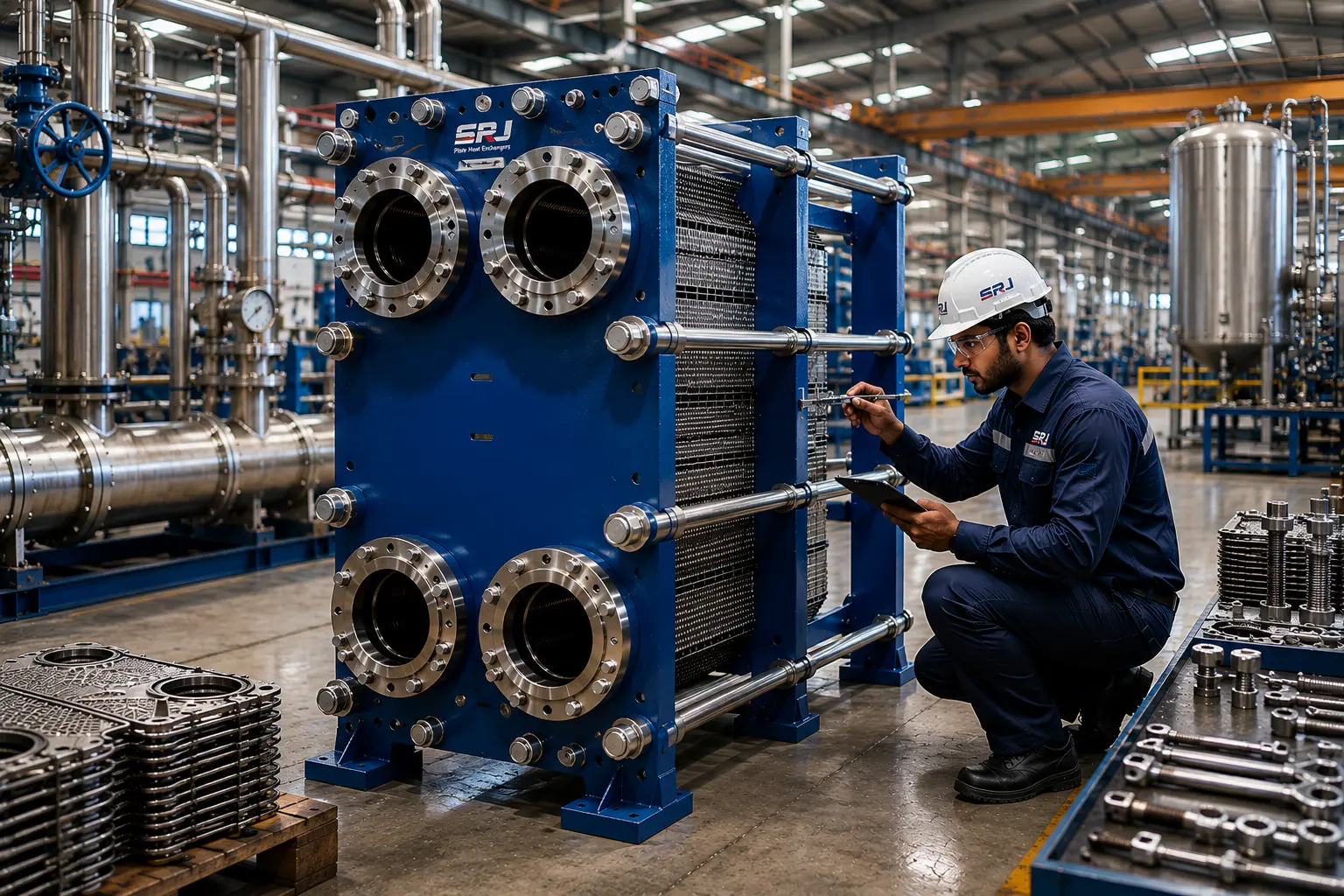
Companies like SRJ Heatt Exchangers India Pvt. Ltd. — an ISO 9001 certified manufacturer with over 17 years in the PHE components space — exemplify this kind of technical depth. Their product range covers more than 150 gasket and plate models compatible with major global brands including Alfa Laval, GEA, Sondex-Danfoss, Kelvion, Tranter, and others, supported by in-house mould development and controlled vulcanisation processes.
Plate Heat Exchanger Suppliers in Anjar: Serving the Pipeline and Steel Corridor
Anjar has earned a reputation as a global pipeline manufacturing hub, with several large-scale steel and pipe companies operating within the taluka. These facilities run hydraulic systems, quench oil circuits, and process water loops that require reliable heat exchangers.
Plate heat exchanger suppliers in Anjar who understand the steel and metalworking sector tend to specify thicker plate gauges (0.7–0.8 mm), higher-grade stainless steels like SS316L or titanium for corrosive cooling water, and frame designs that tolerate vibration from adjacent heavy machinery. If your supplier defaults to SS304 plates without asking about your water chemistry or ambient conditions, consider that a warning.
What to Ask a Supplier Before You Buy
Rather than comparing only unit price, put these questions to any PHE supplier you are considering:
- What plate corrugation pattern do you use, and can you provide both high-theta and low-theta options for different flow regimes?
- Do you manufacture your own plates, or do you source them from a third party?
- Can you supply OEM-compatible replacements for my existing unit, and do you verify dimensional compatibility before shipment?
- What is your standard lead time for replacement gaskets, and do you hold inventory for common models?
- Will you provide a thermal design datasheet or performance curve for the proposed unit?
These questions quickly separate technically grounded manufacturers from companies that are simply reselling imported stock.
PHE Gasket Suppliers in Mundra: Keeping Port-Adjacent Industries Running
Mundra’s industrial landscape runs on tight schedules. Power plants, SEZ-based chemical processors, and logistics operations near the port cannot afford extended downtime waiting for replacement gaskets. PHE gasket suppliers in Mundra who maintain ready inventory of high-demand models — and can dispatch within 24 to 48 hours — offer a genuine operational advantage.
Beyond availability, pay attention to how a supplier stores their gaskets. Elastomeric gaskets degrade when exposed to direct sunlight, ozone, or extreme temperature swings during storage. A supplier who keeps gaskets in climate-controlled or UV-shielded warehousing demonstrates a basic quality consciousness that translates into longer seal life once the gasket is installed in your unit.
PHE Plate Manufacturers in Kandla: Supporting Import-Export Process Equipment
Kandla’s Special Economic Zone and the adjacent Deendayal Port have historically driven demand for process equipment in the food, chemical, and petroleum sectors. PHE plate manufacturers in Kandla who serve these industries must navigate a broader range of metallurgical requirements than manufacturers focused on a single sector.
For food and dairy processing — including milk pasteurisation and juice heating — plates must meet food-grade surface finish standards, typically a surface roughness (Ra) below 0.8 micrometres. For chemical applications, the plate alloy selection extends beyond standard stainless steels to nickel alloys such as Hastelloy C-276, or even tantalum for severely corrosive duties.
A manufacturer that can offer this metallurgical range from a single source, while maintaining consistent pressing quality across different alloys, is worth the premium over a supplier who handles only one or two materials.
Maintenance Realities That Most Manufacturer Websites Will Not Tell You
Buying a plate heat exchanger is only the beginning of the cost equation. Here is what experienced plant engineers in Kutch already know:
Gaskets are consumables. Depending on your process fluid and temperature, expect to replace gaskets every 3 to 7 years. Budget for this recurring cost upfront, and establish a supply relationship with a manufacturer who can deliver replacements on short notice.
CIP is not optional. Clean-in-place procedures extend plate life and maintain thermal efficiency. For dairy and food applications, alkaline and acid CIP cycles should follow a set frequency. For oil cooling and process water, periodic dismantling and manual cleaning may be unavoidable — especially where scaling or biological fouling occurs.
Plate inspection matters. During every gasket replacement, inspect plates for pitting, cracking, and thinning. A manufacturer who offers dye-penetrant testing or dimensional re-verification during maintenance visits adds measurable value to the relationship.
Frame bolt torque is critical. Over-tightening or uneven tightening warps plates and accelerates gasket wear. Follow the manufacturer’s specified torque sequence and values — and verify that your supplier provides this documentation with every unit delivered.
Choosing Between a Local Kutch Supplier and a Distant National Brand
National and multinational PHE brands offer established design credibility, but they often route orders through regional distributors with limited technical support. A locally rooted manufacturer or supplier in the Kutch region — whether based in Gandhidham, Bhuj, Anjar, Mundra, or Kandla — can offer faster response times, on-site technical assessment, and willingness to handle small-batch or urgent replacement orders that larger companies deprioritise.
The ideal approach for many industrial facilities in Kutch is a hybrid one: specify equipment from a manufacturer with proven engineering capability and OEM-compatible product lines — such as SRJ Heatt Exchangers India Pvt. Ltd., which produces precision-pressed plates and gaskets compatible with all major PHE brands — while leveraging their regional reach for ongoing maintenance and spares support.
Final Considerations for Buyers in Kutch
Selecting plate heat exchanger manufacturers in Kutch comes down to three non-negotiable factors: technical competence in plate metallurgy and gasket formulation, genuine in-house manufacturing capability (not just trading), and a supply chain that respects the urgency of industrial operations in a port-driven economy.
Price will always matter, but a gasket that fails six months early or a plate that corrodes within a year costs far more than the initial savings. Invest time in verifying your manufacturer’s pressing tolerances, material certifications, and willingness to provide application-specific guidance. The right partner will welcome that scrutiny — because it is exactly what separates a manufacturer from a middleman.