
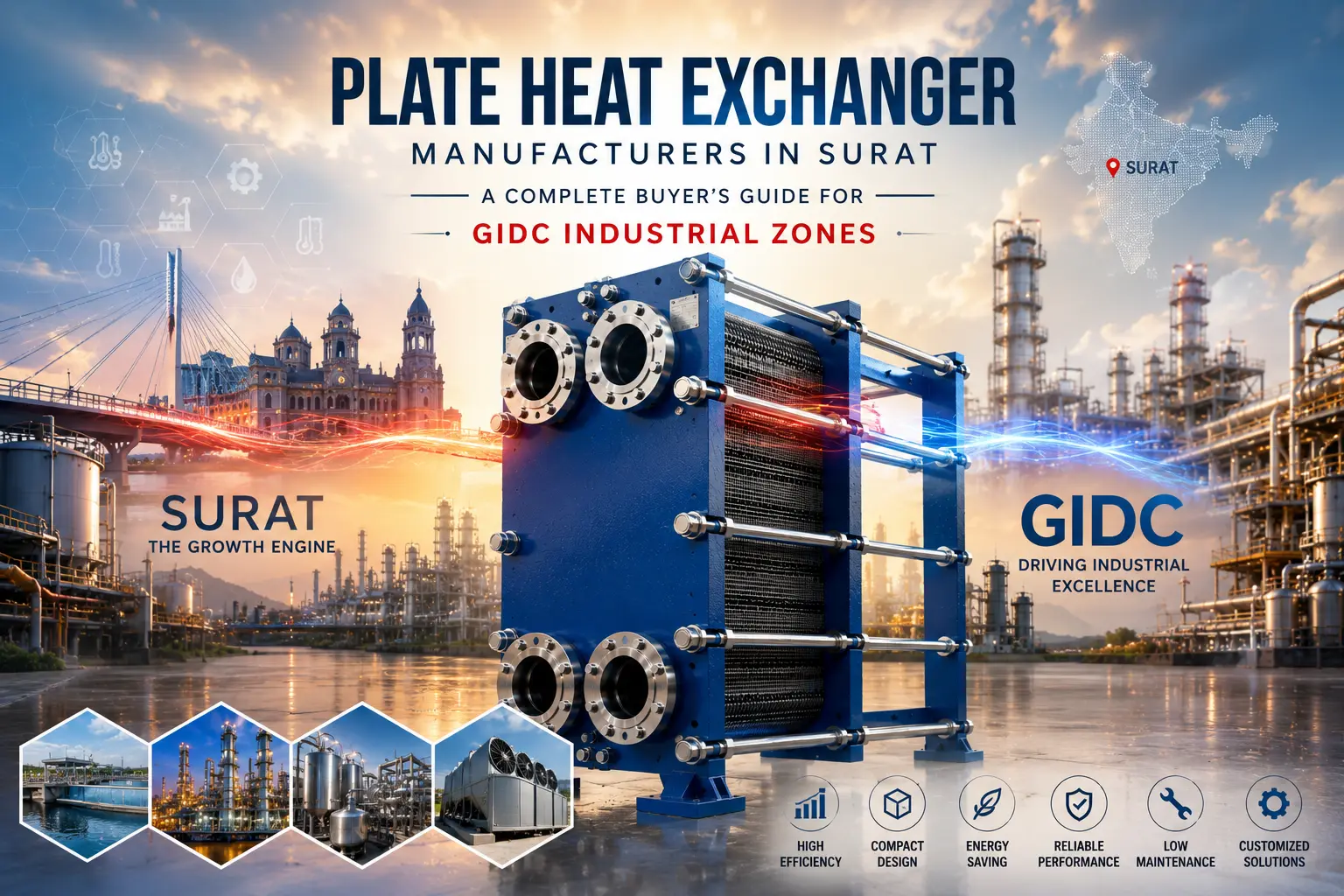
Plate heat exchanger manufacturers in Surat serve one of Gujarat’s most industrially diverse markets. From the textile dyeing units packed into Sachin GIDC to the petrochemical complexes at Hazira, thermal management demands vary dramatically — and so do the specifications buyers need to get right.
This guide cuts through the noise. Whether you’re sourcing a complete PHE unit, replacement plates, or gaskets, here’s what experienced procurement teams and plant engineers in Surat’s GIDC zones actually need to know.
Why Surat’s Industrial Zones Create Unique PHE Demand
Plate Heat Exchanger Manufacturers in Sachin GIDC
Sachin GIDC spans over 700 hectares and houses roughly 2,250 industrial units — nearly 78% of them textile operations. Dyeing, printing, and processing units are intensive PHE users: hot water recovery from discharged dye baths, steam condensate cooling, and effluent pre-cooling for CETP compliance are the core applications.
The fluids here are mildly corrosive — slightly acidic or alkaline depending on dye chemistry. That makes SS 316L plate material a smarter long-term choice over SS 304, and it means gasket selection matters more than most buyers initially assume.
Plate Heat Exchanger Suppliers in Pandesara GIDC
Pandesara’s mix of chemical processors and textile auxiliaries manufacturers works with aggressive fluids — surfactants, solvents, reactive dyes, process acids. Standard NBR gaskets fail quickly in these environments. Viton (FKM) gaskets are frequently the correct specification here, not an upsell.
Any vendor who quotes based on temperature alone, without asking about the specific process fluid, is skipping a critical engineering step.
PHE Gasket Manufacturers in Hazira GIDC
Hazira operates at a different scale. Reliance, ONGC, L&T, and NTPC installations demand full documentation — material test certificates, hydrostatic test reports, ISO compliance — alongside large frame sizes and higher pressure ratings.
PHE gasket manufacturers in Hazira GIDC supply titanium-plate units for seawater cooling, fully welded PHEs for hydrocarbon service, and semi-welded designs for ammonia refrigeration. Buyers here know their specifications precisely; the supplier’s job is to deliver with full traceability.
PHE Gasket Suppliers in Olpad GIDC and PHE Plate Manufacturers in Kim GIDC
Olpad and Kim GIDC are newer, growing zones with food processing, pharma, and light engineering units. PHE requirements here often carry food-grade or pharmaceutical specifications — FDA-compliant EPDM gaskets, electropolished plates, and audit-ready documentation.
PHE plate manufacturers in Kim GIDC serving export-oriented units increasingly stock SS 316L and titanium as standard, because export markets demand corrosion-resistant specifications by default.
PHE Types: Matching the Design to the Application
Gasketed PHEs are the most common across Surat’s GIDC zones. Plates are clamped in a frame with rubber gaskets sealing each channel. The unit can be opened, cleaned, and reconfigured without cutting pipework. For textile dyeing units in Sachin and food processors in Olpad where periodic cleaning is routine, this flexibility is the deciding factor.
Brazed PHEs have no gaskets — plates are permanently joined using copper or nickel brazing, creating compact, high-pressure-rated units ideal for refrigeration circuits, hydraulic oil cooling, and HVAC. The tradeoff is that a fouled or leaking brazed PHE requires unit replacement rather than repair.
Welded and semi-welded PHEs serve aggressive applications where gasket failure is unacceptable. Fully welded units handle high-pressure chemical streams. Semi-welded designs — one side welded, one gasketed — are standard for ammonia refrigeration and chemical service where only one fluid stream is aggressive.
Gasket Materials: The Detail That Determines Lifespan
NBR handles water, mineral oils, and dilute aqueous solutions up to around 120°C. It’s the standard workhorse stocked by most PHE gasket suppliers across Surat. However, NBR degrades rapidly in aromatic hydrocarbons, ketones, and steam above 100°C — a failure mode that catches plants off guard when process fluids change.
EPDM is correct for steam, hot water, alkaline cleaning solutions, and CIP chemicals. It also comes in FDA-compliant grades for food contact applications — the right choice for Olpad GIDC food processing units running gasketed PHEs.
Viton (FKM) handles temperatures up to approximately 200°C and resists chlorinated solvents, fuels, and aggressive process chemicals. PHE gasket suppliers in Pandesara GIDC serving chemical processors stock Viton as a standard line, not a special order.
HNBR is increasingly specified for refrigeration service — ammonia and CO₂ circuits particularly — bridging nitrile chemistry with improved temperature performance.
One practical detail: modern PHEs use clip-on gaskets that snap into plate grooves without adhesive. Adhesive-bonded gaskets — still offered by some local vendors — are unsuitable for food applications and take significantly longer to replace during maintenance shutdowns.
How to Evaluate PHE Manufacturers in Surat
Ask for thermal sizing documentation. A real manufacturer provides a calculation showing plate count, flow rates, thermal duty, and pressure drop on both sides. A vendor who quotes without any design documentation is a risk regardless of pricing.
Confirm plate material grade in writing. The quote must explicitly state SS 304, SS 316L, titanium, or Hastelloy. Surat’s coastal water supply carries variable chloride levels — the corrosion performance difference between 304 and 316L is not theoretical here, it shows up in equipment lifespan.
Verify gasket compatibility against actual process fluid. Provide full fluid details, not just temperature. Any supplier who quotes a gasket compound without this information is guessing.
Get spare parts pricing upfront. Some vendors offer competitive unit prices and recover margin on replacement gasket sets. Knowing the full gasket kit cost at purchase time reveals the true operating cost over the equipment’s life.
Check ISO 9001 status. Required for vendor qualification in Hazira’s major plant environments. A useful indicator of traceability and quality management consistency for buyers everywhere else.
Conclusion
The plate heat exchanger manufacturers in Surat operating across Sachin GIDC, Pandesara, Hazira, Olpad, and Kim GIDC cover a wide range of capability and reliability. Proximity to your site is a genuine advantage — faster delivery, easier site visits, simpler warranty resolution — but it doesn’t substitute for technical competence.
Qualify suppliers on their ability to design and document, not just deliver. Specify gasket materials and plate grades explicitly. Ask for spare parts pricing before signing. That due diligence takes days; the wrong purchase can cost months of production.